Café habits · Real-life English
Bring Your Own Cup: Reusable Cups at Australian Cafés
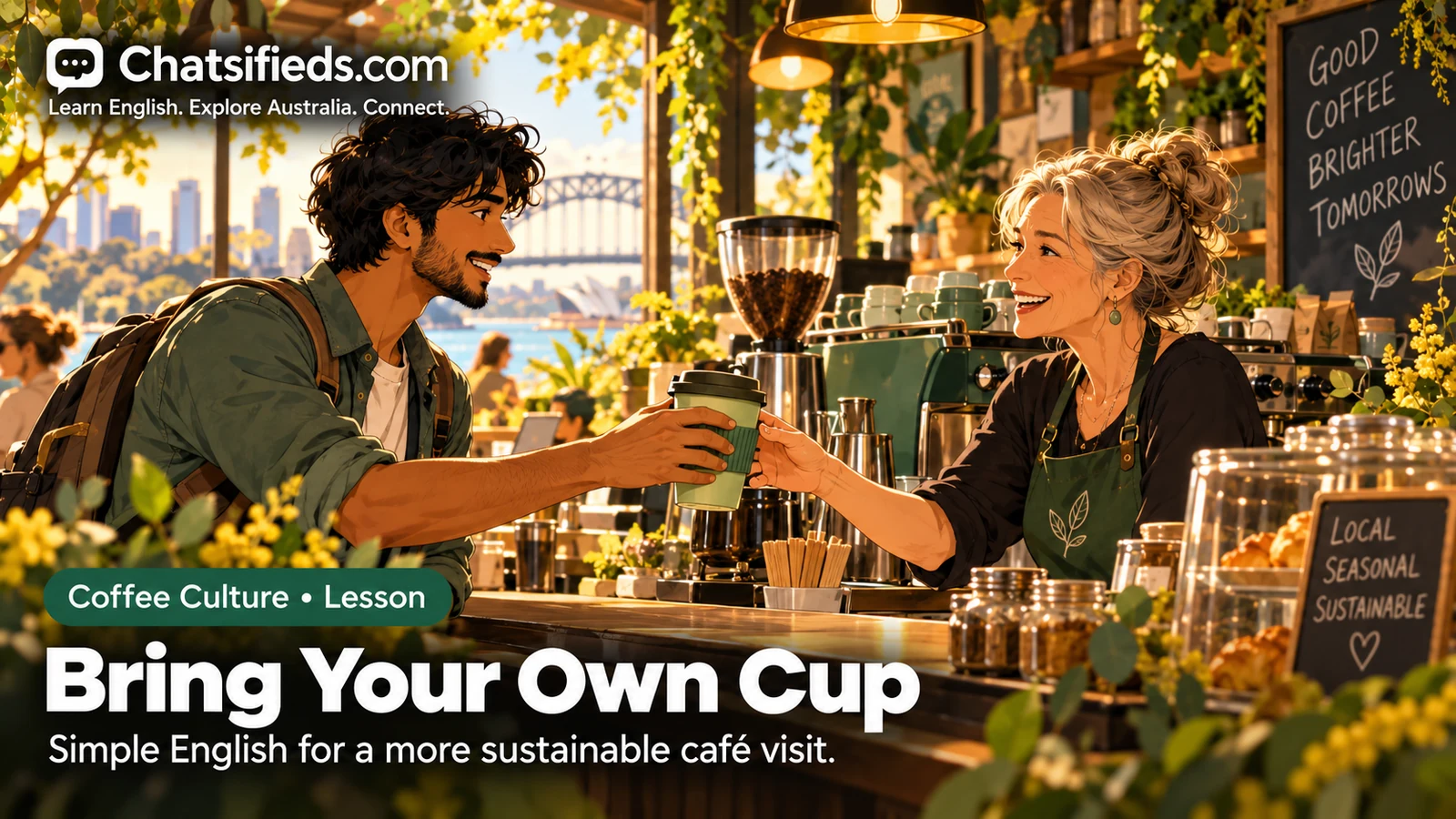
Want to use your own reusable cup? Learn how to ask politely, how to understand a yes, a no or a condition, and why a no is not rude.
Published 17/10/2026 · Educational guide
What you need to know
Ask before you order: "Could I use my own cup, please?" Some cafés will happily say yes, some have their own steps, and some may say no. All of these answers are normal, so stay friendly and say thanks either way.
Understand the Australian context
Government health pages in several parts of Australia say that customers can bring their own cup or container, and that the decision to fill it belongs to the business. In other words, a café can say yes, can have its own process, or can decide not to fill customer cups. The ACT, Tasmanian and local council pages all describe it this way.
Those pages also say the cup should be clean and have a lid that fits well. The Tasmanian health department adds that a container should be food-grade and not chipped or cracked. If a cup arrives dirty, the café may clean it first or refuse to fill it. One council page says it is reasonable for a café to decline if it cannot clean and sanitise customer containers.
So a polite question and a calm reaction matter more than perfect grammar. This lesson is for language practice only, not legal or health advice. Rules and café habits can change, so ask the staff, and check current guidance from your state or local council if you want the details.
Key words and phrases
- reusable cup
- a cup you wash and use again, instead of a single-use cup
- takeaway cup
- the paper or plastic cup a café gives you to take your drink away
- lid
- the cover that goes on top of a cup
- rinse
- to wash something quickly with water
- for here
- a way to say you will drink in the café, not take it away
- bring your own
- use something you bring yourself; people often shorten it to BYO
- policy
- the rules a business has chosen to follow
- fit
- to be the right size, as in 'the lid fits this cup'
Conversation practice: asking to use your own cup
Customer: Hi there. Could I get a flat white in my own cup, please?
Staff: Sure, can I have a look at it?
Customer: Of course. It's a reusable cup with a lid.
Staff: Thanks. It looks clean. Do you want it to stay with you or should we take it behind the counter?
Customer: Whatever works best for you. I'm happy either way.
Staff: We'll make it at the machine and pour it in. Is the lid on tight?
Customer: Yes, it fits well. I'll put it on myself.
Staff: Perfect. Is that for here or to go?
Customer: To go, please. Is it okay if I rinse the cup at the sink first?
Staff: Sorry, we can't let customers behind the counter. We can rinse it for you if you like.
Customer: That's fine, thank you. No worries.
Staff: All good. Your drink will be a couple of minutes.
- "Could I get ... in my own cup?" is a clear, polite way to ask. Say it before you order, so the staff can think about it.
- "Whatever works best for you" shows you are flexible. Each café has its own way of doing things.
- If staff say no, "No worries, thanks anyway" keeps the mood friendly.
More useful phrases
- Could I use my own cup, please?
- Can you fill the cup I brought?Use it: At the counter, before you order.
- Is that okay with you?
- Does the café accept this?Use it: When you hand over your cup and are not sure.
- Sorry, we can't do that today.
- We are not able to fill your cup.Use it: What staff might say; listen for it and stay calm.
- We'll need to rinse it first.
- Staff want to wash the cup before using it.Use it: A common type of condition. Answer with 'Sure, thanks'.
- No worries, I'll take a takeaway cup.
- I accept your answer and will use your cup instead.Use it: When the café says no.
- Is that for here or to go?
- Will you drink it in the café or take it away?Use it: A question staff often ask; answer 'for here' or 'to go'.
Common mistakes and better ways to say it
Less helpful: “You must fill my cup.”
Try instead: “Could you fill my cup, please, if that's okay?”
A café decides for itself, so asking politely works better than giving an order.
Less helpful: “Why you not accept my cup?”
Try instead: “No worries, thanks for letting me know.”
A no is not an insult, and a friendly reply keeps things pleasant.
Less helpful: “Put coffee in this.”
Try instead: “Could I have a flat white in this cup, please?”
Naming the drink and adding please sounds clear and polite.
Less helpful: “This cup is clean, don't look.”
Try instead: “Sure, have a look. It's clean and the lid fits.”
Staff may want to check, so welcoming it makes the chat easier.
A no is not rude
When you hear a no, it can feel personal, but usually it is not. Official guidance says the choice is the business's own, and a café may follow its own steps for keeping drinks safe. Some staff may check your cup, ask to rinse it, or prefer to use a takeaway cup. All of this can happen in a friendly way.
As a customer, you can make things easy. Bring a clean cup with a lid that fits, ask before you order, and avoid the busiest minutes if you can. If staff say no, a smile and a quick 'No worries' is the natural response. You can ask again another day or try a different café.
Advertisement
Try it yourself
Role-play two customers. In the first, ask to use your own cup and the café says yes after checking it. In the second, ask and hear 'Sorry, we can't today'. Practise answering both with a friendly reply.
Phrase Wall practice: use this phrase
Could I use my own cup, please?
Say the example aloud, then try it in a real conversation. Discover more useful phrases and save your favourites to My Learning.
Quick check
Think about each answer first, then open “Show answer”. This is a self-check, not a scored quiz.
1. What is a polite way to ask to use your own cup?
- Could I use my own cup, please?
- Fill this now.
- My cup is better.
Show answer
Answer: A. Could I use my own cup, please?. Starting with 'Could I' and adding 'please' is a polite request.
2. The staff member says, "Sorry, we can't do that today." What is a friendly reply?
- That's rude.
- No worries, thanks anyway.
- You have to.
Show answer
Answer: B. No worries, thanks anyway. A café may have its own process or decline. A friendly reply keeps things pleasant.
3. What does 'for here' mean?
- Take it away
- Drink in the café
- Pay later
Show answer
Answer: B. Drink in the café. 'For here' means you will stay and drink in the café.
4. Which cup is best to bring according to the official guidance in this lesson?
- A clean cup with a fitting lid
- Any cup, even a dirty one
- A cracked cup
Show answer
Answer: A. A clean cup with a fitting lid. The guidance says to bring a clean cup with a lid that fits, and not one that is chipped or cracked.
Frequently asked questions
Can I always use my own cup at a café?
Not always. Government guidance says the decision belongs to the business, so a café can accept, set its own process or decline. Ask politely before you order.
What if the café says my cup is dirty?
Guidance says a café may clean a dirty cup first or refuse to fill it. Start with a clean cup, and say 'Sure, thanks' if staff offer to rinse it.
Is it rude to ask?
No. Asking politely is fine. Just accept the answer calmly, whatever it is.
Where can I check the rules?
Ask the café, and look at your state health department or local council website for current guidance. This lesson is for English practice only and is not legal advice.
Phrase Wall & local business learning
Practise this English in real life
Explore useful Australian English on the Phrase Wall. Relevant businesses can support this lesson with a clearly labelled student offer or real-world practice opportunity.
Sponsorship is clearly labelled and never changes educational answers. Sponsored content policy.
Continue learning
- Café English hub
- “Having Here or Takeaway?” Meaning in Australian Cafés
- How to Order Takeaway Coffee in Australia
- What Will the Barista Ask? Australian Cafe English
- Australian Cafe Etiquette for International Students
- How to OrderCoffee in Australia
Sources checked
These pages were read while writing this lesson. Links are external references, not sponsorships or endorsements.
- ACT Government — bring-your-own containers in food businesses
- Tasmanian Department of Health — BYO containers fact sheet
- Hobart City Council — food safety tips for reusable cups
- Ballina Shire Council — reusable containers fact sheet for customers
This is an English-learning article. Rules, menus and café habits change, so check current official guidance and ask the café for the details that matter to you.