Cafe food · Real-life English · Level: Beginner
Cabinet Classics: Lamington, Vanilla Slice and Sausage Roll
The glass cabinet near the till is full of treats with unusual names. Learn what some famous ones are called, a little about their stories, and how to order them.
Published 15/11/2026 · Educational guide
What you need to know
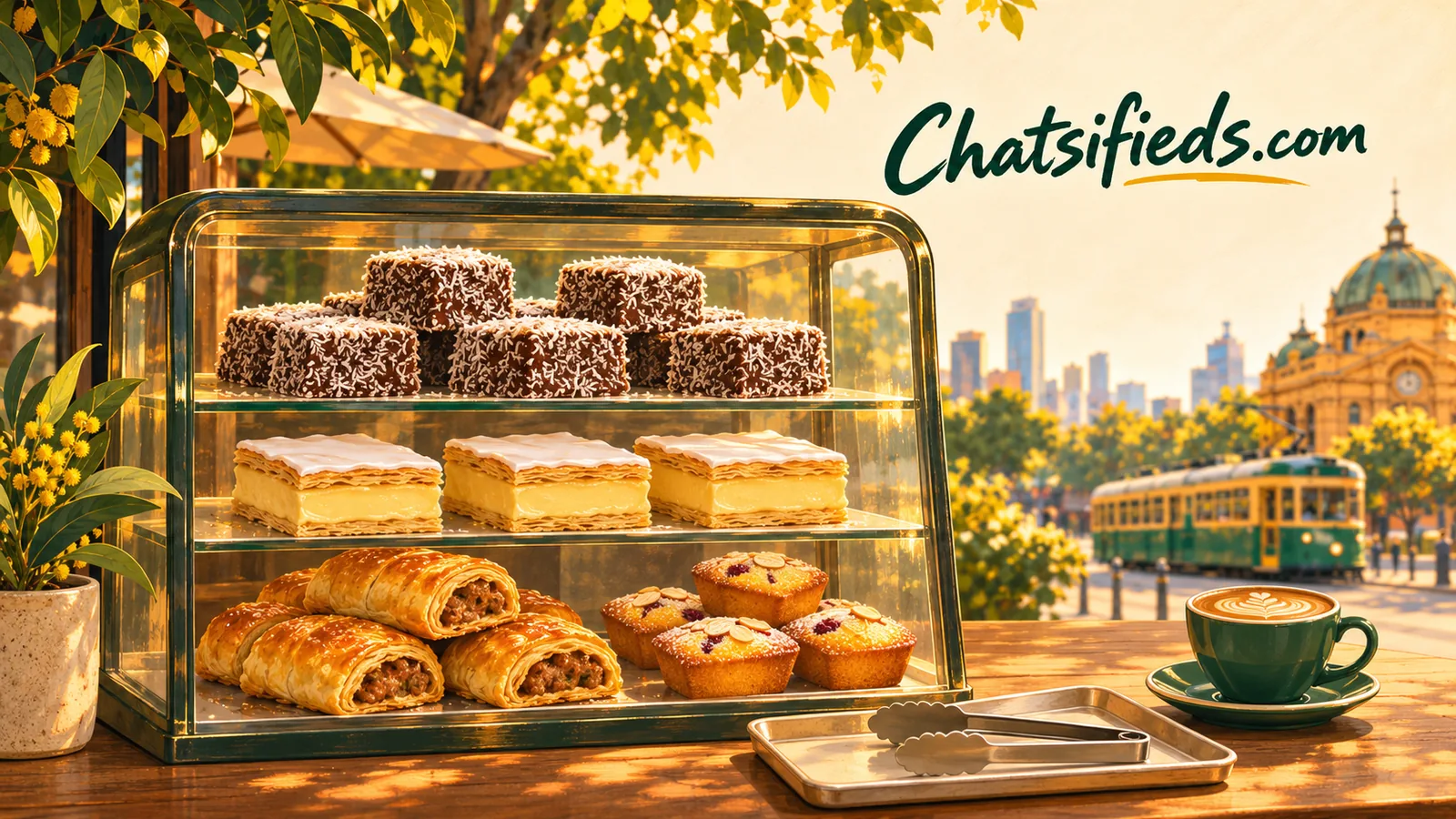
The cabinet is the glass display of cakes, slices and pastries in a café. Popular items include lamingtons, vanilla slice, sausage rolls, Anzac biscuits, friands and scones. To order, point or say the name and use a polite question: "Could I get a lamington, please?" If you have an allergy, say so and ask the staff to check the ingredients.
Understand the Australian context
Many Australian cafés keep baked treats in a glass cabinet by the counter. Some of the names are hard to guess, so it helps to know a few. A lamington is a square of sponge cake dipped in chocolate and rolled in desiccated coconut. The State Library of Queensland says nobody knows for sure who invented it. A popular theory is that it was made in a governor's kitchen, and the cake is named after Lord Lamington, who was Governor of Queensland from 1896 to 1901. The first known recipe appeared in December 1900.
A vanilla slice has three layers: puff pastry, custard and icing. An Australian food writer describes it as a version of the French mille-feuille and says it is not uniquely Australian. Still, it is a humble bakery favourite, and the icing can change by region. In some places it is passionfruit, in others raspberry, and in Victoria you often see white icing with a chocolate ripple. Australians also use joke names for it, and 'snot block' is one. It is only a joke, so do not use it when you order politely.
A sausage roll is a savoury pastry with a meat filling. One trade article says it came from France, became a cheap street food in London, and was brought to Australia by British settlers, but treat that as a simple background note. The Anzac biscuit is a sweet oat and golden syrup biscuit. The Australian War Memorial says its origin is contested, so we should not say exactly who made the first one.
Key words and phrases
- cabinet
- The glass display at a café that holds cakes, slices and savoury food.
- lamington
- A sponge cake square covered in chocolate and coconut.
- vanilla slice
- A dessert with puff pastry, custard and icing.
- sausage roll
- A savoury pastry with a meat filling.
- friand
- A small oval cake made with ground almonds, butter and egg whites.
- Anzac biscuit
- A sweet oat biscuit made with golden syrup.
- Devonshire tea
- A scone with jam and cream, often served with tea.
- heat it up
- Warm the food before you eat it.
Conversation practice: choosing from the cabinet
Customer: Hi there. Could I get a flat white, please?
Staff: Sure thing. Anything from the cabinet?
Customer: Yes, what's that one with the chocolate and coconut?
Staff: That's a lamington. It's sponge cake with chocolate and coconut on the outside.
Customer: Lovely. Could I get one, please? Is it okay to eat it cold?
Staff: Yep, they're served cold. Would you like to try the vanilla slice as well?
Customer: What's in the vanilla slice?
Staff: Puff pastry, custard and icing on top. It's a classic.
Customer: Sounds good, but I have an allergy. Could you check the ingredients for me, please?
Staff: Of course. Tell me the allergy, and I'll check with the kitchen.
Customer: Thank you. I'll wait for your answer before I decide.
Staff: No worries. I'll let you know in a minute.
- "What's that one with...?" is a natural way to ask about a food when you do not know its name.
- "I have an allergy. Could you check the ingredients for me?" is clear and polite. Wait for the staff to check before you eat anything.
- "No worries" means "that's fine" or "you're welcome". It is a very common friendly reply in Australia.
More useful phrases
- Could I get a lamington, please?
- I would like to order a lamington.Use it: When you know the name of the item and want to order.
- What's that one called?
- Please tell me the name of that food.Use it: When you point to something in the cabinet.
- What's in the vanilla slice?
- What ingredients does it have?Use it: When you want to know more before you order.
- Can you heat it up, please?
- Please warm this food for me.Use it: For a sausage roll or another warm item.
- Could I have a scone with jam and cream, please?
- I would like a scone served with jam and cream.Use it: When you want a Devonshire tea style treat.
- I have an allergy. Could you check the ingredients?
- Please look at the ingredients because I cannot eat some foods.Use it: Before you order any food from the cabinet.
- Is that for here or takeaway?
- Staff ask if you will eat it in the café or take it with you.Use it: You will hear this after you order. Answer "Having here" or "Takeaway, thanks."
- I'll take that one, thanks.
- I choose that item.Use it: When you point at the food you want.
Common mistakes and better ways to say it
Less helpful: “Give me the chocolate coconut cake.”
Try instead: “Could I get a lamington, please?”
Using the real name is clearer and sounds more natural. If you do not know it, ask, "What's that one called?"
Less helpful: “Is this safe for me?”
Try instead: “I have an allergy. Could you check the ingredients for me?”
Staff can check ingredients, but they need to know it is an allergy. A clear request helps them do the right thing.
Less helpful: “I want a snot block.”
Try instead: “Could I get a vanilla slice, please?”
'Snot block' is a joke name used among friends. At the counter, the proper name is polite and easy to understand.
Less helpful: “Put it hot.”
Try instead: “Could you heat it up, please?”
"Heat it up" is the normal phrase, and "Could you...?" is polite.
Culture note: treats with stories
Many cabinet items come with stories, and Australians enjoy talking about them. A friand is a small almond cake that grew out of the French financier, though it uses flour. In Australia, a scone with jam and cream is often called Devonshire tea, and the cream is usually whipped or thick rather than clotted. One local history source says the jam usually goes on first, then the cream. You can start a friendly chat by asking, "Which one is your favourite?"
Banana bread is also common in cabinets and is often toasted with butter. We do not claim it is an Australian invention, but it is a good example of a food you can customise: "Could I get banana bread, toasted, with butter?" Ingredients vary from café to café, so for any item the best habit is to ask the staff what is in it, especially if you have an allergy.
Advertisement
Try it yourself
Imagine you are in front of a café cabinet. Practise asking, "What's that one called?" Then order a lamington or a scone with a polite sentence, and ask if the staff can heat up a sausage roll. Finish by saying, "I have an allergy. Could you check the ingredients?"
Phrase Wall practice: use this phrase
What's that one called?
Say the example aloud, then try it in a real conversation. Discover more useful phrases and save your favourites to My Learning.
Quick check
Think about each answer first, then open “Show answer”. This is a self-check, not a scored quiz.
1. What is a lamington?
- A sponge cake square with chocolate and coconut
- A savoury meat pastry
- A type of coffee
Show answer
Answer: A. A sponge cake square with chocolate and coconut. A lamington is sponge cake dipped in chocolate and rolled in desiccated coconut.
2. What is the polite way to ask staff to warm a pastry?
- Make it hot now.
- Could you heat it up, please?
- I want it hot.
Show answer
Answer: B. Could you heat it up, please?. "Could you heat it up, please?" is the natural, polite phrase.
3. What do you say if you have a food allergy?
- I have an allergy. Could you check the ingredients?
- Is this nice?
- It is probably fine.
Show answer
Answer: A. I have an allergy. Could you check the ingredients?. A clear statement and a request to check the ingredients is the safest way to start the conversation.
4. What do we know about the lamington's origin?
- It was invented by a famous chef in 1950
- The origin is disputed, and the first known recipe is from 1900
- It was first made in London
Show answer
Answer: B. The origin is disputed, and the first known recipe is from 1900. The State Library of Queensland says the origin is disputed, and the first known recipe dates from December 1900.
Frequently asked questions
Is a vanilla slice the same as a mille-feuille?
A food writer describes the vanilla slice as an Australian version of the French mille-feuille. Both use layers of puff pastry, and the Australian version is known for its custard and icing.
Why is it called an Anzac biscuit?
The Australian War Memorial says the origin of the sweet biscuit is contested, and it is unknown how the recipe became linked with Anzac. We should say the story is uncertain.
Can the café tell me if a cabinet item is safe for my allergy?
Ingredients vary from café to café, so ask the staff to check. Say, "I have an allergy. Could you check the ingredients?" and wait for their answer.
Is 'snot block' a polite name?
No. It is a playful nickname for the vanilla slice, used in jokes. When you order, use "vanilla slice".
Chatsifieds Phrase Wall
Take three useful phrases into real Australian conversation.
Practise these related phrases, learn what they mean and build confidence before you use them in real life.
Phrase Wall & local business learning
Practise this English in real life
Explore useful Australian English on the Phrase Wall. Relevant businesses can support this lesson with a clearly labelled student offer or real-world practice opportunity.
Sponsorship is clearly labelled and never changes educational answers. Sponsored content policy.
Continue learning
- Café English hub
- Food Allergy Conversations in Australian Cafés: Clear English for Customers and Staff
- Café Sides & Add-Ons in Australia: Hash Browns, Halloumi, Bacon & Avo
- How to Read an Australian Cafe Menu
- Anything Else? Finishing an Australian Cafe Order
- “Having Here or Takeaway?” Meaning in Australian Cafés
Sources checked
These pages were read while writing this lesson. Links are external references, not sponsorships or endorsements.
- State Library of Queensland: who invented the lamington?
- Australian War Memorial: Anzac biscuits
- SBS Food: vanilla slice and its joke names
- Altona Laverton Historical Society: Devonshire tea
- Baking Business: a history of classic Aussie bakery items (trade source)
This is an English-learning article. Rules, menus and café habits change, so check current official guidance and ask the café for the details that matter to you.