
1. Notice
Read the menu or listen for the key word in context. Do not try to translate every sentence. Identify the choice the staff member needs from you.
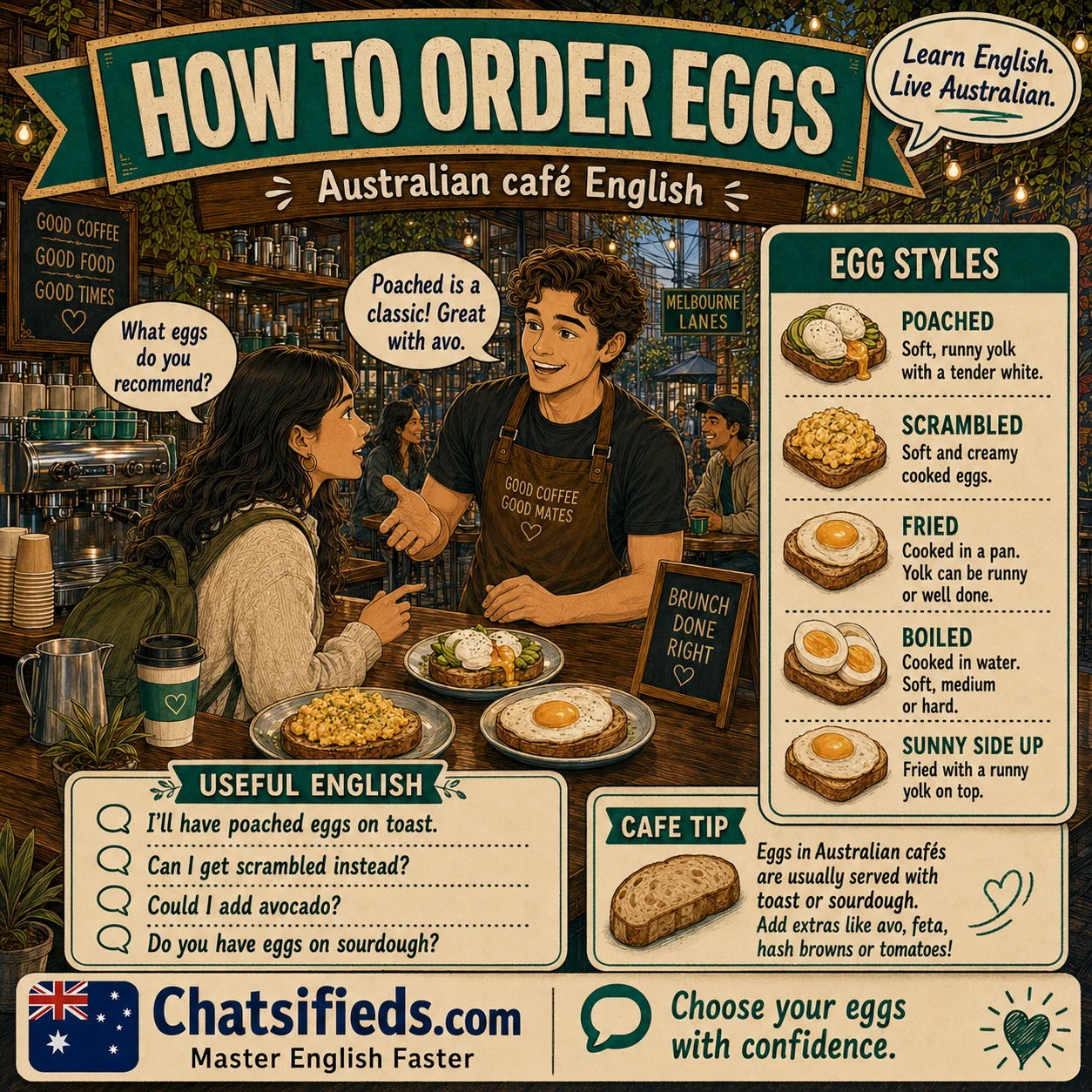
When a menu includes eggs, staff may ask How would you like your eggs? Common answers include poached, scrambled or fried.
Quick answer
The question is about cooking style, not whether you like eggs. If the menu specifies one style already, changing it may or may not be available.
You may also hear questions about toast, sides or how well cooked fried eggs should be. Keep your first answer simple, then respond to one follow-up at a time.
Poached eggs cook in water without their shell. Scrambled eggs are mixed while cooking. Fried eggs cook in a pan. Cafe methods vary.
Build the skill
Read the menu or listen for the key word in context. Do not try to translate every sentence. Identify the choice the staff member needs from you.
Use a short, clear answer first. Add please or thanks where it sounds natural. If the detail matters, ask one specific follow-up question rather than guessing.
If you miss the question, say, Sorry, could you say that again? Real communication includes checking, repeating and correcting. That is a skill, not a failure.
Australian cafe English is flexible. Menus, accents, recipes and service systems vary, so learn the core vocabulary and the clarification phrases together. That combination lets you handle a new cafe even when the exact wording is different from this lesson.
Speak naturally
Vocabulary
Listening practice
Choose the egg cooking style.
Choose a bread option.
The staff are checking how cooked you want the yolk.
Real dialogue
Common learner mistake
A common mistake is answering Yes to How would you like your eggs? The question requires a style, such as poached or scrambled.
Try it for real
Practise the question and three different answers. Then add one bread choice and one coffee to make a full breakfast order.
Quick check
Poached, scrambled and fried are useful starting points.
The yellow centre remains soft or liquid rather than fully firm.
You can ask, but availability depends on the cafe.
FAQ
Poached, scrambled and fried are useful starting points.
The yellow centre remains soft or liquid rather than fully firm.
You can ask, but availability depends on the cafe.
Ask the staff to repeat them or point to the menu.
No. Bread, eggs, seasoning and sides vary by cafe.
Chatsifieds Phrase Wall
Every Chatsifieds lesson connects language to real life. Practise these related phrases, learn what they mean and build confidence before you use them in a café, class, workplace or everyday conversation.
Related learning
This lesson belongs to a connected Coffee English learning collection. Use the main collection and related lessons to build the idea, the culture and the everyday English together.
Join Speak English Like a Pro on Facebook to practise everyday English, ask questions, share what you are learning and discover new Chatsifieds lessons.