
Café drinks · Real-life English
Matcha, Hojicha and Non-Coffee Drinks: Café English
Not every café order is a coffee. Learn what matcha and hojicha are and how to order them hot or iced, with the milk and sweetness you like.
Published 17/10/2026 · Educational guide
What you need to know
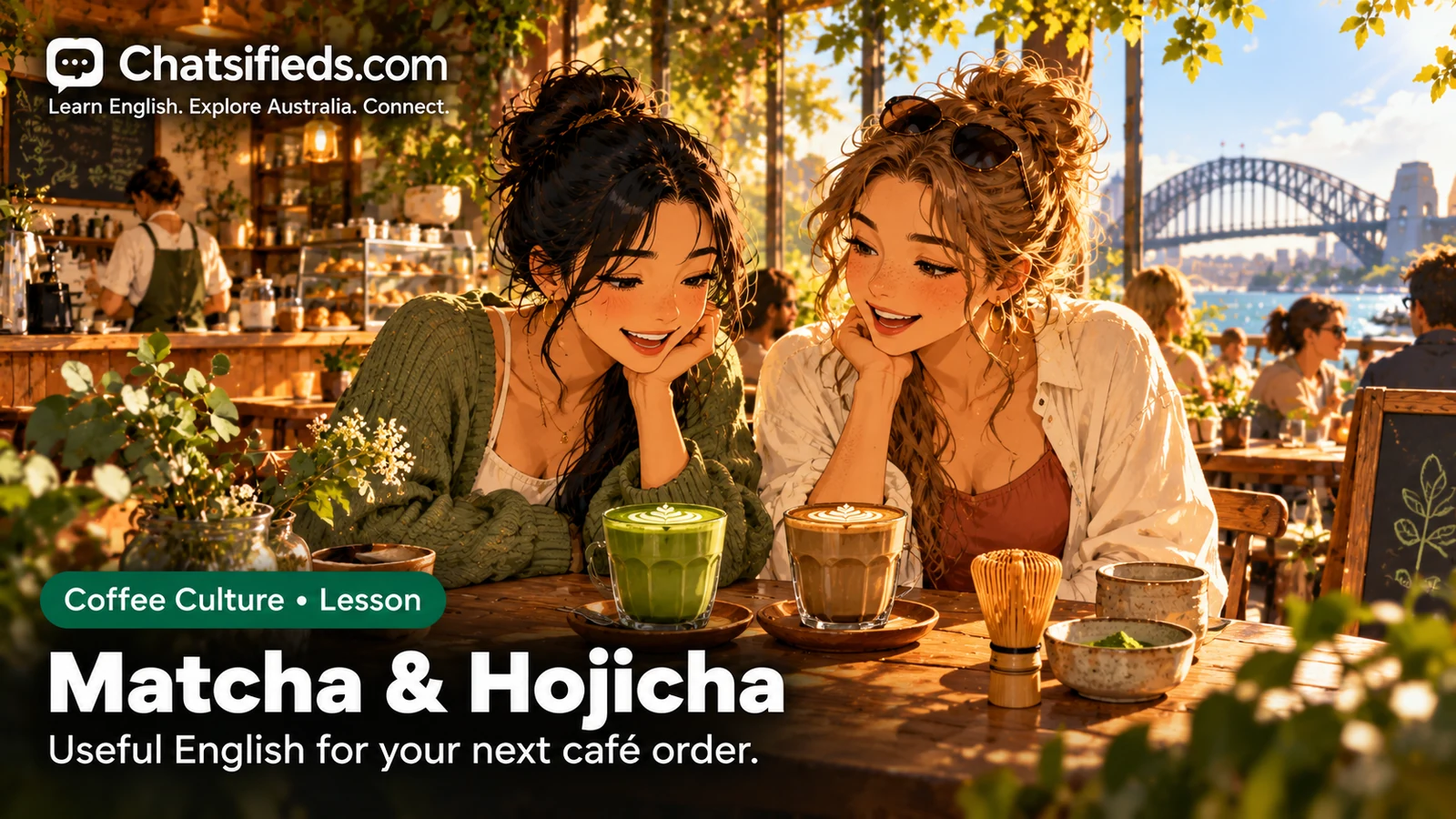
Matcha is a powdered green tea, and hojicha is a roasted tea that is also sold as a powder. In a café you can order either as a latte, hot or iced, then choose your milk and ask about sweetness. If you want no coffee today, simply say so.
Understand the Australian context
Matcha is a Japanese green tea made into a fine powder. It is traditionally whisked with water, and cafés also use it in lattes and other mixed drinks. Hojicha is a Japanese tea that is roasted, which gives it a darker colour and a toasty taste. It is sold as leaves or as a powder, and cafés can prepare it in a similar way to matcha, either as a straight tea or as a latte.
An Australian trade magazine describes matcha as a regular part of café menus, served hot, cold and in signature drinks, and says hojicha is also used in lattes and iced drinks. This does not mean every café has both, so the menu is your best guide. Chai and mocha drinks have their own lessons on this site.
When you order, the main choices are the same as for a latte: hot or iced, which milk, and whether it is sweetened. Some cafés add sweetener to a drink by default and others do not, so it is sensible to ask.
Key words and phrases
- matcha
- A green tea made into a fine powder.
- hojicha
- A roasted Japanese tea, sold as leaves or powder.
- matcha latte
- Matcha mixed with milk, served hot or iced.
- iced
- Served cold with ice.
- sweetened
- Made with added sugar, honey or syrup.
- unsweetened
- With nothing sweet added.
- non-coffee
- A drink that does not contain coffee.
- cuppa
- A casual Australian word for a cup of tea.
Conversation practice: ordering a hojicha latte
Staff: Hi there, what can I get you?
Customer: Hi. I'm not having coffee today. Do you have any tea lattes?
Staff: We do. There's a matcha latte and a hojicha latte.
Customer: Could you tell me what hojicha is?
Staff: It's a roasted tea. It tastes toasty rather than grassy like matcha.
Customer: That sounds good. Could I have a hojicha latte, please?
Staff: Sure. Hot or iced?
Customer: Iced, please. With oat milk, if that's okay.
Staff: No worries. Do you want it sweetened or plain?
Customer: Is it sweetened already?
Staff: Not unless you ask for it. We can add a little syrup.
Customer: Plain is fine for now, thanks.
- "I'm not having coffee today" is a simple, friendly way to say what you do not want. You do not need to explain why.
- "Is it sweetened already?" is useful because cafés can be different. Ask instead of guessing.
- "If that's okay" softens a request, which sounds polite and relaxed.
More useful phrases
- Do you have any non-coffee drinks?
- What can I order that has no coffee in it?Use it: When you want tea, chai or another option.
- Could I have a matcha latte, iced?
- I would like a cold matcha latte.Use it: When you order a drink in a normal café.
- I'd like it without coffee, please.
- Please do not add any coffee.Use it: For a drink that can include a coffee shot, such as a mocha or a chai.
- Could I have it unsweetened?
- Please do not add sugar or syrup.Use it: When you prefer a less sweet drink.
- Which milk would you recommend?
- Which milk works well with this drink?Use it: When you are not sure what to choose.
- What's the difference between matcha and hojicha?
- Please explain how the two drinks are different.Use it: When you want to learn before ordering.
Common mistakes and better ways to say it
Less helpful: “I want green tea coffee.”
Try instead: “Could I have a matcha latte, please?”
Matcha is a tea, so name the drink instead of mixing the words tea and coffee.
Less helpful: “No coffee for me, only milk.”
Try instead: “I'm not having coffee today. Could I have a hojicha latte?”
Saying what you would like is clearer than only saying what you do not want.
Less helpful: “Is this the black matcha?”
Try instead: “Is that the hojicha, the roasted one?”
Hojicha and matcha are different teas, so use the right name.
Less helpful: “Give me less caffeine.”
Try instead: “Could you suggest something without coffee, please?”
Staff can help more when you ask for a type of drink instead of a technical request.
A café is not only about coffee
Many Australian cafés offer more than coffee, such as tea, chai, hot chocolate and matcha drinks. Staff are used to customers who do not want coffee, for any reason, so you can say "I'm not having coffee today" without further explanation. You do not need to apologise.
Menus can use different names for similar drinks, and ingredients may vary from café to café. If you have a dietary need or allergy, tell the staff clearly and ask them to check. If you are unsure about a drink, ask, "What's in it?" and then choose what suits you.
Advertisement
Try it yourself
Role-play with a friend: you are at a café and you do not want coffee. Ask what non-coffee drinks they have, order a matcha or hojicha latte, and choose hot or iced, your milk and sweetness. Then swap roles and play the barista.
Phrase Wall practice: use this phrase
I'm not having coffee today.
Say the example aloud, then try it in a real conversation. Discover more useful phrases and save your favourites to My Learning.
Quick check
Think about each answer first, then open “Show answer”. This is a self-check, not a scored quiz.
1. What is matcha?
- A roasted milk drink
- A green tea made into a fine powder
- A type of coffee bean
Show answer
Answer: B. A green tea made into a fine powder. Matcha is a powdered green tea.
2. Which sentence clearly says you do not want coffee?
- I'm not having coffee today.
- I want coffee tea.
- Give me no drink.
Show answer
Answer: A. I'm not having coffee today. It is short, polite and clear.
3. What does unsweetened mean?
- With extra syrup
- With no sugar or syrup added
- Served very hot
Show answer
Answer: B. With no sugar or syrup added. Unsweetened means nothing sweet has been added.
4. You are unsure if the drink has sugar already. What should you do?
- Guess
- Ask, "Is it sweetened already?"
- Leave without ordering
Show answer
Answer: B. Ask, "Is it sweetened already?". Cafés can differ, so asking is the safest choice.
Frequently asked questions
Is hojicha the same as matcha?
No. Both are Japanese teas that cafés can use in lattes, but hojicha is roasted and tastes toasty, while matcha is a bright green powder. People sometimes call hojicha black matcha, but that name is not technically correct.
Can I have a matcha or hojicha latte iced?
Often yes, but it depends on the café. Ask, "Can I have it iced?" Staff will tell you.
How do I ask for a different milk?
Say, "Could I have it with oat milk, please?" and check whether there is an extra charge. Our milk options lesson has more phrases.
How do I say I do not want coffee in a chai or mocha?
Say, "Could I have it without coffee, please?" Some drinks, like a dirty chai, include coffee only when you ask. Check the menu or ask staff.
Phrase Wall & local business learning
Practise this English in real life
Explore useful Australian English on the Phrase Wall. Relevant businesses can support this lesson with a clearly labelled student offer or real-world practice opportunity.
Sponsorship is clearly labelled and never changes educational answers. Sponsored content policy.
Continue learning
- Café English hub
- What Is aChai Latte? ☕
- What Is a Dirty Chai? Australian Cafe English
- What Is aMocha? ☕
- How to Ask for Milk Options in Australian Cafés
- Dietary English at Australian Cafes: Vegan, Gluten-Free and Allergies
Sources checked
These pages were read while writing this lesson. Links are external references, not sponsorships or endorsements.
- Barista Magazine — matcha and hojicha explained, and how cafés serve them
- VinePair — hojicha and matcha, and how they are served
- Beanscene — matcha and hojicha on Australian café menus
This is an English-learning article. Rules, menus and café habits change, so check current official guidance and ask the café for the details that matter to you.