
Coffee drinks · Real-life English · Level: Intermediate
Vietnamese, Turkish and Greek Coffee: Café English
Some coffees are brewed in a very different way from a normal espresso. Learn the words you need to order Vietnamese, Turkish and Greek coffee and to enjoy them.
Published 15/11/2026 · Educational guide
What you need to know
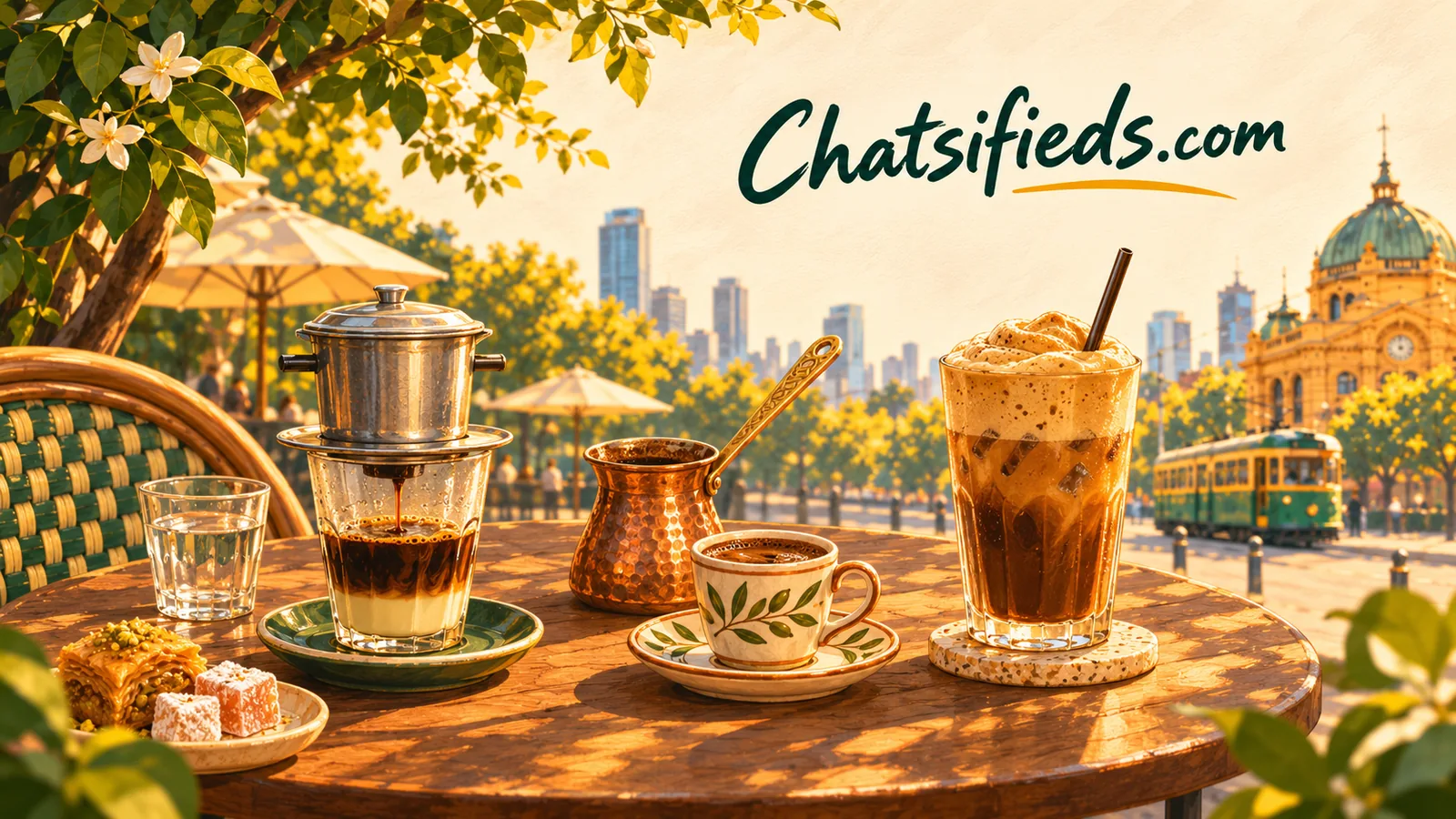
Vietnamese coffee is made with a small filter called a phin and is usually served with sweetened condensed milk. Turkish and Greek coffee are brewed in a small pot with very fine grounds that stay in the cup, and Turkish coffee is usually served without milk. In Australia our sources place these drinks mostly in Vietnamese cafés and banh mi shops and in Turkish and Greek restaurant settings, so it helps to know the words and to ask.
Three coffees, three ways of brewing
Vietnamese-style coffee is made with a phin, a small filter device that needs no filter paper, and it is usually made with sweetened condensed milk. A coffee magazine reports strong demand in suburbs of Sydney, Brisbane and Melbourne, especially in Vietnamese cafés and banh mi shops, and links it to Australia’s large Vietnamese population. It also says Vietnam is the world’s biggest producer of Robusta beans, known for a chocolatey, full-bodied taste.
Turkish coffee is finely ground and not filtered. It is brewed in a small, heavy pot called a cezve, also called a briki. Cold water, coffee and optional sugar are heated slowly until a thick froth forms. It is strong, usually served without milk, in a small cup with a glass of water. In our sources, a Sydney chef serves it with sweets after meals in his Turkish restaurants.
Greek coffee also uses very fine grounds, cooked in a small pot called a briki, with sugar if you like. The pot is taken off the heat when the foam, called kaimaki, rises, before the coffee boils. In both Turkish and Greek coffee the grounds settle at the bottom of the cup, so you wait a couple of minutes and sip slowly. The last mouthful can be thick. Greek has named sweetness levels: sketos (plain), me oligi (a little), metrios (medium) and glikos (sweet).
Key words and phrases
- phin
- A small filter device used to make Vietnamese-style coffee. It needs no paper filter.
- sweetened condensed milk
- Thick, sweet milk that is usually added to Vietnamese-style coffee.
- cezve
- A small, heavy pot used to make Turkish coffee. It is also called a briki.
- briki
- The small pot used to make Greek coffee. The name is also used for the Turkish pot.
- grounds
- The very small pieces of coffee that settle at the bottom of a Turkish or Greek coffee cup.
- kaimaki
- The foam that rises on top of Greek coffee as it is cooked.
- metrios
- A Greek word for medium sweet, used when ordering Greek coffee.
- freddo
- A Greek-style iced coffee. The frappé is another Greek-style iced coffee.
Conversation practice: ordering Vietnamese coffee
Customer: Hi. Could I please have a Vietnamese coffee with condensed milk?
Staff: Sure. Hot or iced?
Customer: Can I get that iced, please?
Staff: No worries. It’s made with a phin filter, so it can take a few minutes.
Customer: That’s fine. Is it very sweet?
Staff: It’s made with sweetened condensed milk, so it’s quite sweet. I can add a little less if you like.
Customer: A little less, please. Is it strong?
Staff: Fairly strong. We use Robusta beans, which have a chocolatey, full-bodied taste.
Customer: Lovely. Do you serve Turkish or Greek coffee as well?
Staff: Not here, sorry. You might find it at a Turkish or Greek restaurant.
Customer: Good idea. Thanks for your help.
Staff: No worries. We’ll call your name when it’s ready.
- “Could I please have …?” plus the name of the drink is a clear, polite way to order something you know.
- “Hot or iced?” is a normal question for a drink that can be served either way. Answer with “Iced, please” or “Hot, please.”
- “Not here, sorry” is a friendly way to say a place does not offer something. It does not mean you asked in the wrong way.
More useful phrases
- Could I please have a Vietnamese coffee with condensed milk?
- A polite way to order Vietnamese-style coffee by name.Use it: At a Vietnamese café or banh mi shop that lists it.
- Can I get that iced, please?
- Please serve the drink cold with ice.Use it: When the drink can be served hot or iced.
- Is it made with a phin filter?
- Is the coffee brewed using the small Vietnamese filter?Use it: When you are curious about how the drink is made.
- Could you make it a little less sweet?
- Please use less sugar or condensed milk.Use it: When you find sweet drinks too sweet.
- I’d like a Greek coffee, medium sweet (metrios), please.
- I want Greek coffee with a medium amount of sugar.Use it: At a place that serves hot Greek coffee.
- Could I have a Turkish coffee with no sugar, please?
- I want Turkish coffee without sugar.Use it: When you prefer unsweetened coffee.
- Let it sit for a minute or two so the grounds can settle.
- Wait before you drink, so the grounds sink to the bottom.Use it: When a friend is about to drink Turkish or Greek coffee too quickly.
Common mistakes and better ways to say it
Less helpful: “Give me the coffee with the condensed milk.”
Try instead: “Could I please have a Vietnamese coffee with condensed milk?”
Naming the drink and adding “please” is clearer and more polite.
Less helpful: “Why is there dirt in my Turkish coffee?”
Try instead: “Is it normal for the grounds to settle at the bottom?”
Turkish coffee is unfiltered, so the grounds are part of the drink. A calm question is polite and helps you learn.
Less helpful: “Quick, I need it now.”
Try instead: “How long will it take, please?”
Turkish and Greek coffee are heated slowly and need time for the grounds to settle. Asking about time is more friendly than asking for speed.
Less helpful: “Normal sweet, please.”
Try instead: “Medium sweet, please. (Metrios, please.)”
Greek coffee has named sweetness levels, so a clear word such as medium or metrios avoids confusion.
Where you might meet these coffees in Australia
Our sources show a few settings. Vietnamese coffee is linked to Vietnamese cafés and banh mi shops in suburbs of Sydney, Brisbane and Melbourne. Turkish coffee appears in a Sydney restaurant example. We found no source saying that hot Turkish or Greek coffee is common in ordinary Australian cafés, so do not expect it on every menu. You may also be offered one at a friend’s home or a community event, and these phrases will help there too.
A Melbourne example shows how Greek coffee has changed. A beach café in Elwood serves Greek-style iced coffees, such as the frappé and the freddo, rather than hot Greek coffee. The owner says the thick foam is hard to make in an electric pot. The article dates the frappé to the 1960s and the freddo to the early 1990s. This is one café, not a rule, but “Greek coffee” on a menu can mean an iced drink.
A Melbourne magazine says Mediterranean migrants, including Greeks, Italians, Turks and Lebanese, arrived in Melbourne from 1947 and helped shape its café culture, making the café a social meeting place. The Vietnamese coffee article links demand to Australia’s large Vietnamese population. Our sources do not give a full history of each coffee, so ask people about their own traditions rather than assuming.
Advertisement
Try it yourself
Choose one drink and practise the order. For Vietnamese coffee, ask for it iced and ask for it a little less sweet. For Greek coffee, ask for it medium sweet (metrios). Say your order aloud twice, once slowly and once the way you would say it at a real counter.
Phrase Wall practice: use this phrase
Could I please have a Vietnamese coffee with condensed milk?
Say the example aloud, then try it in a real conversation. Discover more useful phrases and save your favourites to My Learning.
Quick check
Think about each answer first, then open “Show answer”. This is a self-check, not a scored quiz.
1. What is a phin?
- A small filter used to make Vietnamese-style coffee
- A glass for iced Greek coffee
- A type of Turkish biscuit
Show answer
Answer: A. A small filter used to make Vietnamese-style coffee. A coffee magazine describes the phin as the small filter device used with ground coffee to make Vietnamese-style coffee, with no filter paper.
2. What happens to the grounds in Turkish and Greek coffee?
- They are filtered out with paper
- They settle at the bottom of the cup
- They are mixed into hot milk
Show answer
Answer: B. They settle at the bottom of the cup. Both coffees are unfiltered, so the grounds settle at the bottom and you wait a couple of minutes before sipping.
3. Which Greek word means medium sweet when ordering coffee?
- Glikos
- Sketos
- Metrios
Show answer
Answer: C. Metrios. The sweetness words are sketos (plain), me oligi (a little), metrios (medium) and glikos (sweet).
4. Which Australian setting for Turkish coffee appears in our sources?
- Every café in Australia
- A Sydney restaurant that serves it with sweets after meals
- Only at the airport
Show answer
Answer: B. A Sydney restaurant that serves it with sweets after meals. SBS Food describes a Sydney chef who serves Turkish coffee with sweets after meals at his restaurants. No source says it is common in every café.
Frequently asked questions
What is Vietnamese coffee?
It is coffee made with a small filter called a phin and usually served with sweetened condensed milk.
Is Turkish coffee the same as Greek coffee?
They are similar: both use very fine grounds in a small pot, and the grounds settle in the cup. Greek coffee is taken off the heat when the foam rises, before it boils. Ask how a restaurant makes it.
Is milk added to Turkish or Greek coffee?
SBS Food says Turkish coffee is usually served without milk. Our Greek source does not mention milk, so ask when you order.
Can I find these coffees in any Australian café?
Not necessarily. Our sources place them in Vietnamese cafés and banh mi shops, a Sydney Turkish restaurant, and one Melbourne café with Greek-style iced coffees. If you cannot see one, ask politely.
Chatsifieds Phrase Wall
Take three useful phrases into real Australian conversation.
Practise these related phrases, learn what they mean and build confidence before you use them in real life.
Phrase Wall & local business learning
Practise this English in real life
Explore useful Australian English on the Phrase Wall. Relevant businesses can support this lesson with a clearly labelled student offer or real-world practice opportunity.
Sponsorship is clearly labelled and never changes educational answers. Sponsored content policy.
Continue learning
- Café English hub
- Coffee and Multicultural Australia: Beyond the Italian Espresso Story
- How Italian Migration Shaped Australian Cafe Culture
- Arabica vs Robusta Coffee Beans: What’s the Difference?
- Australian Iced Coffee vs Iced Latte: What Is the Difference?
- How to Read an Australian Cafe Menu
Sources checked
These pages were read while writing this lesson. Links are external references, not sponsorships or endorsements.
- Beanscene magazine: Coffee for the culture
- SBS Food: the long, rich history of Turkish coffee
- Neos Kosmos: Greekness in a glass, Elwood beach kiosk
- Beat Magazine: Melbourne migration told through cafés and restaurants
- The Greek Foodie: how to make Greek coffee
This is an English-learning article. Rules, menus and café habits change, so check current official guidance and ask the café for the details that matter to you.