What you need to know
At most sit-down restaurants you arrive, say how many people you are, and a staff member shows you to a table. You order from the menu, eat, then ask for the bill. Venues differ, so if you are not sure, ask "Do we order at the table or at the counter?"
The usual steps of a restaurant visit
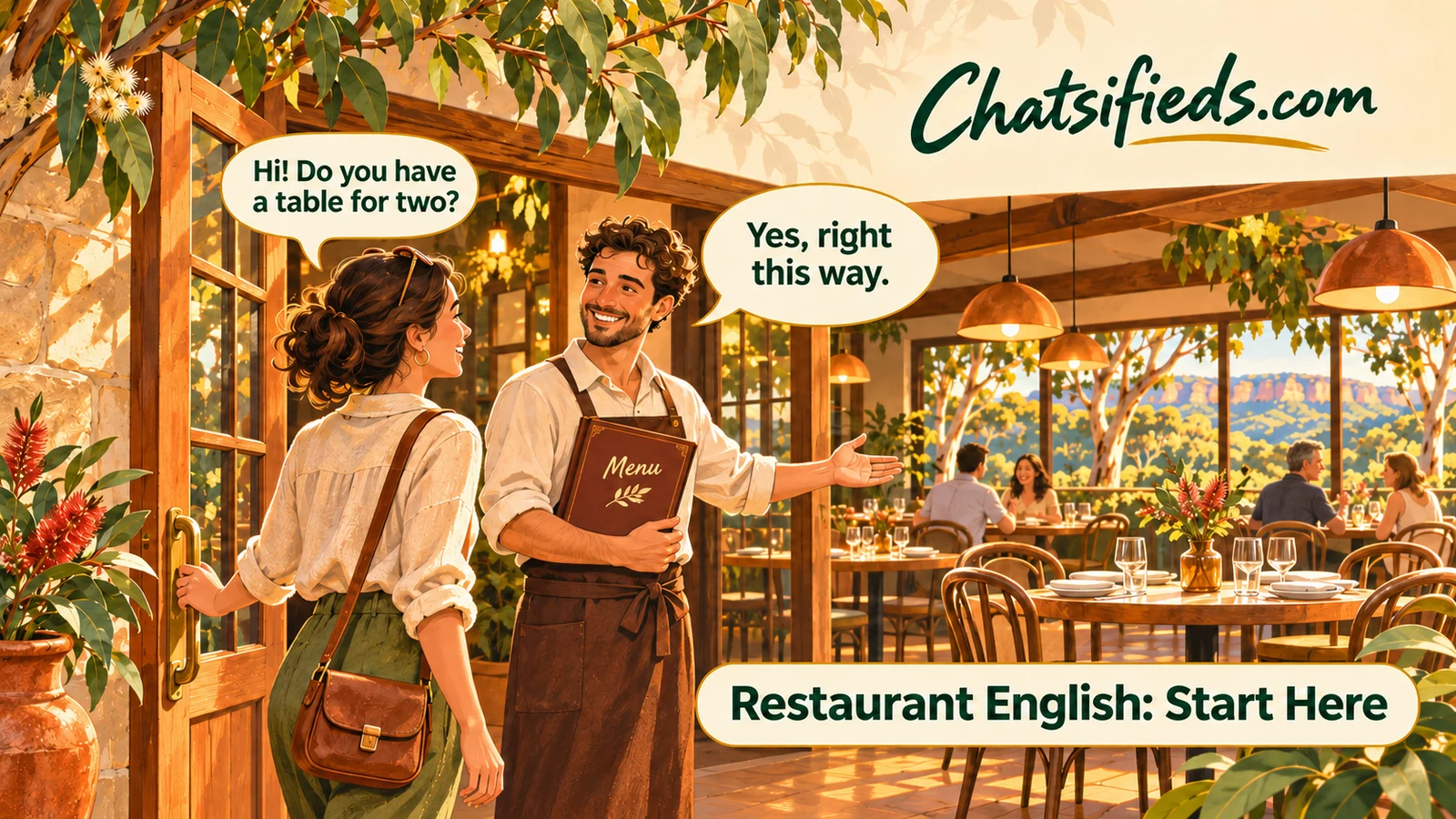
A sit-down restaurant often works like this. You walk in and a staff member greets you. You say how many people are in your group, for example "Table for two, please." They take you to a table, or ask you to wait at the door or bar.
At the table you get menus. A waiter comes to ask about drinks first, then takes your food order a little later. You do not need to hurry. When you finish, the waiter may ask, "Would you like to see the dessert menu?" When you are ready to leave, you ask for the bill.
Casual places are different. In a cafe, food court, pizza shop or many pubs, you order and pay at a counter first, then take a number or wait for your food. This is often called counter service. A restaurant with a waiter is called table service.
Staff are usually friendly and a little casual. You will hear "How are you going?", "No worries" and "Enjoy!" These are friendly words, not tests. You can answer "Good, thanks" and carry on.
Next steps: choose a place with [Read Restaurant Reviews and Ratings](/resources/australian-restaurant-english/read-restaurant-reviews-and-ratings-english-australia.html), try [Food Courts, Markets and Street Food](/resources/australian-restaurant-english/food-courts-markets-and-street-food-english-australia.html) for a casual first meal, and practise [Small Talk With Staff and Saying Thanks](/resources/australian-restaurant-english/restaurant-small-talk-with-staff-and-saying-thanks-english-australia.html).
Key words and phrases
- table for two
- A request for a table that seats two people.
- booking
- A table you reserved before you arrived.
- menu
- The list of food and drinks you can order.
- waiter
- A person who brings food to your table. Many people say "waitstaff" or just "staff".
- order
- To ask for food or drinks. Also the food you asked for.
- entree
- A small first dish. In Australia, entree means a starter, not the main meal.
- main
- The biggest dish of the meal.
- bill
- The paper or screen that shows what you must pay. Australians say "bill", not "check".
- table service
- A waiter brings your food to your table.
- counter service
- You order and pay at a counter before you sit or wait.
- tap and go
- Paying by touching your card or phone on the machine.
Dialogue: arriving, ordering and paying
Customer: Hi, do you have a table for two, please?
Waiter: Hi there. Do you have a booking?
Customer: No, sorry, we don't.
Waiter: No worries. Follow me. Is this table okay?
Customer: Yes, that's perfect, thanks.
Waiter: Here are your menus. Can I get you something to drink?
Customer: Could we have two glasses of tap water, please?
Waiter: Of course. Are you ready to order, or do you need a few minutes?
Customer: Could we have a few more minutes, please?
Waiter: Sure. Just let me know when you're ready.
Customer: We're ready now. I'll have the chicken, please.
Waiter: Great choice. Anything else?
Customer: No, that's all for now. Thanks.
Customer: Excuse me, could we get the bill, please?
Waiter: Sure. Are you paying together?
Customer: Yes, together. Can I pay by card?
Waiter: Of course. Tap here. Thanks, enjoy your night.
- "Do you have a table for two?" is a normal way to ask when you have no booking.
- "No worries" is a friendly way to say "That is fine".
- "Could we have a few more minutes?" is polite and normal. Staff do not mind.
- To get attention, make eye contact and say "Excuse me". Do not shout or click your fingers.
More useful phrases
- Table for two, please.
- Asks for a table for two people.Use it: When you arrive without a booking.
- We have a booking under Lee.
- Tells staff you reserved a table, with your name.Use it: When you arrive with a booking.
- Could we see the menu, please?
- Asks for the menu.Use it: When no menu has arrived yet.
- Could we have a few more minutes?
- Asks for more time before ordering.Use it: When you are not ready.
- I'll have the chicken, please.
- A polite, common way to order.Use it: When you choose a dish.
- Could we get some water, please?
- Asks for water for the table.Use it: At the start of the meal.
- Excuse me, could we get the bill, please?
- Asks to pay.Use it: When you finish the meal.
- Do we order at the table or at the counter?
- Checks how the venue works.Use it: When you are not sure about the system.
- Thanks, that was lovely.
- A friendly thank you when leaving.Use it: When you pay or leave.
A restaurant visit, step by step
Most visits follow these steps. Watch the room first if you are unsure.
| Step | What happens | Useful English |
|---|---|---|
| Arrive | Staff greet you and ask about a booking. | Table for two, please. |
| Sit down | You get a table and menus. | Is this table okay? Yes, thanks. |
| Drinks | The waiter asks about drinks first. | Could we have two waters, please? |
| Order | You choose food. The waiter writes it down. | I'll have the chicken, please. |
| Eat | Staff check on you once or twice. | Everything is great, thanks. |
| Pay | You ask for the bill, then pay by card or at the counter. | Could we get the bill, please? |
Casual places may ask you to order and pay at the counter first.
Say it aloud: arriving at a restaurant
Saying a sentence out loud before you need it makes real conversations easier. Accents differ, so aim to be clear, not perfect.
- Slow. Read the sentence slowly, one phrase at a time.
- In full. Say: Hi, do you have a table for two, please?
- At normal speed. Say it again, as you would in a real conversation.
- Listen. Listen for the reply, such as "Do you have a booking?" or "Follow me".
Practice 1: Role-play with a partner
Situation: You arrive at a restaurant at dinner time with a friend. You have no booking. A staff member meets you at the door.
Work with a friend, a classmate or your mirror. One person is the host. The other is a customer. Read the lines, then cover the “You could say” answers and try it from memory. Swap roles.
host: “Hi there. How many people?”
You could say:
- “Two, please.”
- “Table for two, please.”
host: “Do you have a booking?”
You could say:
- “No, sorry, we don't.”
- “No, we just walked in.”
host: “No worries. Here are your menus. Would you like something to drink?”
You could say:
- “Could we have two glasses of water, please?”
- “Yes, could we see the drinks menu?”
host: “Are you ready to order?”
You could say:
- “Could we have a few more minutes, please?”
- “Yes, I'll have the chicken, please.”
host: “Can I get you anything else?”
You could say:
- “No, that's all, thanks.”
- “Could we get the bill, please?”
Challenge: Do the role-play again with a booking. Say "We have a booking under" and your name.
Practice 2: Fill the gap
Say the missing word or phrase out loud before you open the answer.
Hi, do you have a ___ for two?
Show answer
table — You ask for a table, not a chair.
Could we get the ___, please?
Show answer
bill — In Australia you ask for the bill.
Could we have a few more ___?
Show answer
minutes — This asks for more time before you order.
I'll ___ the chicken, please.
Show answer
have — "I'll have..." is the usual way to order.
We have a ___ under Lee.
Show answer
booking — A booking is a table you reserved.
Excuse ___, could we get some water?
Show answer
me — "Excuse me" gets a waiter's attention politely.
Common mistakes and better ways to say it
Less helpful: “Give me the menu.”
Try instead: “Could we see the menu, please?”
A question with please sounds polite.
Less helpful: “I want the chicken.”
Try instead: “I'll have the chicken, please.”
"I'll have..." sounds friendlier than "I want".
Less helpful: “Check, please.”
Try instead: “Could we get the bill, please?”
Australians say bill. Check is American.
Less helpful: “(clicking fingers to call the waiter)”
Try instead: “Excuse me, could we order?”
Eye contact and "Excuse me" are polite.
Less helpful: “Table, two.”
Try instead: “Table for two, please.”
A full sentence sounds natural and kind.
Culture note: relaxed service and no pressure
Restaurant service in Australia is usually relaxed. Staff do not rush you out, and you can say "We need a few more minutes" as often as you like. Many people stay a long time and chat.
Tipping is optional. An SBS article says tipping is voluntary and that 10 per cent is the usual amount for good service. An RMIT student page says you do not have to tip in Australia. If you want to tip, you can say "Keep the change" or add it on the card machine. You do not need to feel pressure.
Since 1 October 2026, the ACCC says businesses can no longer add a surcharge for paying with Visa, Mastercard, American Express or eftpos. A weekend or public holiday surcharge can still apply if the menu shows it. This lesson teaches English only, so always read the menu and the bill.
Advertisement
Real-life mission
On your next meal out, try one small step in English. Tick each step.
If you feel nervous, practise the sentences out loud first. Staff hear these questions every day.
Phrase Wall practice: phrases to own
Open a phrase to see it on the Phrase Wall, practise it, and save it to My Learning.
- “Table for two, please.”Asks for a table when you arrive.
- “Could we get the bill, please?”A polite way to ask to pay.
- “Could we have a few more minutes?”Asks the waiter to wait before you order.
- “Do we order at the table or at the counter?”Checks how the restaurant works.