
Australian Supermarket English · Fresh food, counters & weights · Level: Beginner
Fruit Names and Condition: Ripe, Firm, Bruised and More
Fruit is easy to buy once you know the names and a few condition words. You will see the same words on signs, labels and in conversations at the fruit and veg section.
Published 18/11/2026 · Educational guide · About 20 minutes
What you need to know
Learn the common fruit names and the condition words ripe, unripe, firm, soft and bruised. Then use simple questions: "Are these ripe?", "Which ones are the sweetest?" and "Do you have any that are ready to eat today?"
Names, counting and condition
Supermarkets sort fruit in different ways. Some fruit is sold loose, so you choose each piece and weigh it. Some is sold in a punnet, a small box, such as strawberries or blueberries. Some is sold in a bunch, such as bananas, or in a bag, such as oranges. The sign tells you if the price is per kilo or each.
Condition words help you choose. Ripe fruit is ready to eat. Unripe fruit is hard and not ready yet. Firm fruit is solid when you press it gently, and soft fruit gives a little. Bruised fruit has a dark, damaged mark. Fruit that is juicy, sweet or sour describes the taste.
Some fruit has two names in Australia. A rockmelon is the orange melon that some countries call cantaloupe. A pawpaw or papaya is a tropical fruit. A mandarin is a small, easy-peel orange. When you are not sure, point and ask "What is this called?"
Key words and phrases
- ripe
- Ready to eat.
- unripe
- Not ready to eat yet. Often hard and sour.
- firm
- Hard when you press it gently.
- soft
- Gives a little when you press it.
- bruised
- Damaged, with a dark mark.
- juicy
- Full of juice.
- sweet
- Tastes of sugar.
- sour
- Sharp and tangy, like a lemon.
- seedless
- Without seeds.
- punnet
- A small box for berries or small fruit.
- in season
- At the time of year when it is grown and usually cheaper.
- piece of fruit
- One apple, one banana or one orange.
Dialogue: choosing fruit
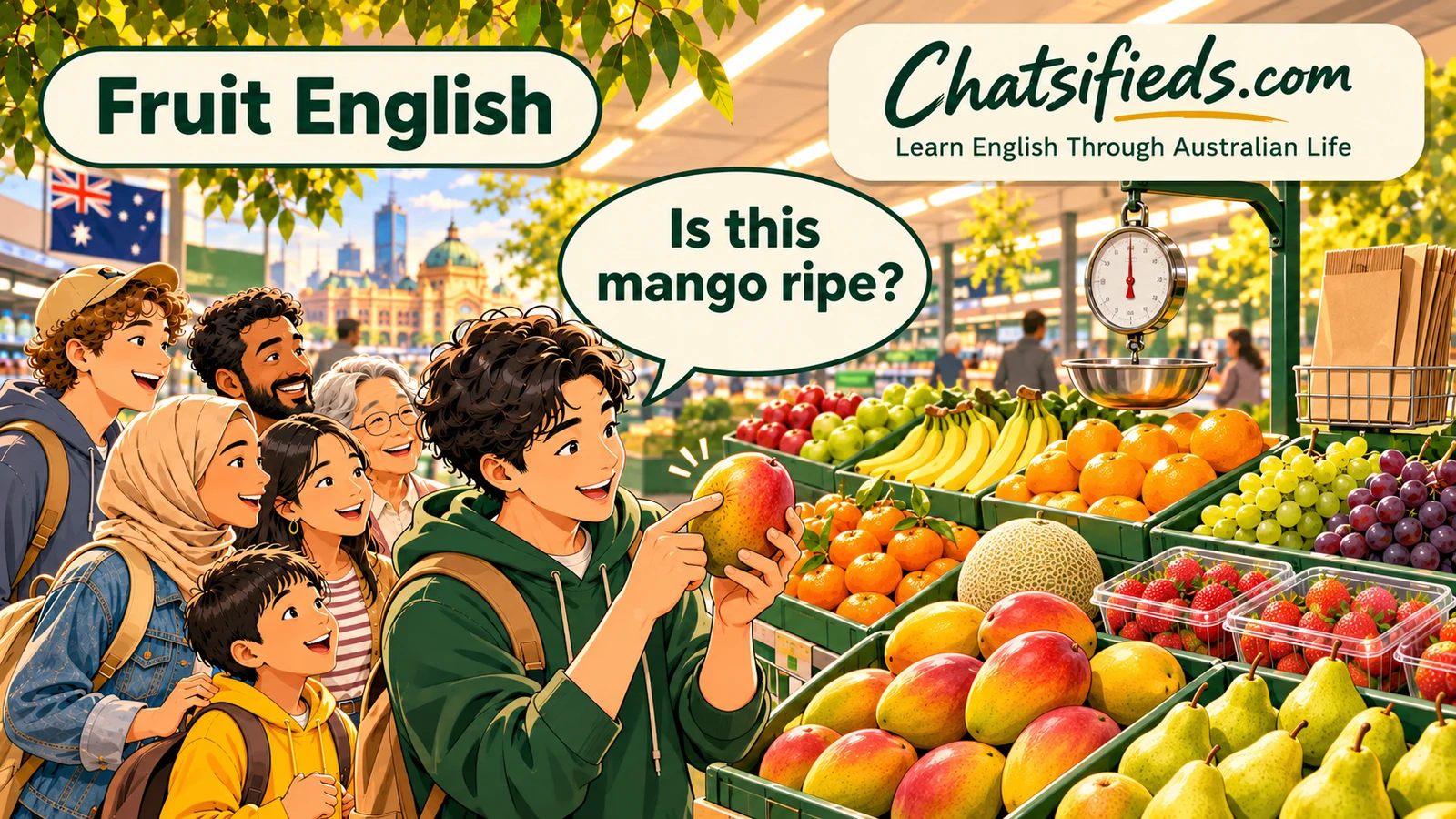
You: Excuse me, are these mangoes ripe?
Team member: Not yet. They are still quite firm. These ones are riper.
You: How can I tell when a mango is ripe?
Team member: It should be slightly soft when you press it gently, and it smells sweet.
You: I would like to eat one today. Which one is ready?
Team member: This one should be ready. It is a little soft.
You: Great. And are the grapes seedless?
Team member: Yes, they are seedless. They are sold per kilo.
You: Could I get half a kilo, please?
Team member: Sure. Put them in a bag and weigh them at the scales, or I can do it.
You: Thanks. Do you have any bananas that are not too ripe?
Team member: Yes, these green ones will be ready in a few days.
- "Ripe", "firm" and "soft" are the most useful condition words.
- "Are these ripe?" and "Is this ready to eat?" are good questions.
- Fruit can be sold per kilo, each, in a bunch or in a punnet. Check the sign.
- Green bananas are not ripe yet. Yellow bananas are ready to eat.
More useful phrases
- Are these ripe?
- Asks if the fruit is ready to eat.Use it: When you choose fruit.
- Do you have any that are ready to eat today?
- Asks for fruit you can eat today.Use it: When you want fruit now.
- Which ones are the sweetest?
- Asks for the sweetest fruit.Use it: When you want sweet fruit.
- Are these seedless?
- Asks if the fruit has no seeds.Use it: For grapes, mandarins or watermelon.
- This one is bruised.
- Says the fruit is damaged.Use it: When you find damaged fruit.
- Is this sold per kilo or each?
- Asks how the price works.Use it: Before weighing.
- Could I get half a kilo, please?
- Asks for a smaller amount.Use it: When you want a small amount.
- I will just take a few.
- Says you want only some.Use it: When fruit is sold loose.
- Do you have any that are not too ripe?
- Asks for fruit that will keep for a few days.Use it: When you shop for later in the week.
- What is this fruit called?
- Asks for the name of a fruit.Use it: When you see a fruit you do not know.
Common fruit in an Australian supermarket
Names, with a note on how it is often sold. Shops and prices differ.
| Fruit | What to know | Often sold |
|---|---|---|
| apple / pear | Firm, sweet or crisp. | Per kilo or in a bag |
| banana | Green is unripe, yellow is ripe, spotty is very ripe. | Per kilo or each |
| orange / mandarin / lemon / lime | Citrus fruit. Mandarins are small and easy to peel. | Loose or in a bag |
| grapes | Often seedless. Red, green or black. | Per kilo |
| strawberries / blueberries / raspberries | Berries. They bruise easily. | In a punnet |
| mango / peach / nectarine / plum | Soft when ripe. Stone fruit has a hard seed in the middle. | Per kilo or each |
| pineapple / watermelon / rockmelon / honeydew | Large fruit. Rockmelon is the orange melon. | Each or by the piece |
| kiwifruit / passionfruit / pawpaw | Soft inside. Pawpaw is also called papaya. | Each or per kilo |
| avocado | Sold in the fruit and veg section. Ripe when slightly soft. | Each |
Say it aloud: asking if fruit is ripe
Saying a sentence out loud before you need it makes real conversations easier. Accents differ, so aim to be clear, not perfect.
- Slow. Read the sentence slowly, one phrase at a time.
- In full. Say: Excuse me, are these mangoes ripe? I would like to eat one today.
- At normal speed. Say it again, as you would in a real conversation.
- Listen. Listen for "ripe", "firm" and "ready" in the answer.
Practice 1: Role-play with a partner
Situation: You are choosing fruit at the fruit and veg section. A team member is nearby.
Work with a friend, a classmate or your mirror. One person is the team member. The other is you. Read the lines, then cover the “You could say” answers and try it from memory. Swap roles.
team member: “Hi, can I help you with anything?”
You could say:
- “Yes, please. Are these peaches ripe?”
- “Hi. Do you have any mangoes that are ready to eat today?”
team member: “These are still firm. This box is riper.”
You could say:
- “Thanks. Which ones are the sweetest?”
- “Great. Are these seedless?”
team member: “The ones in the back are sweetest.”
You could say:
- “Is this sold per kilo or each?”
- “Could I get half a kilo, please?”
team member: “Per kilo. I will weigh them for you.”
You could say:
- “Thank you very much.”
- “Thanks. Could I also get some bananas that are not too ripe?”
Challenge: Choose three fruit and ask for each one using a different question, then say how much you want.
Practice 2: Fill the gap
Say the missing word or phrase out loud before you open the answer.
Are these mangoes ___?
Show answer
ripe — This asks if the fruit is ready to eat.
This banana is green, so it is ___.
Show answer
unripe — Green bananas are not ready yet.
Strawberries are sold in a ___.
Show answer
punnet — A punnet is a small box.
Is this fruit sold per kilo or ___?
Show answer
each — This asks how the price works.
This apple has a dark mark. It is ___.
Show answer
bruised — Bruised means damaged.
Are these grapes ___? I do not like seeds.
Show answer
seedless — Seedless means no seeds.
Common mistakes and better ways to say it
Less helpful: “This fruit is bad.”
Try instead: “This one is bruised. Do you have another?”
Say exactly what is wrong.
Less helpful: “Is this fruit ready?”
Try instead: “Are these ripe? Is this ready to eat today?”
Use "ripe" or "ready to eat".
Less helpful: “Give me grapes.”
Try instead: “Could I get half a kilo of grapes, please?”
Use "could I" and an amount.
Less helpful: “How much one?”
Try instead: “Is this sold per kilo or each?”
A full question is clearer.
Culture note: choosing and sharing
In most Australian supermarkets you can choose your own fruit. Pick it up gently, look for marks and put it in a bag. Many shops ask you to weigh loose fruit at the scales or the checkout.
Australians often say that fruit tastes best in season. Prices for some fruit can be lower when it is in season. If you are not sure when something is in season, ask a team member, or look at the signs near the fruit.
Real-life mission
Practise fruit words in the real world.
You do not need to buy anything. Looking and saying the names is good practice.
Phrase Wall practice: phrases to own
Open a phrase to see it on the Phrase Wall, practise it, and save it to My Learning.
- “Are these ripe?”Asks if fruit is ready to eat.
- “Which ones are the sweetest?”Asks which fruit is sweetest.
- “Are these seedless?”Asks if fruit has no seeds.
- “This one is bruised. Do you have another?”Politely says fruit is damaged and asks for another.
- “Do you have any that are not too ripe?”Asks for fruit that will keep for a few days.