What you need to know
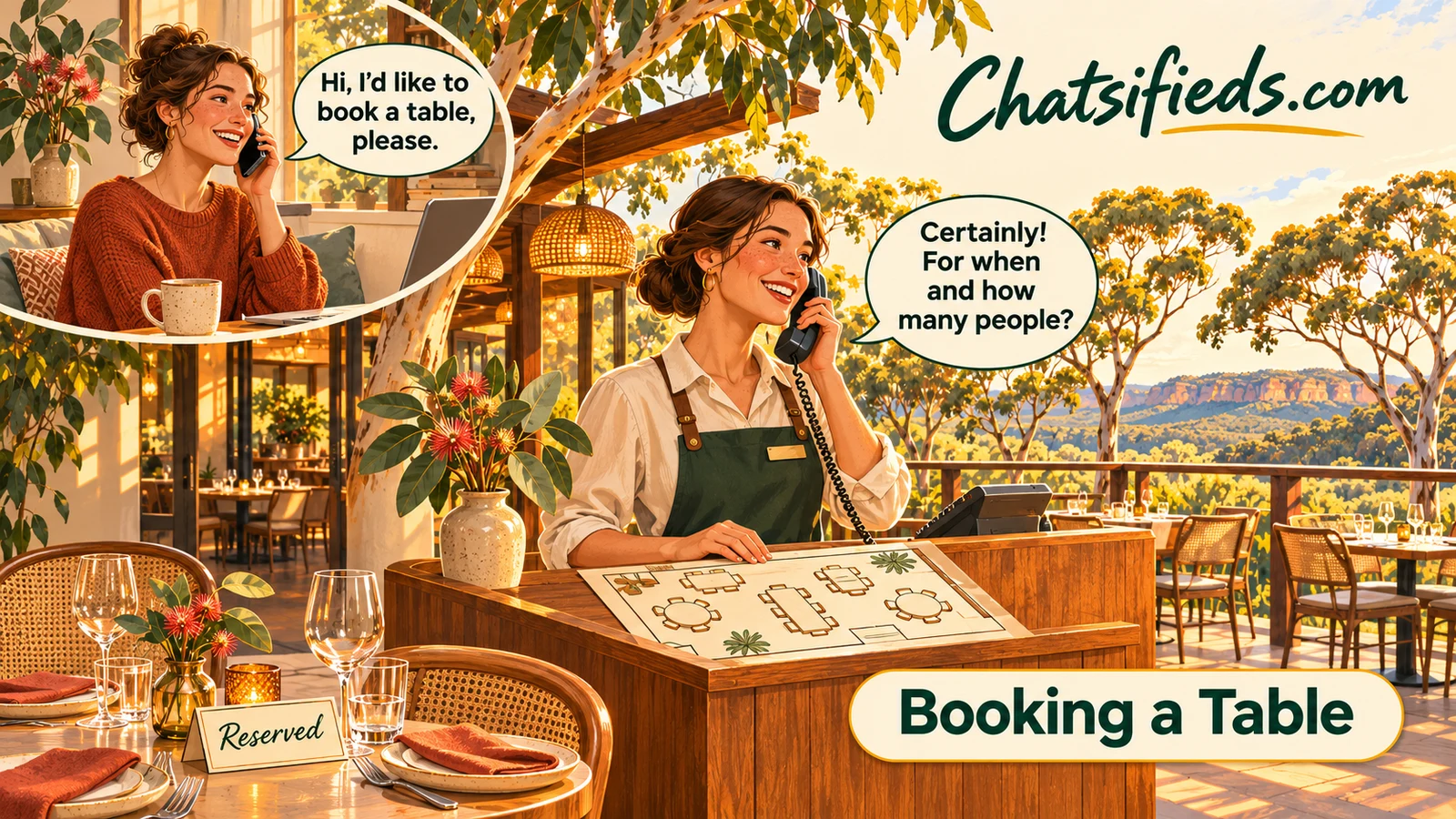
For a group, book ahead and say how many people and any needs: "I'd like to book a table for ten, please." For children, ask "Do you have high chairs?" and "Is there a kids' menu?" Ask about group rules, such as a set menu or separate bills, before the day.
Groups, families and shared tables
Restaurants plan their tables carefully, so a group of six or more usually needs a booking. When you phone or book online, say how many people are coming, the day and the time. Ask "Do you take group bookings?" Some restaurants ask for a deposit, a set menu or a limit on separate bills for big groups. Rules differ by venue, and the ACCC says businesses must give clear prices before you book, so read the booking terms.
With small children, ask if the restaurant has high chairs and a kids' menu. A kids' menu is a short list of smaller, cheaper meals for children. Staff often bring crayons or a colouring sheet. If a child has an allergy, tell staff clearly, and see the allergy lesson in this topic.
At busy casual places you may be asked to share a long table with other people. This is called a communal table or shared table. You can say "Is it okay if we sit here?" to the other diners. A friendly nod is enough, and you do not have to chat.
In a big group it helps to order together. You can say "Could we order drinks first, and food in ten minutes?" or "We'd like to share a few dishes." Ask about splitting the bill early, and see the paying lessons for more.
Key words and phrases
- group booking
- A reservation for a large number of people, often six or more.
- high chair
- A tall seat for a baby or small child at the table.
- kids' menu
- A short menu with smaller meals for children.
- pram
- A baby carriage. Many people say "pram" or "stroller".
- long table
- A table for a large group.
- shared table
- A table you share with other diners. Also called a communal table.
- set menu
- A fixed meal at a fixed price. You do not choose each dish.
- separate bills
- Each person or couple pays their own bill.
- deposit
- Money or a card hold to keep a big booking.
- baby change
- A table or room for changing a baby's nappy.
- colouring sheet
- A paper with a picture for children to colour.
Dialogue: booking a table for a group with kids
Customer: Hi, I'd like to book a table for ten people, please.
Staff: Sure. What day and what time?
Customer: Saturday at six o'clock. Two of the guests are children.
Staff: No problem. Do you need high chairs?
Customer: Yes, two high chairs, please. Is there a kids' menu?
Staff: Yes, we do a kids' menu for children under twelve.
Customer: Great. Do you take separate bills for a big group?
Staff: For ten people we ask for one bill or up to three cards.
Customer: Thanks. Is there a deposit for a group this size?
Staff: We take a card number to hold the table. I'll explain the cancellation policy.
Customer: Thank you. Can we also fit a pram near the table?
Staff: Yes, we'll put you at the long table by the wall.
Customer: Lovely. Could we order drinks first and food later?
Staff: Of course. We'll take drinks when you arrive.
Customer: Thanks very much. See you on Saturday.
- "Do you take group bookings?" is a good question before you plan.
- "Do you take separate bills?" is better asked early for a big group.
- "Is there a deposit?" is a polite way to check about charges.
- Staff are used to families. Asking about prams and high chairs is normal.
More useful phrases
- I'd like to book a table for ten, please.
- Starts a group booking.Use it: On the phone or in person.
- Do you take group bookings?
- Checks if the restaurant takes large groups.Use it: Before you plan.
- Do you have any high chairs?
- Asks for a seat for a baby or small child.Use it: When you book or arrive.
- Is there a kids' menu?
- Asks about children's meals.Use it: When you have children.
- Is there room for a pram?
- Asks about space for a baby carriage.Use it: When you arrive with a baby.
- Can we do separate bills?
- Asks if each person can pay their own.Use it: Before ordering for a group.
- Is there a set menu for groups?
- Asks about a fixed group meal.Use it: When you book a big table.
- Is it okay if we sit here?
- Asks to share a table.Use it: At a communal table.
- Could we order drinks first?
- Asks to order drinks, then food later.Use it: When the group is not ready to order.
Questions for groups and families
Ask these when you book or when you arrive. Rules differ between venues.
| You need | You can ask | Staff may say |
|---|---|---|
| A big table | Do you take group bookings? | Yes, for up to twelve people. |
| A child seat | Do you have any high chairs? | Yes, we have two. |
| Children's food | Is there a kids' menu? | Yes, for children under twelve. |
| Space for a pram | Is there room for a pram? | Yes, we'll seat you by the wall. |
| Separate payments | Can we do separate bills? | For big groups we ask for one bill. |
| Fixed meal | Is there a set menu for groups? | Yes, it's fifty dollars a person. |
Prices in the table are examples only. Always check with the restaurant.
Say it aloud: booking for a group with kids
Saying a sentence out loud before you need it makes real conversations easier. Accents differ, so aim to be clear, not perfect.
- Slow. Read the sentence slowly, one phrase at a time.
- In full. Say: I'd like to book a table for ten, and we need two high chairs, please.
- At normal speed. Say it again, as you would in a real conversation.
- Listen. Listen for the reply, such as "What time?" or "We have two high chairs".
Practice 1: Role-play with a partner
Situation: You phone a restaurant to book a family lunch for eight people, including two small children.
Work with a friend, a classmate or your mirror. One person is the restaurant staff. The other is a customer. Read the lines, then cover the “You could say” answers and try it from memory. Swap roles.
restaurant staff: “Hello, how can I help?”
You could say:
- “I'd like to book a table for eight, please.”
- “Hi, do you take group bookings?”
restaurant staff: “What day, and what time?”
You could say:
- “Sunday at twelve thirty.”
- “Saturday lunch, around one o'clock.”
restaurant staff: “Any special needs?”
You could say:
- “Two children, so two high chairs, please.”
- “Is there a kids' menu?”
restaurant staff: “We do a kids' menu. Anything else?”
You could say:
- “Can we do separate bills?”
- “Is there room for a pram?”
restaurant staff: “We ask for one bill for big groups. Can I take a name?”
You could say:
- “It's Lee, L-E-E.”
- “Okay, thanks. It's under Park.”
Challenge: Do the role-play again, but you arrive and the restaurant has no high chairs left. Ask: "Is there anything else we can use?"
Practice 2: Fill the gap
Say the missing word or phrase out loud before you open the answer.
Do you take ___ bookings?
Show answer
group — A group booking is for many people.
Do you have any high ___?
Show answer
chairs — A high chair is for a baby or small child.
Is there a kids' ___?
Show answer
menu — A kids' menu has smaller meals for children.
Can we do ___ bills?
Show answer
separate — Separate bills means each person pays their own.
Is there room for a ___?
Show answer
pram — A pram is a baby carriage.
Is it okay if we sit ___?
Show answer
here — This asks to share a table politely.
Common mistakes and better ways to say it
Less helpful: “We are many people. Table big.”
Try instead: “I'd like to book a table for ten, please.”
A full sentence with the number is clear.
Less helpful: “(arriving with ten people and no booking)”
Try instead: “Do you take group bookings?”
Call ahead so the restaurant can plan a table.
Less helpful: “Child chair?”
Try instead: “Do you have any high chairs?”
A full polite question is clearer.
Less helpful: “(asking for separate bills at the end)”
Try instead: “Can we do separate bills?”
Ask early because big groups may have rules.
Culture note: families are welcome in many restaurants
Many Australian restaurants welcome children, especially earlier in the evening. Cafes, pubs and family restaurants often have a kids' menu and high chairs. Some fine dining restaurants do not suit small children, so it helps to ask before you book.
Booking terms for big groups can include a deposit, a set menu or a cancellation fee. The ACCC says businesses must communicate clear prices before you book. Always read the terms and ask staff if you are unsure. This lesson teaches English, not legal advice.
At a shared table, a friendly "Is it okay if we sit here?" is enough. You do not need to talk to the other diners, but a smile is polite. If a child makes noise, a quick "Sorry about that" is normal and kind.
Advertisement
Real-life mission
Practise group and family English this week. Tick each step.
Even if you do not go with a group, practising these phrases helps with family and friends.
Phrase Wall practice: phrases to own
Open a phrase to see it on the Phrase Wall, practise it, and save it to My Learning.
- “Do you take group bookings?”Checks if a restaurant accepts large groups.
- “Do you have any high chairs?”Asks for a seat for a baby or small child.
- “Can we do separate bills?”Asks if each person can pay their own bill.
- “Is it okay if we sit here?”Asks to share a table politely.