
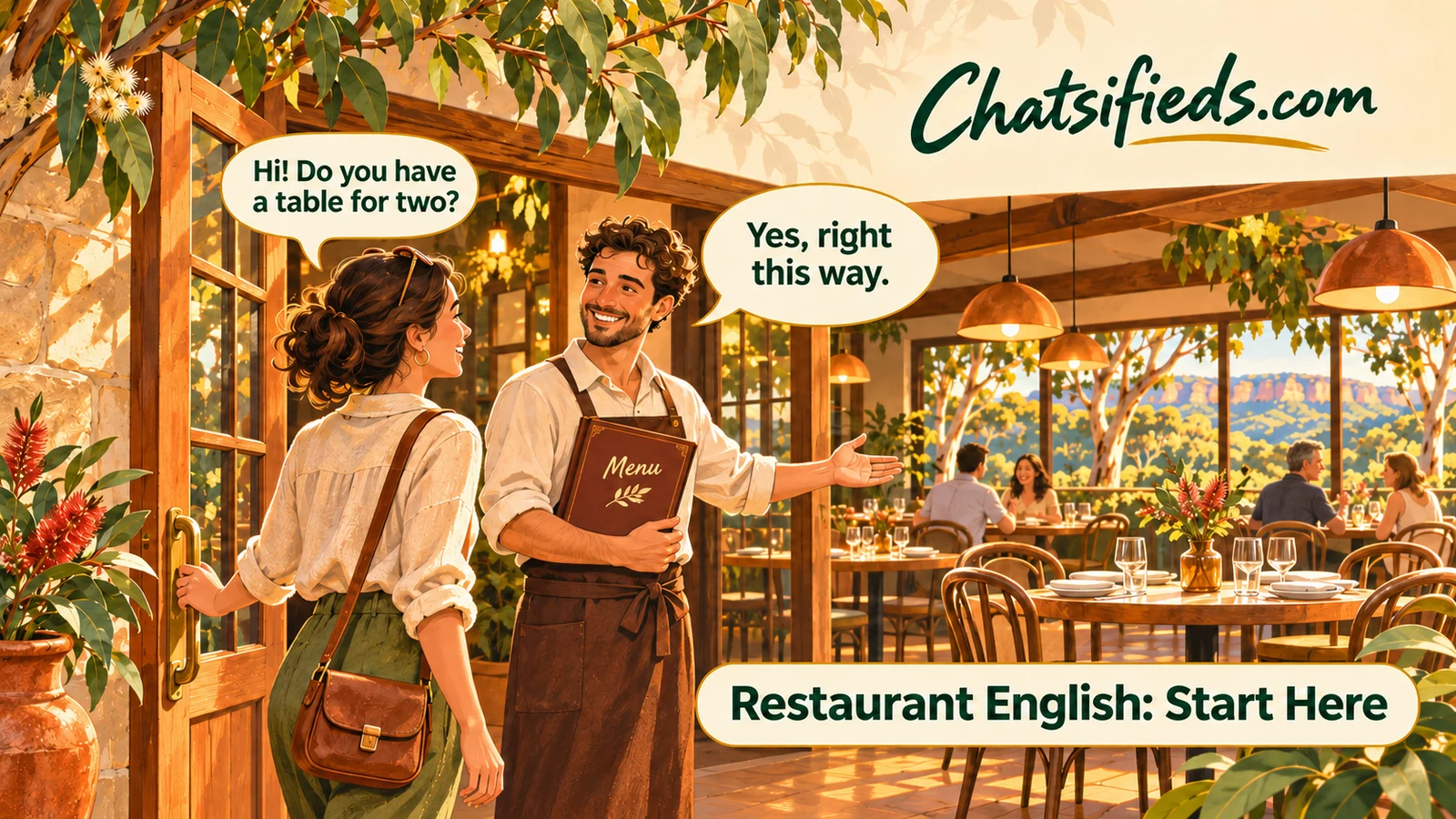
What you need to know
Five tasks: 1) greet the host, 2) order one dish politely, 3) ask one question about the food, 4) ask for the bill, 5) say thanks as you leave. Each task is one short sentence. Tick them off on your next meal.
How the mission works
Pick a cafe, a restaurant or a takeaway shop that feels comfortable. You do not have to do all five tasks in one visit. Aim for one new sentence each time. Small steps build confidence.
The five tasks follow a meal. For more phrases see the [Restaurant English Cheat Sheet](/resources/australian-restaurant-english/restaurant-english-cheat-sheet-esl.html) and [Ordering Food and Drinks](/resources/australian-restaurant-english/ordering-food-and-drinks-what-the-waiter-says-english-australia.html). If a sentence goes wrong, it is fine. Say "Sorry, could you say that again?"
Safe practice matters too. If you have an allergy, always tell staff clearly. See [Allergy English](/resources/australian-restaurant-english/allergy-english-telling-staff-clearly-restaurants-australia.html). This lesson teaches English only and is not medical advice.
Key words and phrases
- mission
- A small task to try in real life.
- checklist
- A list of steps to tick off.
- greet
- Say hello.
- order
- Ask for food or drink.
- recommend
- Suggest something good.
- the bill
- The list of what you owe.
- confidence
- Feeling sure you can do it.
- repeat
- Say again.
- progress
- Getting better step by step.
Dialogue: completing the mission at a cafe-restaurant
Customer: Hi, how are you?
Host: Good, thanks. Table for one?
Customer: Yes, please.
Waiter: Are you ready to order?
Customer: Could I get the fish and chips, please?
Waiter: Sure. Anything to drink?
Customer: What do you recommend?
Waiter: The lemon squash is popular.
Customer: Great, I'll have that. Thank you.
Waiter: How is everything?
Customer: Lovely, thanks. Could I have the bill, please?
Waiter: Of course. Here you go.
Customer: Thanks very much. Have a good night.
- Five tasks appear: greet, order, ask, bill, thanks.
- "What do you recommend?" is a safe way to ask a question.
- Small talk like "How are you?" is normal.
More useful phrases
- Hi, how are you?
- Greets staff.Use it: When you arrive.
- Table for one, please.
- Asks for a table.Use it: At the door.
- Could I get the fish and chips, please?
- Orders a dish.Use it: At the table.
- What do you recommend?
- Asks for a suggestion.Use it: When choosing.
- Lovely, thanks.
- Says the meal is good.Use it: When asked how it is.
- Could I have the bill, please?
- Asks to pay.Use it: At the end.
- Thanks very much.
- Thanks staff.Use it: When leaving.
- Have a good night.
- A friendly goodbye.Use it: When leaving in the evening.
- Sorry, could you say that again?
- Asks staff to repeat.Use it: When you did not understand.
The five tasks
Tick each task when done.
| Task | Say | Done? |
|---|---|---|
| 1. Greet | Hi, how are you? | [ ] |
| 2. Order | Could I get the fish and chips, please? | [ ] |
| 3. Ask | What do you recommend? | [ ] |
| 4. Bill | Could I have the bill, please? | [ ] |
| 5. Thanks | Thanks very much. Have a good night. | [ ] |
You can do one task per visit. That is fine.
Say it aloud: the five-minute mission
Saying a sentence out loud before you need it makes real conversations easier. Accents differ, so aim to be clear, not perfect.
- Slow. Read the sentence slowly, one phrase at a time.
- In full. Say: Hi, how are you? Could I get the fish and chips, please? Thanks very much.
- At normal speed. Say it again, as you would in a real conversation.
- Listen. Listen for "Table for one?", "Anything to drink?" and "Here you go".
Practice 1: Role-play with a partner
Situation: You are eating alone at a casual restaurant and want to do the mission.
Work with a friend, a classmate or your mirror. One person is the waiter. The other is a customer. Read the lines, then cover the “You could say” answers and try it from memory. Swap roles.
waiter: “Hi, how are you?”
You could say:
- “Good, thanks. How are you?”
- “Hi, I'm well, thanks.”
waiter: “Are you ready to order?”
You could say:
- “Could I get the fish and chips, please?”
- “What do you recommend?”
waiter: “Anything to drink?”
You could say:
- “A lemon squash, please.”
- “Just tap water, thanks.”
waiter: “How is everything?”
You could say:
- “Lovely, thanks.”
- “Great, thank you.”
waiter: “Anything else?”
You could say:
- “Could I have the bill, please?”
- “No, that's all. Thanks.”
Challenge: Do it again, but make one task harder: ask "What's in this dish?" before you order.
Practice 2: Fill the gap
Say the missing word or phrase out loud before you open the answer.
Hi, how are ___?
Show answer
you — A common greeting.
Could I ___ the fish and chips, please?
Show answer
get — Could I get... is a polite order.
What do you ___?
Show answer
recommend — Asks for a suggestion.
Could I have the ___, please?
Show answer
bill — The bill is what you pay.
Thanks very ___.
Show answer
much — Thanks very much is friendly.
Have a good ___.
Show answer
night — A friendly goodbye.
Common mistakes and better ways to say it
Less helpful: “(waiting silently and doing nothing)”
Try instead: “Hi, how are you?”
A short greeting starts well.
Less helpful: “Fish and chips.”
Try instead: “Could I get the fish and chips, please?”
A polite full sentence.
Less helpful: “(leaving without saying anything)”
Try instead: “Thanks very much. Have a good night.”
A short goodbye is friendly.
Less helpful: “(trying to do everything perfectly)”
Try instead: “(aim for one new sentence)”
Progress matters more than perfection.
Culture note: small and friendly
In Australia short friendly chats with staff are normal: "How are you?", "Lovely, thanks." You do not need a long answer. A smile and "Thanks" are enough.
If you are nervous, start with a takeaway shop or a quiet cafe. Staff are used to learners and newcomers. Many learners find the second visit easier than the first.
This lesson teaches English only.
Advertisement
Real-life mission
Do the mission on your next meal out. Tick each task when done.
Aim for progress, not perfection. Celebrate each task.
Phrase Wall practice: phrases to own
Open a phrase to see it on the Phrase Wall, practise it, and save it to My Learning.
- “Table for one, please.”Asks for a table for one person.
- “Lovely, thanks. Everything is great.”Answers how the meal is.
- “Thanks very much. Have a good night.”A friendly goodbye.
- “Hi, how are you?”A friendly greeting for staff.