
What you need to know
Say what you eat with "I'm vegetarian", "I'm vegan", "I eat halal food" or "I need gluten free". Then ask "Does this dish have meat in it?" or "Is there a vegetarian option?" Words and menu codes can mean different things at different places, so ask staff to check.
Saying what you eat
Melbourne restaurants serve many diets. Vegetarian usually means no meat or fish. Vegan usually means no animal products at all, including milk, eggs and honey. Gluten free means no wheat and other grains with gluten, and people choose it for health or other reasons. Dairy free means no milk products. Halal means food prepared in line with Islamic rules. On packaged food, SA Health explains that a gluten free claim can only be used if the product contains no detectable gluten. That rule is about labels on packaged food, so for restaurant food, ask the venue how it prepares the dish.
These words are not exactly the same everywhere. One restaurant may use fish sauce in a dish it calls vegetarian, and another may not. Menu codes such as V, VG, GF and DF are common, but they are not a promise. Ask staff to check with the chef, and say clearly what you need.
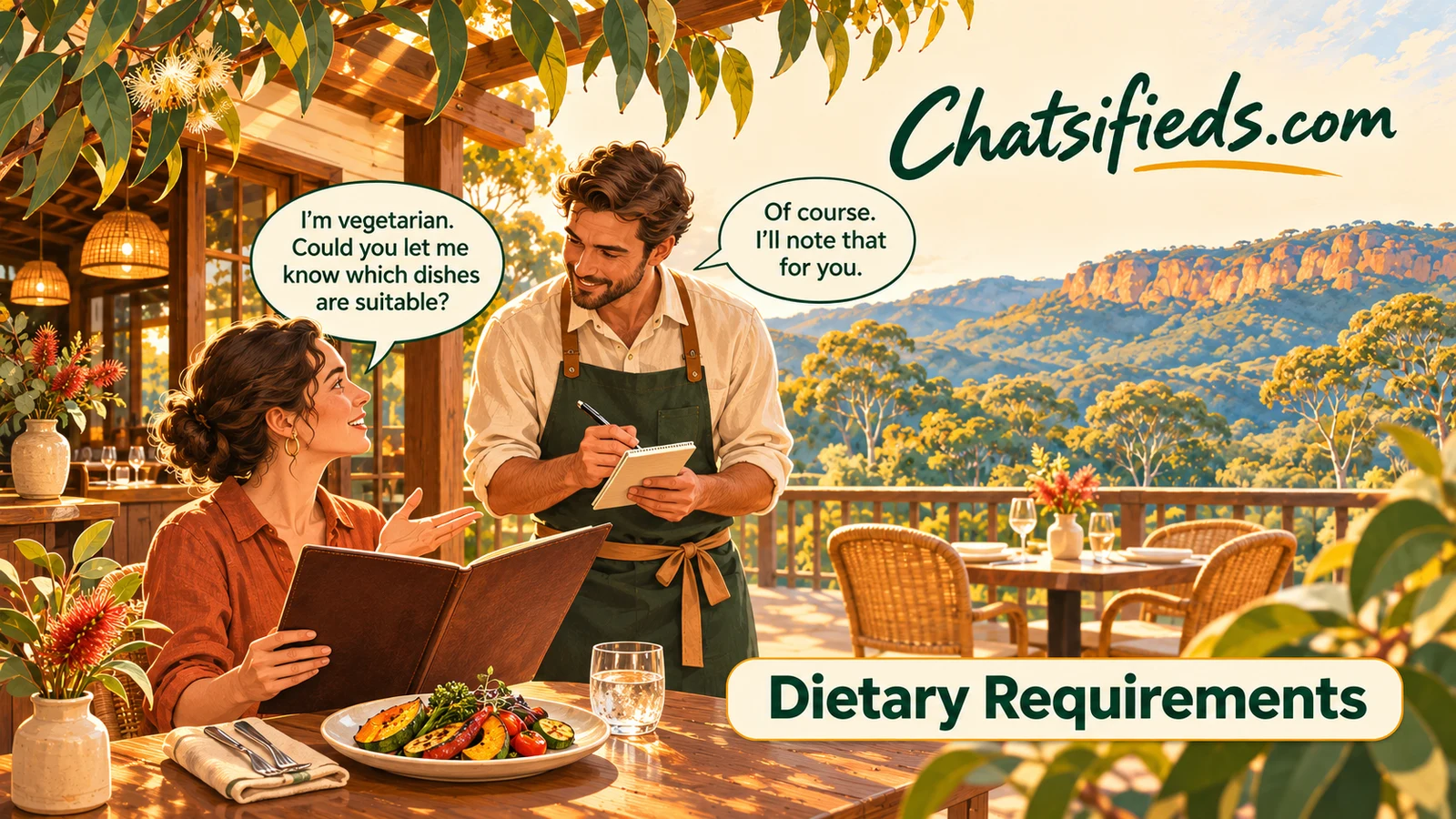
To ask politely, start with a short sentence about you, then a question: "I'm vegetarian. Is there a vegetarian main?" Or ask about one dish: "Does the pasta have any meat or fish in it?" If staff are not sure, say "Could you check with the chef, please?"
If you cannot eat a food for health reasons, such as an allergy, use the allergy lesson in this topic. This lesson is about choices and preferences, and it is not medical advice.
Menu warnings are explained in ["May Contain" and Allergen Warnings on Menus](/resources/australian-restaurant-english/may-contain-and-allergen-warnings-on-menus-english-australia.html). For packaged food, see [Allergens and Dietary Needs](/resources/australian-supermarket-english/allergens-and-dietary-needs-supermarket-english-australia.html) in the supermarket series.
Key words and phrases
- vegetarian
- A person who does not eat meat or fish. Also a dish without them.
- vegan
- A person who eats no animal products, including milk, eggs and honey.
- gluten free
- Made without wheat and other grains that contain gluten.
- dairy free
- Made without milk, cheese or butter.
- halal
- Food prepared in line with Islamic rules. Ask the venue what they mean.
- pescatarian
- A person who eats fish but not other meat.
- meat free
- A dish without meat. Check if it has fish or animal products.
- plant-based
- Made from plants. Often used for vegan dishes.
- option
- A choice on the menu. "Is there a vegetarian option?"
- check with the chef
- Ask the kitchen to confirm what is in a dish.
- menu code
- Letters such as V, VG, GF and DF next to a dish.
Dialogue: asking about a vegetarian and gluten free meal
Customer: Hi, I'm vegetarian. Is there a vegetarian main?
Waiter: Yes, the mushroom risotto and the pumpkin curry are both vegetarian.
Customer: Does the risotto have any meat or fish in it, like stock?
Waiter: I'm not sure about the stock. I'll check with the chef.
Waiter: The chef says it's made with vegetable stock.
Customer: Great, thank you. My friend needs gluten free food.
Waiter: The curry is gluten free. The risotto is too, but the bread isn't.
Customer: Could you check that the curry has no wheat in it, please?
Waiter: Of course. I'll ask the kitchen.
Customer: Thanks. Is there a vegan dessert?
Waiter: Yes, we have a coconut sorbet. It's dairy free and vegan.
Customer: Perfect. We'll have the risotto, the curry and the sorbet to share.
Waiter: Lovely. I'll let the kitchen know about the gluten free order.
- "I'm vegetarian" is a short, clear way to start.
- Asking about stock is a good question. Many soups and risottos use meat stock.
- "I'll check with the chef" means the waiter will ask the kitchen to be sure.
- "Is there a vegan dessert?" is a polite way to ask for a specific option.
More useful phrases
- I'm vegetarian.
- Says you do not eat meat or fish.Use it: At the start of your order.
- I'm vegan. Is there anything on the menu for me?
- Says you eat no animal products and asks for choices.Use it: When you read the menu.
- Is there a vegetarian option?
- Asks about vegetarian dishes.Use it: When no code is on the menu.
- Does this have any meat or fish in it?
- Checks one dish.Use it: When you are not sure about a dish.
- Is this dish gluten free?
- Asks about gluten.Use it: When you need gluten free food.
- Could you check with the chef, please?
- Asks staff to confirm with the kitchen.Use it: When staff are not sure.
- Is the meat halal?
- Asks if the meat is halal.Use it: When you eat halal food.
- Is there a dairy free option?
- Asks for a dish without milk products.Use it: When you avoid dairy.
- Does that menu code mean it's definitely vegan?
- Checks a menu code.Use it: When you see VG next to a dish.
Diet words and what to ask
These meanings are common but not exact. Always ask staff to check.
| Word | Usually means | A good question |
|---|---|---|
| Vegetarian (V) | No meat or fish | Does it have stock or fish sauce? |
| Vegan (VG) | No animal products | Is there milk, egg or honey in it? |
| Gluten free (GF) | No wheat and other gluten grains | Is the sauce gluten free too? |
| Dairy free (DF) | No milk products | Is it cooked in butter? |
| Halal | Prepared in line with Islamic rules | Is the meat halal? |
| Pescatarian | Fish but no other meat | Is there a fish or vegetable dish? |
If a dish matters for health or safety, say so clearly and ask staff to check with the chef.
Say it aloud: saying what you eat
Saying a sentence out loud before you need it makes real conversations easier. Accents differ, so aim to be clear, not perfect.
- Slow. Read the sentence slowly, one phrase at a time.
- In full. Say: Hi, I'm vegetarian. Is there a vegetarian main?
- At normal speed. Say it again, as you would in a real conversation.
- Listen. Listen for dish names and for "I'll check with the chef".
Practice 1: Role-play with a partner
Situation: You are at a restaurant with a friend. One of you is vegetarian and one needs gluten free food. The waiter comes to your table.
Work with a friend, a classmate or your mirror. One person is the waiter. The other is a customer. Read the lines, then cover the “You could say” answers and try it from memory. Swap roles.
waiter: “Hi there. Do you have any dietary needs I should know about?”
You could say:
- “Yes, I'm vegetarian.”
- “Yes, my friend needs gluten free food.”
waiter: “No problem. Our vegetarian mains are marked V.”
You could say:
- “Great. Does the pasta have any meat or fish in it?”
- “Is there a vegetarian option that is also gluten free?”
waiter: “I'm not sure about the sauce. I'll check with the chef.”
You could say:
- “Thanks, could you check, please?”
- “Thanks. Does it have any dairy in it?”
waiter: “The chef says the sauce has no meat. It's made with vegetables.”
You could say:
- “Thank you. I'll have that, please.”
- “Great. Is it gluten free too?”
waiter: “Would you like a vegan dessert?”
You could say:
- “Yes, what do you have?”
- “No, thanks. Just the main.”
Challenge: Do the role-play again, but you eat halal food. Ask: "Is the meat halal?" and listen carefully to the answer.
Practice 2: Fill the gap
Say the missing word or phrase out loud before you open the answer.
I'm ___. I do not eat meat or fish.
Show answer
vegetarian — Vegetarian means no meat or fish.
Is there a ___ option?
Show answer
vegan — Vegan means no animal products.
Is this dish ___ free?
Show answer
gluten — Gluten free means no wheat and similar grains.
Could you check with the ___, please?
Show answer
chef — The chef knows what is in a dish.
Does this have any meat or ___ in it?
Show answer
fish — Vegetarian usually means no fish too.
Is the meat ___?
Show answer
halal — Halal is a word for food prepared in line with Islamic rules.
Common mistakes and better ways to say it
Less helpful: “I no eat meat.”
Try instead: “I'm vegetarian.”
A short clear sentence is easy to understand.
Less helpful: “(assuming V on a menu is a promise)”
Try instead: “Could you check with the chef, please?”
Menu codes are not a promise. Ask staff.
Less helpful: “No gluten.”
Try instead: “Is this dish gluten free?”
A full question gets a clearer answer.
Less helpful: “Is it halal? (and not listening to the answer)”
Try instead: “Is the meat halal? Could you check?”
Listen to what the staff say about how they use the word.
Culture note: diets are common and staff are used to them
Many Australians choose vegetarian, vegan or gluten free food, and many restaurants mark their menus with codes such as V, VG, GF and DF. Staff are used to these questions and are happy to help. A friendly question and a thank you are enough.
Allergy & Anaphylaxis Australia says menus do not have to list allergens, so you should talk to staff directly. That advice is for allergies, but it is a good habit for any diet: say what you need, and ask staff to check. If you have an allergy, see the allergy lesson in this topic.
Halal, vegan and gluten free claims can mean different things in different venues. It is fine to ask "What do you mean by halal here?" or "How do you make sure it's gluten free?" This lesson teaches English, not religious or dietary advice.
Real-life mission
Practise diet English this week. Tick each step.
If you are not sure whether a dish is right for you, ask staff to check with the chef.
Phrase Wall practice: phrases to own
Open a phrase to see it on the Phrase Wall, practise it, and save it to My Learning.
- “I'm vegetarian. Is there a vegetarian main?”Says you do not eat meat or fish and asks for a main.
- “Does this have any meat or fish in it?”Checks one dish for meat or fish.
- “Is this dish gluten free?”Asks about gluten.
- “Could you check with the chef, please?”Asks staff to confirm with the kitchen.