
Australian Supermarket English · Culture & slang · Level: Beginner to intermediate
Australian Supermarket Slang: Woolies, Snags and Bickies
Australians shorten words and nickname shops. At the supermarket you may hear 'Woolies', 'snags' and 'bickies' and wonder what they mean. This lesson helps you understand them and decide which ones to use.
Published 18/11/2026 · Educational guide · About 18 minutes
What you need to know
Slang is informal, so you can understand it without using it. 'Woolies' means Woolworths. A 'snag' is a sausage, a 'bickie' is a biscuit, 'avo' is avocado and a 'bottle-o' is a liquor shop. Standard words are always fine in a shop.
Why supermarket slang sounds so different
Many Australian slang words are short forms of longer words, often ending in -o or -ie. Avocado becomes avo, biscuit becomes bickie, and sandwich becomes sanga. Friends and family use these words all the time, and you will hear them in shops, on shopping lists and in conversation.
Slang changes between regions, ages and groups of friends. Some words are widely known and some are used by only a few people. Because of this, a good plan is to learn to understand the common words first. You can start to use a few later if they feel natural.
Shop staff and signs mostly use standard English. A staff member who says 'sausages' is just as friendly as one who says 'snags'. Use slang with friends, flatmates and colleagues if you like. Standard words never sound wrong.
Key words and phrases
- Woolies
- A nickname for Woolworths. Coles is usually just called Coles.
- snag
- A casual word for a sausage, often cooked on a barbecue.
- bickie
- A casual word for a biscuit.
- avo
- Short for avocado.
- bottle-o
- A shop that sells alcohol, also called a bottle shop.
- capsicum
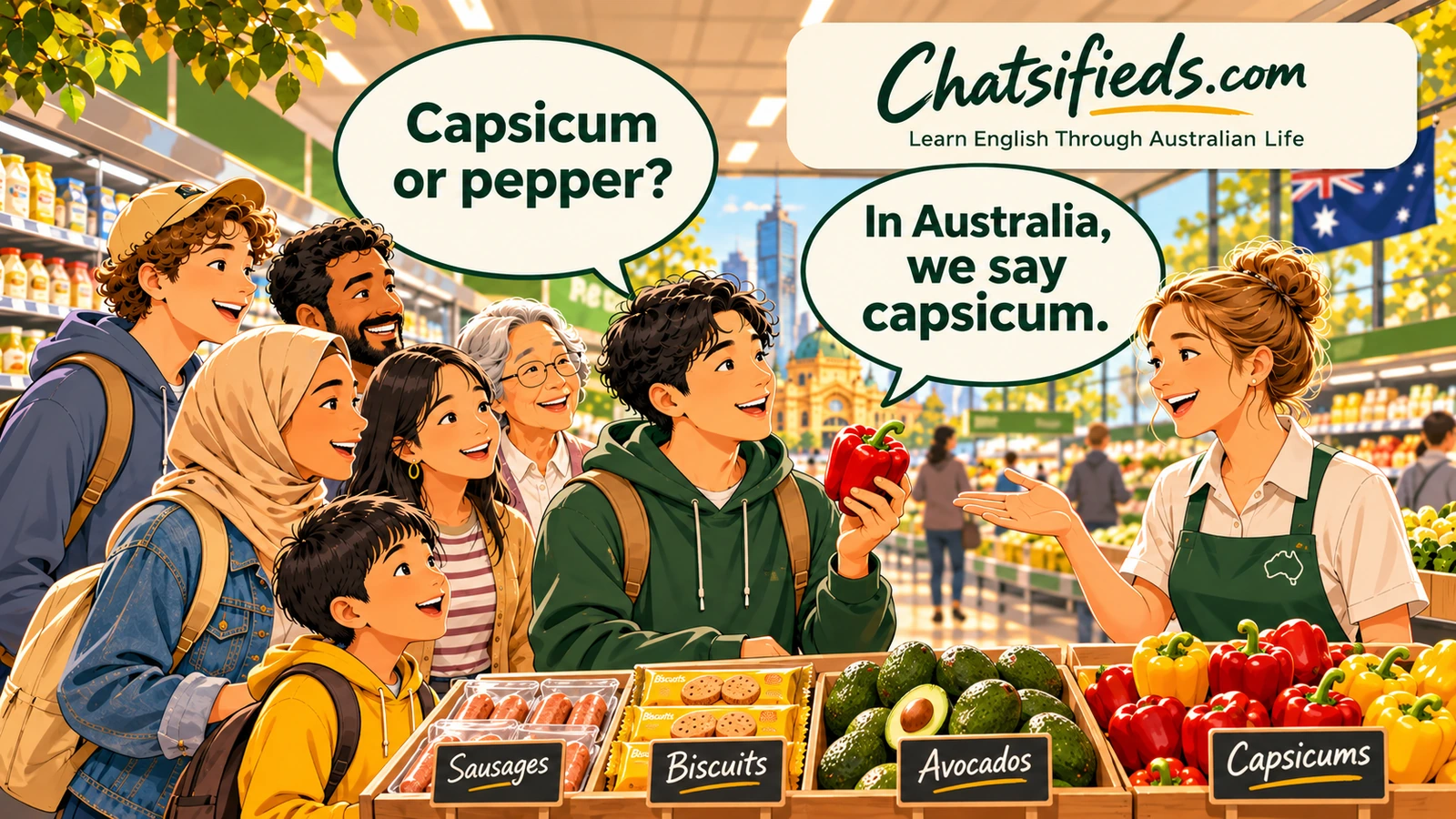
- The Australian word for bell pepper.
- chook
- A casual word for a chicken.
- sanga
- A casual word for a sandwich.
- paw paw
- A tropical fruit, also called papaya.
- milk bar
- A small local shop selling milk, snacks and basics.
- chips
- Hot chips (like French fries) or packet chips, depending on the situation.
- stubbie
- A small bottle of beer.
Dialogue: a shopping list with slang
Flatmate: I'm heading to Woolies. Do you need anything?
You: Woolies? Is that Woolworths?
Flatmate: Yeah, that's right. Everyone calls it Woolies.
You: Oh, okay. Could you get some bread, please?
Flatmate: Sure. We need snags for the barbie on Saturday too.
You: Sorry, snags?
Flatmate: Sausages. We usually cook them on the barbecue.
You: Got it. And can you get an avo for my toast?
Flatmate: An avo? Nice. You're sounding like a local already!
You: Ha, I'm trying! What about some bickies?
Flatmate: Biscuits? Sure. Chocolate ones or plain ones?
You: Chocolate ones, please. Thanks a lot.
- The flatmate uses slang, but the learner uses a mix of standard and slang words. This is normal.
- Asking 'Sorry, snags?' is a good way to check a word you do not know.
- 'Barbie' means barbecue. Many Australian slang words end in -ie or -o.
- 'Sounding like a local' is a friendly compliment, not a correction.
More useful phrases
- Sorry, what's a snag?
- Asks about the meaning of a word you do not know.Use it: With a friend, flatmate or staff member.
- Is that the same as ___?
- Checks that a slang word means what you think.Use it: When you want to be sure before buying.
- I'm heading to Woolies.
- Says you are going to Woolworths.Use it: With friends or flatmates.
- Do you need anything from the shops?
- Offers to buy something for someone.Use it: Before you go shopping with or for others.
- Could you grab some bickies?
- Asks someone to buy biscuits. 'Grab' means pick up.Use it: With friends or flatmates.
- I'll swing by the bottle-o.
- Says you will visit the liquor shop.Use it: When you plan a stop on the way.
- Can you say that again, please?
- Asks someone to repeat, politely.Use it: When slang is too fast to follow.
- I haven't heard that one before.
- Says that a word is new to you.Use it: When a friend uses a new word.
Slang and standard words side by side
Learn to understand the slang word first. The standard word always works.
| Slang | Standard English | Where you might hear it |
|---|---|---|
| Woolies | Woolworths | With friends about where to shop. |
| snag | sausage | Barbecues and the meat section. |
| bickie | biscuit | Shopping lists and the biscuit aisle. |
| avo | avocado | Cafés and fruit and veg. |
| bottle-o | liquor shop | Plans with friends. |
| sanga | sandwich | Lunch plans. |
| chook | chicken | Butcher and barbecue chat. |
Slang varies between people. If a word is new, ask.
Say it aloud: checking a slang word
Saying a sentence out loud before you need it makes real conversations easier. Accents differ, so aim to be clear, not perfect.
- Slow. Read the sentence slowly, one phrase at a time.
- In full. Say: Sorry, what's a snag?
- At normal speed. Say it again, as you would in a real conversation.
- Listen. Listen for the answer. It is usually a short word, such as 'a sausage'.
Practice 1: Role-play with a partner
Situation: Your flatmate gives you a shopping list full of slang words. You do not know some of them.
Work with a friend, a classmate or your mirror. One person is the flatmate. The other is the shopper. Read the lines, then cover the “You could say” answers and try it from memory. Swap roles.
flatmate: “Can you grab snags, bickies and an avo from Woolies?”
You could say:
- “Sorry, what are snags?”
- “Snags? Is that sausages?”
flatmate: “Yes, sausages. Beef ones are fine.”
You could say:
- “Okay. And bickies are biscuits, right?”
- “Got it. And what is a bickie?”
flatmate: “Yep, any chocolate ones. And an avo is an avocado.”
You could say:
- “An avocado. Easy.”
- “Thanks. Is that everything?”
flatmate: “That's it. Oh, and I'll swing by the bottle-o on the way home.”
You could say:
- “Sorry, the bottle-o?”
- “Is that the bottle shop?”
Challenge: Swap roles. As the flatmate, write a short list using five slang words, then explain each one in standard English.
Practice 2: Fill the gap
Say the missing word or phrase out loud before you open the answer.
Woolies is a nickname for ___.
Show answer
Woolworths — Coles is usually just called Coles.
A snag is a ___.
Show answer
sausage — Often cooked on a barbecue.
A bickie is a ___.
Show answer
biscuit — A sweet or savoury baked snack.
Avo is short for ___.
Show answer
avocado — Many slang words are short forms.
Sorry, what's a ___? (asking about a word you do not know)
Show answer
snag — Asking is normal and polite.
The ___ is a shop that sells alcohol.
Show answer
bottle-o — Also called a bottle shop.
Common mistakes and better ways to say it
Less helpful: “I will buy a Woolies.”
Try instead: “I'm going to Woolies.”
Woolies is a shop name, not something you buy.
Less helpful: “Where are the snags? (to a person who has not heard the word)”
Try instead: “Where are the sausages?”
Use standard words with staff if you are unsure.
Less helpful: “(using lots of slang to sound Australian)”
Try instead: “(using a few words you are sure of)”
Too much slang can sound forced. Use what feels natural.
Less helpful: “(pretending to understand)”
Try instead: “Sorry, what does that mean?”
Asking is better than guessing.
Culture note: slang is friendly, not a test
Australians use slang to sound relaxed and friendly. They are usually happy to explain a word, and many enjoy doing so.
You do not have to prove you know the slang. Understanding it is helpful. Using standard words in shops is always fine.
Real-life mission
This week, listen for slang in real shops and with friends.
If no one uses slang around you, read a few shopping lists or social posts instead.
Phrase Wall practice: phrases to own
Open a phrase to see it on the Phrase Wall, practise it, and save it to My Learning.
- “Sorry, what's a snag?”A polite way to ask about a slang word you do not know.
- “I'm heading to Woolies.”A casual way to say you are going to Woolworths.
- “Could you grab some bickies?”A casual request to pick up biscuits.
- “I haven't heard that one before.”A friendly way to say a word is new to you.