
Australian Supermarket English · Culture & slang · Level: Beginner to intermediate
Australian vs American Grocery Words
The same food can have two names. In Australia you look for capsicum, mince and lollies, not bell peppers, ground beef and candy. Learn the pairs so you can read signs and ask staff clearly.
Published 18/11/2026 · Educational guide · About 20 minutes
What you need to know
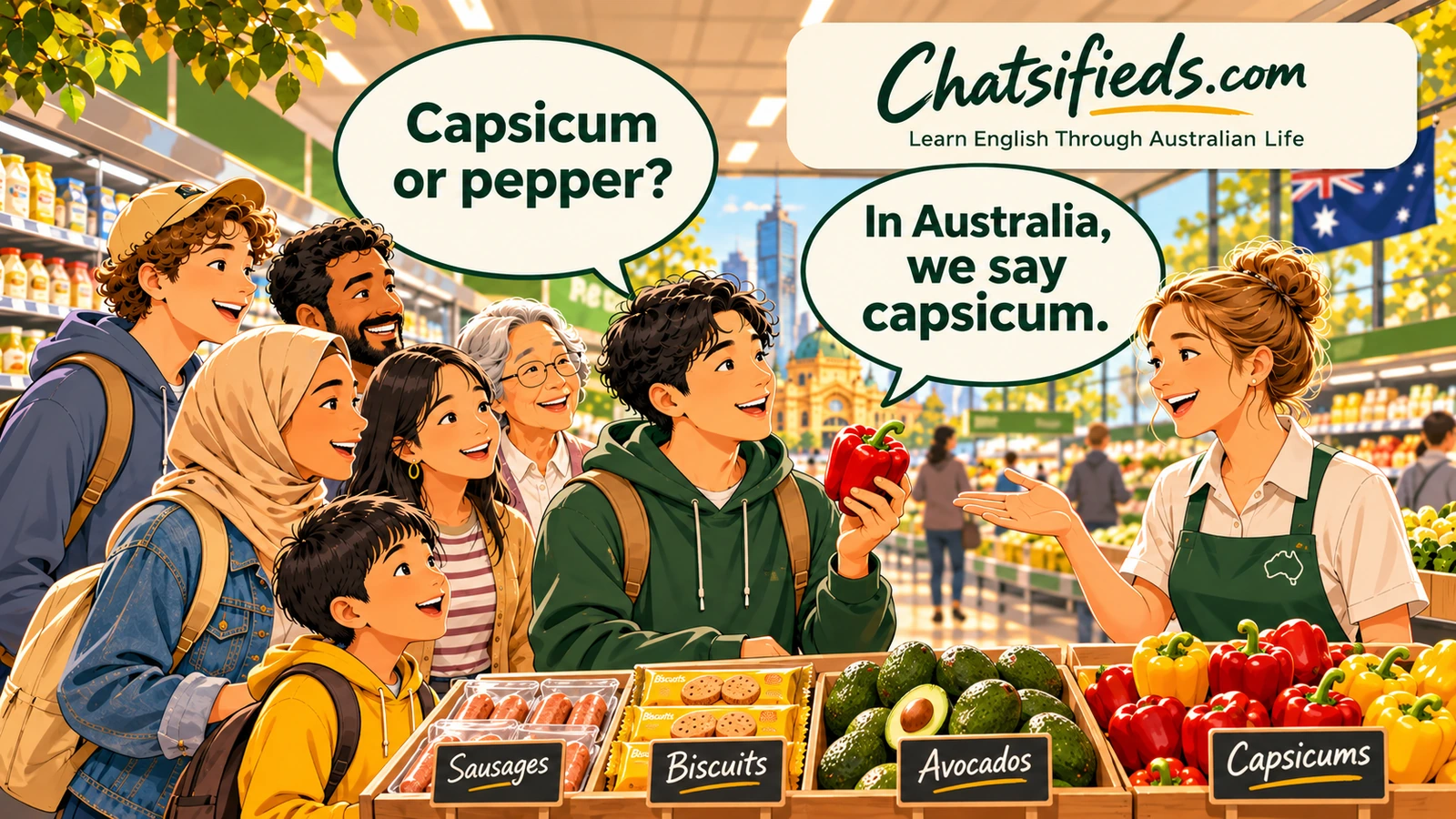
Many Australian grocery words differ from American English. Commonly used Australian words include capsicum (bell pepper), mince (ground beef), tomato sauce (ketchup), biscuit (cookie), lollies (candy), takeaway (takeout) and trolley (cart). If staff do not understand one word, try the other. Both are usually fine.
Why grocery words differ
Australian English has its own everyday food words. If you learned English from American or British sources, you may know a different word for the same thing. That is normal, and staff are used to explaining.
A fetched list of Australian food slang gives some examples: capsicum means bell pepper, chips means French fries, a snag is a sausage, a bickie is a biscuit or cookie, an avo is an avocado, a chook is a chicken, and a sanga is a sandwich. Some of these are casual words you will hear more than you will read on shelf signs.
Some words are tricky because they have more than one meaning. In Australia, "chips" can mean hot chips (like French fries) or packet potato chips. Context tells you which. If you are unsure, ask: "Sorry, do you mean hot chips or packet chips?"
Spelling and signs can follow either style. Many packets use the Australian word, but some imported products use another word. Learn both and you will always find what you need.
Key words and phrases
- capsicum
- The Australian word for bell pepper. It can be red, green or yellow.
- mince
- Minced meat, such as beef mince. Americans say ground beef.
- tomato sauce
- The red sauce for pies, sausages and chips. Americans call it ketchup.
- biscuit
- A sweet or savoury baked snack. Americans often say cookie or cracker.
- lollies
- Sweets. Americans say candy.
- takeaway
- Food you take with you. Americans say takeout.
- trolley
- A big shopping cart on wheels.
- rockmelon
- An orange melon with rough skin. Americans say cantaloupe.
- coriander
- A green herb. Americans say cilantro.
- spring onion
- A long green onion. Americans say scallion or green onion.
- chips
- Hot chips (French fries) or packet potato chips, depending on the situation.
- zucchini
- A long green summer vegetable. British English says courgette.
- icy pole
- A frozen fruit stick. Americans say popsicle.
- snag
- A casual word for a sausage, often cooked on a barbecue.
Dialogue: looking for capsicum and mince
You: Excuse me, where can I find bell peppers?
Staff member: Do you mean capsicums? They're in the fruit and veg, near the tomatoes.
You: Capsicums. Yes! Thank you. And where is the ground beef?
Staff member: We usually say mince. It's in the meat fridge, on the left.
You: Mince. Got it. Do you have any cilantro, sorry, coriander?
Staff member: Coriander's right there, next to the parsley.
You: Thanks. One more thing. Where are the cookies?
Staff member: Biscuits are in aisle 8. Chocolate biscuits are halfway down.
You: Biscuits. I'll remember that.
Staff member: No worries. You'll pick up the words quickly.
You: I hope so. Thanks for explaining.
Staff member: Anytime. Have a good one!
- The customer used the American word first. The staff member gave the Australian word in a friendly way. This is very common.
- "Do you mean ...?" is a useful question when two words could be the same thing.
- "Sorry, coriander" shows a quick, natural self-correction. You can do this too.
- "No worries" and "Have a good one" are friendly Australian replies.
More useful phrases
- Do you mean ___?
- Checks that two words are the same thing.Use it: When staff say a word you do not know.
- What do you call this in Australia?
- Asks for the local word.Use it: When you are holding or pointing to a product.
- Is that the same as ___?
- Compares two words or products.Use it: When you think two names mean one thing.
- Sorry, I mean ___.
- Corrects yourself politely.Use it: When you say the wrong word and fix it.
- Where are the biscuits?
- Asks for cookies and crackers using the Australian word.Use it: At the front or in an aisle.
- Where can I find mince?
- Asks for ground meat using the Australian word.Use it: At the meat section.
- Do you sell tomato sauce?
- Asks for ketchup.Use it: In the sauces aisle.
- Could you point to it, please?
- Asks someone to show you the item.Use it: When words are not enough.
Australian and American grocery words at a glance
Commonly used pairs. Both words are often understood.
| Australian word | American word | Example sentence |
|---|---|---|
| capsicum | bell pepper | "Where are the red capsicums?" |
| mince | ground beef | "I need 500 grams of mince." |
| tomato sauce | ketchup | "Do you sell tomato sauce?" |
| biscuit | cookie | "Where are the biscuits?" |
| lollies | candy | "Where can I find lollies?" |
| takeaway | takeout | "A takeaway coffee, please." |
| trolley | cart | "Where can I get a trolley?" |
| rockmelon | cantaloupe | "Is this rockmelon ripe?" |
| coriander | cilantro | "A bunch of coriander, please." |
| spring onion | scallion | "Do you have spring onions?" |
| chips (hot or packet) | fries or potato chips | "Hot chips or packet chips?" |
Usage varies by person and region. If staff look unsure, say the other word or point to the item.
Say it aloud: checking a word
Saying a sentence out loud before you need it makes real conversations easier. Accents differ, so aim to be clear, not perfect.
- Slow. Read the sentence slowly, one phrase at a time.
- In full. Say: Sorry, do you mean capsicum?
- At normal speed. Say it again, as you would in a real conversation.
- Listen. Listen for the stress on the first part of "capsicum" and for how short and friendly the answer is.
Practice 1: Role-play with a partner
Situation: You are cooking dinner for friends. You need bell peppers, ground beef and ketchup, but you only know the American words.
Work with a friend, a classmate or your mirror. One person is the staff member. The other is the customer. Read the lines, then cover the “You could say” answers and try it from memory. Swap roles.
staff member: “Hi, can I help you find something?”
You could say:
- “Yes, please. Where can I find bell peppers?”
- “Hello. I'm looking for bell peppers, but I'm not sure what you call them here.”
staff member: “Ah, capsicums! They're next to the tomatoes.”
You could say:
- “Capsicums. Thank you!”
- “Oh, capsicum. Is that the same as bell pepper?”
staff member: “Yes, the same thing. Anything else?”
You could say:
- “Where is the ground beef, please?”
- “Yes, I need ground beef. Do you say mince?”
staff member: “Mince is in the meat fridge. And ketchup is tomato sauce, in aisle 5.”
You could say:
- “Mince and tomato sauce. Got it, thanks.”
- “Great, thanks for teaching me the words.”
Challenge: Do it again with three new pairs from the table: for example rockmelon, coriander and biscuits. Say each Australian word aloud twice.
Practice 2: Fill the gap
Say the missing word or phrase out loud before you open the answer.
Australians usually say ___, not bell pepper.
Show answer
capsicum — Capsicum is the common Australian word.
I need 500 grams of beef ___.
Show answer
mince — Mince means ground meat.
Do you sell ___ sauce? (for a pie)
Show answer
tomato — Tomato sauce means ketchup.
Where are the ___? (sweets, candy)
Show answer
lollies — Lollies is the everyday Australian word for sweets.
Sorry, do you ___ hot chips or packet chips?
Show answer
mean — "Do you mean ...?" checks the meaning.
I'd like a ___ coffee, please. (to take away)
Show answer
takeaway — Takeaway is the Australian word for takeout.
Common mistakes and better ways to say it
Less helpful: “Where is the cilantro?”
Try instead: “Sorry, where is the coriander?”
Coriander is the common Australian word for the herb.
Less helpful: “I want cookies.”
Try instead: “Could you tell me where the biscuits are?”
Biscuits is common here, and a question is more polite.
Less helpful: “Where are the chips? (and pointing at fries)”
Try instead: “Do you mean hot chips or packet chips?”
Chips can mean two things. Ask to be sure.
Less helpful: “(staying silent when you do not know a word)”
Try instead: “Sorry, what do you call this here?”
Asking is normal and helps staff help you.
Culture note: two words are fine
Nobody expects a newcomer to know every Australian word. Staff often understand American and British words too, because Australians watch international TV and meet visitors every day.
A good habit is to say the Australian word when you learn it, and keep the other word as a back-up. Listen to the people around you. You will hear the local words repeated at checkouts, in the aisles and in recipes.
Real-life mission
On your next shop, hunt for three Australian words in real life. Tick each one when you have found it.
Take a photo of a sign if you like. It helps you remember the word later.
Phrase Wall practice: phrases to own
Open a phrase to see it on the Phrase Wall, practise it, and save it to My Learning.
- “Do you mean hot chips or packet chips?”Checks which kind of chips someone is talking about.
- “What do you call this in Australia?”Asks for the local name of a food or product.
- “Sorry, I mean coriander.”Corrects yourself politely when you use another word.
- “Is that the same as bell pepper?”Checks whether two names mean the same item.