
Australian Supermarket English · Fresh food, counters & weights · Level: Beginner to intermediate
Pantry Staples: Baking, Sauces, Oils, Spreads and Tinned Food
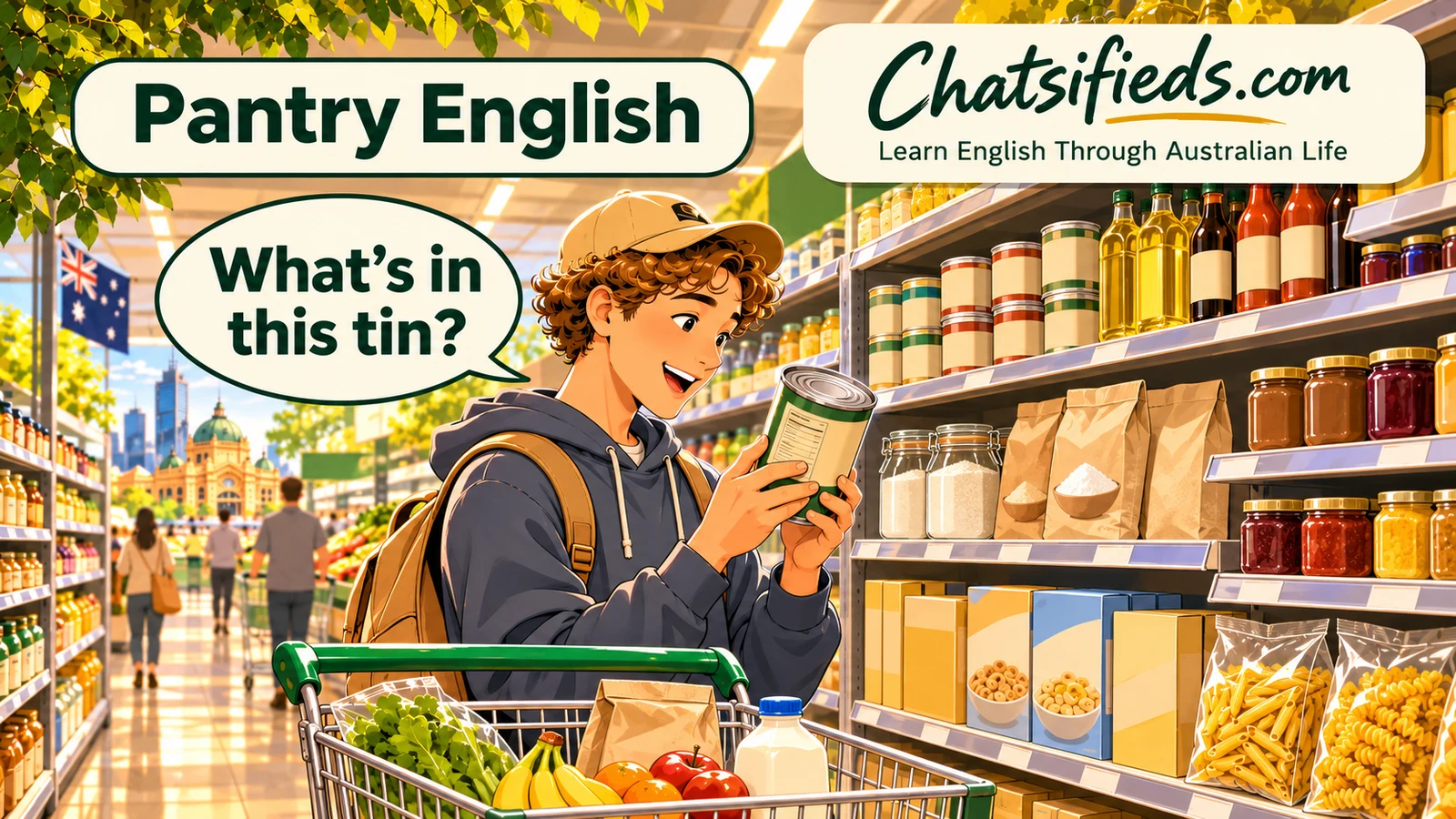
The pantry aisles hold the foods you use every week: flour, oil, sauces, spreads and tins. If you know the names, you can shop quickly and follow recipes with confidence.
Published 18/11/2026 · Educational guide · About 25 minutes
What you need to know
Learn the groups first: baking, oils and vinegar, sauces and condiments, spreads, tinned food and dry goods. Then ask short questions like "Where is the self-raising flour?" and "What is the difference between plain and self-raising flour?"
The pantry in groups
Supermarkets group pantry food by type. The baking section has flour, sugar, baking powder, bicarb soda and vanilla. The oils and vinegar section has olive oil, vegetable oil and different vinegars. The sauces and condiments section has tomato sauce, barbecue sauce, soy sauce, mayonnaise, mustard and sweet chilli sauce. Jams, honey, peanut butter and Vegemite are spreads. Tinned food, also called canned food, includes tomatoes, beans, tuna, chickpeas and coconut milk.
Some words are different from other countries. Tomato sauce is the Australian word for the sauce that Americans call ketchup. Icing sugar is very fine sugar for cakes, called powdered sugar in the US. Caster sugar is finer than normal white sugar. Plain flour has nothing added, while self-raising flour has a raising agent added, which helps cakes rise.
If you cannot find something, describe it and ask. "It is a white powder for baking" or "It is a sauce for sausages" is enough for a team member to help. The lesson on describing a product has more examples.
Key words and phrases
- plain flour
- Flour with nothing added.
- self-raising flour
- Flour with a raising agent added, used for cakes.
- caster sugar
- Very fine white sugar for baking.
- icing sugar
- Very fine sugar for cakes and icing.
- bicarb soda
- Bicarbonate of soda, a baking ingredient.
- tomato sauce
- A red sauce, called ketchup in some countries.
- condiment
- A sauce or spice you add to food.
- spread
- A food you put on bread or toast.
- tinned
- In a metal tin. Also called canned.
- dry goods
- Food that is not wet, such as rice and pasta.
- stock
- A liquid or cube for flavouring soups and sauces.
- vinegar
- A sour liquid used in cooking and dressings.
Dialogue: finding pantry items
You: Excuse me, where is the self-raising flour?
Team member: It is in the baking aisle, next to the plain flour.
You: What is the difference between plain and self-raising?
Team member: Self-raising has a raising agent in it, so cakes rise. Plain flour does not.
You: I see. And where are the tinned tomatoes?
Team member: They are in the tinned food aisle, near the beans.
You: Do you have a sauce for sausages? I do not know the name.
Team member: Tomato sauce? It is in the sauces section, aisle five.
You: Is tomato sauce the same as ketchup?
Team member: Yes, in Australia we say tomato sauce.
You: Great. And where can I find honey and peanut butter?
Team member: With the spreads, next to the jam.
- "Plain flour" and "self-raising flour" are different products.
- Tomato sauce is the Australian word for ketchup.
- Tinned and canned both mean food in a metal can.
- Use "What is the difference between ... and ...?" when two products look similar.
More useful phrases
- Where is the self-raising flour?
- Asks where a baking item is.Use it: When you cannot find it.
- What is the difference between plain and self-raising flour?
- Asks how two products are different.Use it: When two products look the same.
- Where are the tinned tomatoes?
- Asks where tinned food is.Use it: When you shop for a recipe.
- Is tomato sauce the same as ketchup?
- Checks a local word.Use it: When you know another name.
- Where do I find the sauces?
- Asks for the sauces section.Use it: When looking for a condiment.
- Do you have a smaller jar?
- Asks for a smaller size.Use it: When you do not need much.
- Is there a home brand one?
- Asks for the shop brand.Use it: When you want a cheaper option.
- Do you have a sugar-free one?
- Asks for a sugar-free option.Use it: For jam or sauce.
- Which one is better for baking?
- Asks for advice.Use it: When you are not sure.
- Could you show me, please?
- Asks staff to point to it.Use it: When explaining is hard.
Pantry words by group
Common names. Shops may use slightly different groups and some words differ from other countries.
| Word | What it is | Group |
|---|---|---|
| plain flour | Flour with nothing added. Used for many recipes. | Baking |
| self-raising flour | Flour with a raising agent added, so cakes rise. | Baking |
| caster sugar | Very fine white sugar. | Baking |
| icing sugar | Very fine sugar for icing and cakes. Called powdered sugar in the US. | Baking |
| brown sugar | Soft sugar with a darker colour. | Baking |
| baking powder | A powder that helps cakes rise. | Baking |
| bicarb soda | Short for bicarbonate of soda, another baking ingredient. | Baking |
| vanilla essence | A liquid that adds vanilla flavour. | Baking |
| cocoa | A dark powder for chocolate flavour. | Baking |
| olive oil | Oil from olives, for cooking and salads. | Oils and vinegar |
| vegetable oil | A plain cooking oil. | Oils and vinegar |
| vinegar | A sour liquid for cooking and dressings. | Oils and vinegar |
| tomato sauce | A red sauce, called ketchup in some countries. | Sauces |
| barbecue sauce | A sweet, smoky sauce for meat. | Sauces |
| soy sauce | A salty brown sauce from soy beans. | Sauces |
| mayonnaise | A creamy sauce for sandwiches and salads. | Sauces |
| mustard | A strong yellow or brown sauce. | Sauces |
| sweet chilli sauce | A sweet, mild-hot sauce. | Sauces |
| Worcestershire sauce | A dark, tangy sauce used in cooking. | Sauces |
| jam | A sweet fruit spread. | Spreads |
| honey | A sweet, thick spread made by bees. | Spreads |
| peanut butter | A spread made from peanuts. | Spreads |
| Vegemite | A salty spread made from yeast extract. | Spreads |
| tinned tomatoes | Tomatoes in a tin, for sauces and stews. | Tinned food |
| baked beans | Beans in a tomato sauce. | Tinned food |
| tinned tuna | Fish in a small tin. | Tinned food |
| chickpeas | Round beans, often tinned. | Tinned food |
| lentils | Small dried or tinned seeds used in soups. | Tinned food |
| coconut milk | A white liquid from coconut, for curries. | Tinned food |
| rice | A grain, usually in a packet or bag. | Dry goods |
| pasta | Dried noodles in many shapes. | Dry goods |
| instant noodles | Noodles you cook in a few minutes. | Dry goods |
| breadcrumbs | Small pieces of dry bread for coating food. | Dry goods |
| oats | Grain for porridge and muesli. | Dry goods |
| tea bags | Small bags of tea. | Tea, coffee and extras |
| instant coffee | A coffee powder you mix with hot water. | Tea, coffee and extras |
| coffee beans | Whole coffee seeds for grinding. | Tea, coffee and extras |
| stock cubes | Small cubes that add flavour to soups. | Tea, coffee and extras |
| gravy | A sauce for meat, often made from a powder. | Tea, coffee and extras |
Say it aloud: asking for a pantry item
Saying a sentence out loud before you need it makes real conversations easier. Accents differ, so aim to be clear, not perfect.
- Slow. Read the sentence slowly, one phrase at a time.
- In full. Say: Excuse me, where is the self-raising flour? What is the difference between plain and self-raising?
- At normal speed. Say it again, as you would in a real conversation.
- Listen. Listen for the aisle name and the word "baking".
Practice 1: Role-play with a partner
Situation: You are buying ingredients for a cake and a pasta dinner. A team member is nearby.
Work with a friend, a classmate or your mirror. One person is the team member. The other is you. Read the lines, then cover the “You could say” answers and try it from memory. Swap roles.
team member: “Hi, are you finding everything okay?”
You could say:
- “Not quite. Where is the self-raising flour, please?”
- “Hi. Could you tell me where the tinned tomatoes are?”
team member: “The flour is in the baking aisle.”
You could say:
- “Thanks. What is the difference between plain and self-raising flour?”
- “Great. Do you have a home brand one?”
team member: “Self-raising has a raising agent in it. Is it for a cake?”
You could say:
- “Yes, it is. Which one is better for baking?”
- “Yes, I am making a cake. Thank you.”
team member: “Then the self-raising is the right one.”
You could say:
- “Thank you very much.”
- “Thanks. Where do I find the sauces?”
Challenge: Ask for four pantry items, including one where you have to describe the product because you do not know the name.
Practice 2: Fill the gap
Say the missing word or phrase out loud before you open the answer.
Where is the ___ flour?
Show answer
self-raising — Self-raising flour has a raising agent.
Tomato sauce is called ___ in some countries.
Show answer
ketchup — The US word for tomato sauce is ketchup.
Tinned food is also called ___ food.
Show answer
canned — Tinned and canned mean the same.
Honey and jam are ___ for bread.
Show answer
spreads — A spread goes on bread or toast.
Very fine sugar for icing is called ___ sugar.
Show answer
icing — Icing sugar is used for cakes.
Do you have a smaller ___?
Show answer
jar — A jar is a glass container.
Common mistakes and better ways to say it
Less helpful: “Where is the red sauce?”
Try instead: “Where is the tomato sauce, please?”
Use the product name when you know it.
Less helpful: “I want flour.”
Try instead: “Could I have plain flour, please? Or is self-raising better for cakes?”
There are different flours.
Less helpful: “Where is the can food?”
Try instead: “Where is the tinned food, please?”
Tinned and canned are both fine, but "tinned" is common in Australia.
Less helpful: “Is this good?”
Try instead: “Which one is better for baking?”
A clearer question gets a better answer.
Culture note: home brand and big shops
Many Australian shoppers buy home brand products for everyday pantry food. They are often cheaper and made to meet the same labelling rules as other products. Ask a team member if you are not sure.
Pantry food is often bought in a big shop once a week or fortnight. A shopping list helps you remember what is missing from your cupboard.
Real-life mission
Practise pantry words in the aisles.
You do not need to buy anything. Reading labels is good practice.
Phrase Wall practice: phrases to own
Open a phrase to see it on the Phrase Wall, practise it, and save it to My Learning.
- “Where is the self-raising flour?”Asks where a baking item is.
- “What is the difference between plain and self-raising flour?”Asks how two flours are different.
- “Is tomato sauce the same as ketchup?”Checks the Australian word for a sauce.
- “Where are the tinned tomatoes?”Asks where a tinned food is.
- “Which one is better for baking?”Asks for advice on a baking product.