
Australian Supermarket English · Culture & slang · Level: Intermediate
Iconic Australian Pantry Products: Names and How to Say Them
Some foods appear again and again in Australian conversation, school lunches and jokes. If you know their names and how to say them, shopping chat becomes easier and friendlier.
Published 18/11/2026 · Educational guide · About 20 minutes
What you need to know
Learn a few famous pantry foods, such as Vegemite, Milo and Weet-Bix, and practise tricky words like zucchini, capsicum and Worcestershire. If you are unsure how to say a word, ask: "How do you say this word?"
Famous foods and everyday words
Vegemite is a spread made from brewer's yeast. A chemist invented it in Melbourne in 1923. It became popular during the Second World War, when a British spread called Marmite was hard to get. Many people spread it thinly on toast. It has a strong, salty taste, so people often say it is an acquired taste.
Milo is a chocolate malt drink powder, developed in 1934 as a tonic for children. Weet-Bix is a wheat breakfast cereal. Arnott's is a well-known biscuit maker, and biscuits are often called "bikkies". Other classics include chocolate crackles, a no-bake treat often made for children's parties, and lamingtons, which are sponge cake squares coated in chocolate and coconut.
Some supermarket words are hard to say. Many people say "avo" for avocado, "brekkie" for breakfast and "Woolies" for Woolworths. Learn the strong syllable of each word, written in capital letters in the table below. If you are not sure, ask someone to say it slowly. People are usually happy to help.
Key words and phrases
- spread
- Something you put on bread or toast.
- yeast extract
- A salty paste made from yeast, used in some spreads.
- acquired taste
- A taste you may need time to enjoy.
- cereal
- A breakfast food made from grain.
- bikkie
- A casual word for biscuit.
- pantry staple
- A food many people keep at home.
- strong syllable
- The part of a word you say with the most force.
- respelling
- Spelling a word the way it sounds.
- say it slowly
- Speak at a slower speed.
- chocolate crackle
- A no-bake chocolate and coconut treat, often made for parties.
Dialogue: learning the names in the aisle
You: Excuse me, what is this jar? I see it everywhere.
Friend: That is Vegemite. It is a spread made from yeast. People put it on toast.
You: How do you say it? Vegemite?
Friend: Close. It is VEJ-ih-mite. Try it again.
You: VEJ-ih-mite. Is it sweet?
Friend: No, it is salty. Most people spread it very thinly.
You: What about this one? Milo?
Friend: Yes, MY-low. It is a chocolate malt powder that you mix with milk.
You: And how do you say this vegetable? Zucchini?
Friend: ZOO-KEE-nee. The strong part is KEE.
You: Could you say that again, slowly?
Friend: Sure. Zoo. KEE. nee.
You: Thanks. That helps a lot.
- The capital letters show the strong syllable, for example ZOO-KEE-nee.
- Australians often shorten words: avo (avocado), brekkie (breakfast), bikkie (biscuit).
- "Could you say that again, slowly?" is a useful polite request.
- Accents differ, so you may hear small differences.
More useful phrases
- How do you say this word?
- Asks for the pronunciation of a word.Use it: When you see a new word.
- Could you say that again, slowly?
- Asks someone to repeat more slowly.Use it: When you did not catch a word.
- How do you spell that?
- Asks for the spelling.Use it: When you want to write it down.
- What is that, exactly?
- Asks what a food is.Use it: When you see something new.
- Is it sweet or salty?
- Asks about the taste.Use it: Before you buy something new.
- How do people usually eat it?
- Asks how a food is eaten.Use it: When you do not know how to use it.
- Is it a spread or a sauce?
- Asks what type of food it is.Use it: When you cannot tell from the jar.
- Where do I find it in the shop?
- Asks where to look.Use it: When you cannot find a product.
- Which one is a good one to try first?
- Asks for a suggestion.Use it: When you want to try something new.
Words and how to say them
The capital letters show the strong syllable. These are simple learner respellings, and accents differ.
| Word | How to say it | What it is |
|---|---|---|
| zucchini | ZOO-KEE-nee | A green vegetable. Some countries call it courgette. |
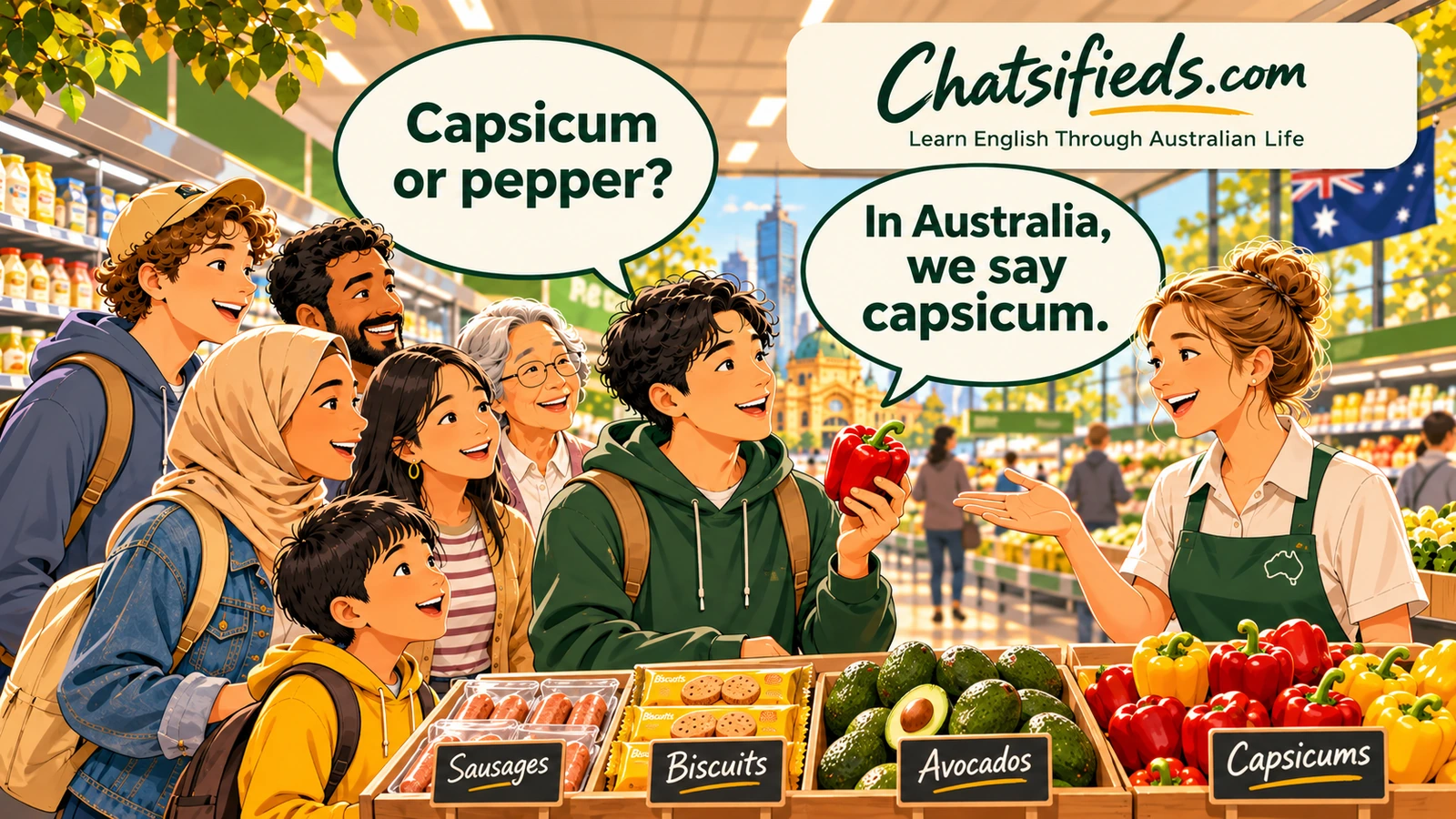
| capsicum | CAP-sih-cum | A bell pepper, red, green or yellow. |
| yoghurt | YOG-ert | A soft, creamy milk food. Some people say YOH-gurt. |
| avocado / avo | av-oh-KAH-doh / AV-oh | A green fruit with a large seed. Often called "avo". |
| Worcestershire sauce | WUS-ter-sher | A dark, tangy sauce used in cooking. |
| Woolies | WOOL-eez | A nickname for Woolworths. |
| bikkie / brekkie | BIK-ee / BREK-ee | Casual words for biscuit and breakfast. |
| Vegemite | VEJ-ih-mite | A salty spread made from yeast extract. |
| Milo | MY-low | A chocolate malt drink powder. |
Say it aloud: asking how to say a word
Saying a sentence out loud before you need it makes real conversations easier. Accents differ, so aim to be clear, not perfect.
- Slow. Read the sentence slowly, one phrase at a time.
- In full. Say: How do you say this word? Could you say it slowly?
- At normal speed. Say it again, as you would in a real conversation.
- Listen. Listen for the strong syllable when the person says the word slowly.
Practice 1: Role-play with a partner
Situation: You are shopping with a friend and you see a food you do not know.
Work with a friend, a classmate or your mirror. One person is the friend. The other is you. Read the lines, then cover the “You could say” answers and try it from memory. Swap roles.
friend: “What are you looking at?”
You could say:
- “What is that, exactly?”
- “How do you say this word?”
friend: “That is Vegemite. It is a salty spread.”
You could say:
- “How do people usually eat it?”
- “Could you say that again, slowly?”
friend: “Most people put a thin layer on toast.”
You could say:
- “Is it sweet or salty?”
- “Which one is a good one to try first?”
friend: “Try a small amount first.”
You could say:
- “Good idea, thanks.”
- “Where do I find it in the shop?”
Challenge: Role-play again. This time you cannot hear the word clearly. Ask: "Could you say that again, slowly?"
Practice 2: Fill the gap
Say the missing word or phrase out loud before you open the answer.
How do you ___ this word?
Show answer
say — This asks for the pronunciation.
Could you say that again, ___?
Show answer
slowly — This asks for slower speech.
Is it sweet or ___?
Show answer
salty — This asks about taste.
Vegemite is a ___ made from yeast.
Show answer
spread — A spread is put on bread or toast.
Many people say ___ for breakfast.
Show answer
brekkie — "Brekkie" is a casual word for breakfast.
The strong syllable of zucchini is ___.
Show answer
KEE — ZOO-KEE-nee has its strong syllable in the middle.
Common mistakes and better ways to say it
Less helpful: “What? I do not understand.”
Try instead: “Could you say that again, slowly?”
A polite request is easier to answer.
Less helpful: “(saying zucchini as "zoo-chi-ni" and giving up)”
Try instead: “How do you say this word?”
Asking is better than guessing. People like helping.
Less helpful: “Vegemite is disgusting.”
Try instead: “It is an acquired taste. I will try a small amount.”
A friendly comment keeps the conversation easy.
Less helpful: “(asking for "that brown thing" without a name)”
Try instead: “Do you know what this is called?”
A direct question gets the word you need.
Culture note: food, humour and sharing
Australians often tease newcomers about Vegemite, but the teasing is friendly. If you try it, use a very thin layer. If you do not like it, say "It is an acquired taste" and smile.
Shortened words like "avo" and "brekkie" are common in speech and casual writing. You do not need to use them, but you will hear them often. Learn to understand them first.
Real-life mission
Practise names and pronunciation in a real shop.
You do not need to buy anything. Looking and saying the words is good practice.
Phrase Wall practice: phrases to own
Open a phrase to see it on the Phrase Wall, practise it, and save it to My Learning.
- “How do you say this word?”Asks someone to say a word so you can hear it.
- “Could you say that again, slowly?”Asks someone to repeat more slowly.
- “How do people usually eat it?”Asks how a food is normally eaten.
- “Is it sweet or salty?”Asks about the taste of a food.