
Australian Supermarket English · Labels, dates & dietary needs · Level: Beginner to intermediate
Reading Food Labels: Ingredients and Nutrition
Food labels are full of small words that matter: ingredients, serving, per 100 g, contains. This lesson helps you read the main parts of an Australian label and ask a simple question when you are not sure.
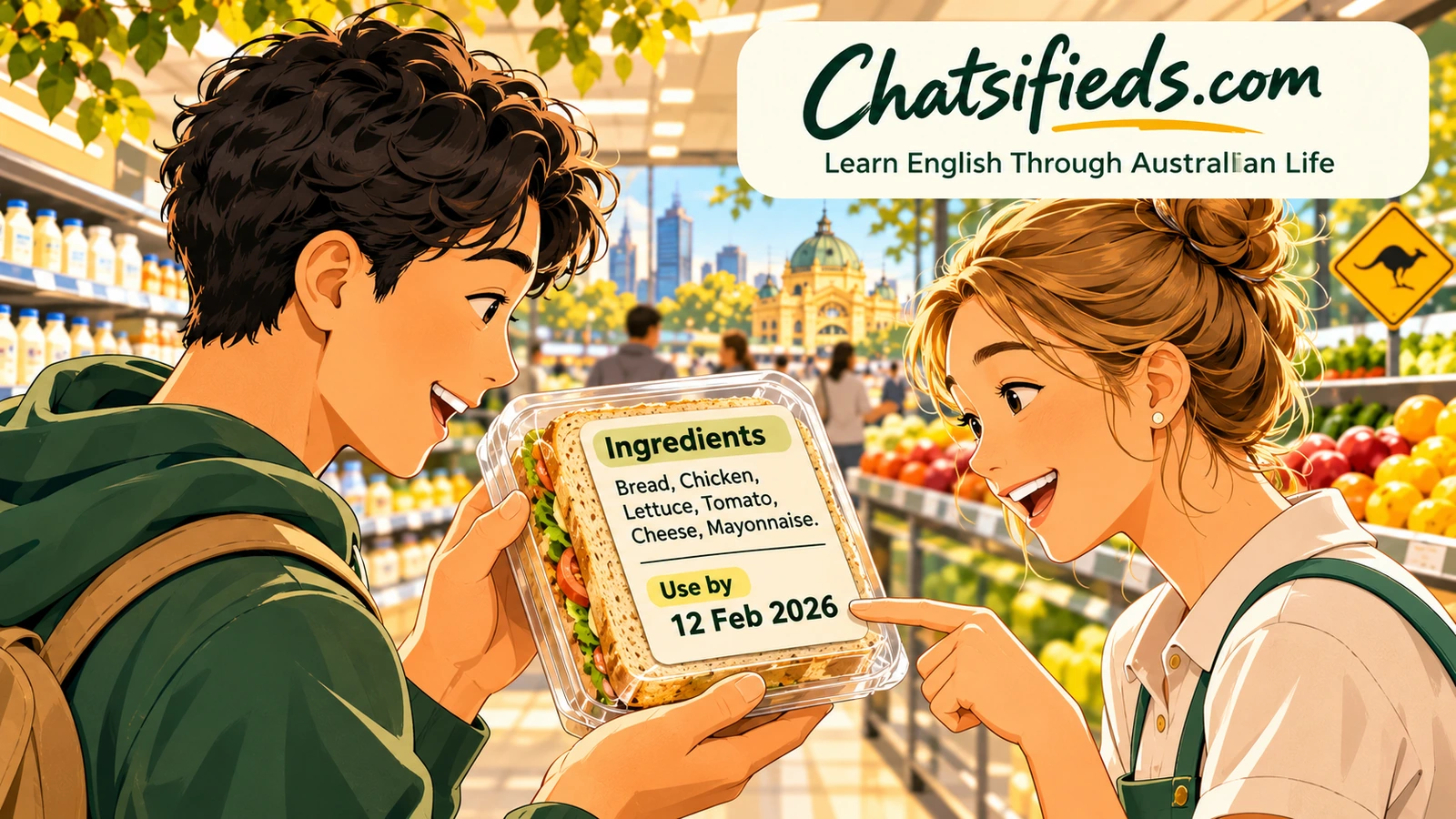
Published 18/11/2026 · Educational guide · About 20 minutes
What you need to know
On an Australian food label, look for the ingredients list (the biggest ingredient is listed first), the allergen information (for example "Contains: milk, soy"), and the nutrition information panel, which shows the amount per serving and per 100 g. If you are unsure, ask staff: "Could you help me read this label?"
The main parts of a food label
Queensland Health explains that a food label shows the name of the food, the ingredients, important allergen information and a nutrition information panel. The label also shows a date mark and the business details. Not every part is in the same place, so look at the front, back and sides of the pack.
The ingredients list shows what the food is made of. Ingredients are listed by weight, from the largest amount to the smallest. If sugar is first, there is more sugar than any other ingredient. This is a useful way to compare similar products.
Allergen information is important. Common allergens such as milk, egg, peanuts, tree nuts, wheat, soy, fish and shellfish must be declared. You often see a short line such as "Contains: milk, soy" near the ingredients. If you have a food allergy, always read the label carefully and ask a health professional about what is safe for you.
The nutrition information panel is usually a small table. It shows the amount of energy, protein, fat, sugars and sodium (salt) per serving and per 100 g. The "per 100 g" column helps you compare different brands fairly.
Key words and phrases
- label
- The information printed on the pack.
- ingredients
- The things a food is made from.
- allergen
- Something that can cause an allergic reaction.
- contains
- Has in it. "Contains: milk" means the product has milk.
- nutrition information panel
- The table that shows energy, fat, sugar, salt and more.
- serving
- One portion of the food.
- per 100 g
- For every 100 grams. Useful for comparing products.
- sugars
- The total sugar in the food, including natural and added sugar.
- sodium
- The part of salt that the table measures.
- preservative
- An ingredient added to help food last longer.
Dialogue: asking for help to read a label
You: Excuse me, could you help me read this label?
Staff member: Sure. What would you like to know?
You: I'd like to know if this has any milk.
Staff member: Let's have a look. Down here it says "Contains: milk, soy".
You: So it has milk. Thanks.
Staff member: Yes. If you need to avoid milk, you could try the soy version over here.
You: Is the sugar high in this one?
Staff member: Check the nutrition panel. Look at the column that says per 100 grams.
You: I see it. It says twelve grams of sugars per 100 grams.
Staff member: That's right. You can compare it with another brand.
You: Great idea. Thanks for your help.
Staff member: No worries. Have a good one.
- "Contains: milk, soy" is the line to look for if you need to avoid an allergen.
- "Per 100 grams" makes comparing two brands fair, because pack sizes differ.
- "Could you help me read this label?" is a polite way to ask for help.
- Staff can help you find the label information, but for health questions you should also ask a doctor or dietitian.
More useful phrases
- Could you help me read this label?
- Asks staff to help you understand the label.Use it: When the words are hard.
- Does this contain milk?
- Asks if milk is an ingredient.Use it: When you avoid milk.
- Where is the ingredients list?
- Asks where to find the list.Use it: When you cannot find it on the pack.
- What does per 100 grams mean?
- Asks about the label unit.Use it: When you see the nutrition panel.
- Is there added sugar in this?
- Asks if sugar was added.Use it: When comparing foods.
- Is this high in salt?
- Asks about the salt level.Use it: When you want to watch your salt.
- Which one has less sugar?
- Asks for a comparison.Use it: At a shelf with similar products.
- Could you check for me?
- Asks staff to look something up.Use it: When the label does not tell you.
Parts of a label at a glance
Where to look and what to say about each part.
| Label part | What it shows | Useful question |
|---|---|---|
| Ingredients list | What is in the food, largest first | "Where is the ingredients list?" |
| Allergen line | Allergens, such as "Contains: milk" | "Does this contain milk?" |
| Nutrition panel | Energy, fat, sugars, salt per serving and per 100 g | "What does per 100 grams mean?" |
| Serving size | The amount counted as one portion | "How big is one serving?" |
| Date mark | Use-by or best-before date | "What's the date on this?" |
| Business details | Who made or packed the food | "Who makes this?" |
Always read the full label. If you have a health condition or allergy, ask a health professional what is safe for you.
Say it aloud: asking about an allergen
Saying a sentence out loud before you need it makes real conversations easier. Accents differ, so aim to be clear, not perfect.
- Slow. Read the sentence slowly, one phrase at a time.
- In full. Say: Does this contain milk?
- At normal speed. Say it again, as you would in a real conversation.
- Listen. Listen for "contains", "may contain" and "doesn't contain". Ask staff to repeat if you are not sure.
Practice 1: Role-play with a partner
Situation: You are comparing two breakfast cereals. You want a lower-sugar option and you avoid milk.
Work with a friend, a classmate or your mirror. One person is the staff member. The other is the customer. Read the lines, then cover the “You could say” answers and try it from memory. Swap roles.
staff member: “Hi there. Can I help you with anything?”
You could say:
- “Yes, please. Could you help me read this label?”
- “Yes. I'm trying to check the sugar in this cereal.”
staff member: “Sure. Look at the nutrition panel. The column per 100 grams is the best for comparing.”
You could say:
- “Thanks. Which one has less sugar?”
- “I see it. This one has twelve grams. And the other?”
staff member: “The other one has eight grams of sugars per 100 grams.”
You could say:
- “Great, thank you. I'll take the second one.”
- “That's helpful. Is the second one lower in salt too?”
staff member: “Check the ingredients if you avoid milk. Look for the line that says "Contains".”
You could say:
- “Does this one contain milk?”
- “Where is the allergen line?”
Challenge: Pick any food in your kitchen. Find the ingredients list and the nutrition panel. Say one sentence about each.
Practice 2: Fill the gap
Say the missing word or phrase out loud before you open the answer.
Could you help me read this ___?
Show answer
label — The label is the printed information on the pack.
Ingredients are listed from the ___ amount to the smallest.
Show answer
largest — The biggest ingredient is listed first.
Contains: milk, ___.
Show answer
soy — The allergen line lists allergens.
Look at the column per 100 ___.
Show answer
grams — Per 100 grams helps you compare brands.
Does this ___ milk?
Show answer
contain — "Contain" means have inside.
Which one has less ___?
Show answer
sugar — A useful question for comparing foods.
Common mistakes and better ways to say it
Less helpful: “Is this safe?”
Try instead: “Does this contain milk?”
A specific question gets a useful answer.
Less helpful: “What is this table?”
Try instead: “What does per 100 grams mean?”
Ask about the exact words you do not know.
Less helpful: “Read it for me.”
Try instead: “Could you help me read this label?”
A polite request sounds friendly.
Less helpful: “(only reading the front of the pack)”
Try instead: “Check the back for the ingredients and allergen line.”
Important information is often on the back or the side.
Culture note: compare, do not guess
Many Australians compare labels to choose food. The per 100 g column is a simple way to compare two products with different pack sizes. If you are not sure, ask a staff member.
Staff can help you find information, but they are not health professionals. For allergies or medical needs, read the whole label and ask a doctor, dietitian or the manufacturer if you are still unsure.
Real-life mission
On your next shop, practise reading labels. Tick each one when you have done it.
Do not rush. Reading labels is a skill that gets faster with practice.
Phrase Wall practice: phrases to own
Open a phrase to see it on the Phrase Wall, practise it, and save it to My Learning.
- “Could you help me read this label?”Politely ask staff to help you understand a label.
- “Does this contain milk?”Ask whether a food has milk in it.
- “Which one has less sugar?”Ask for a comparison between two products.
- “What does per 100 grams mean?”Ask about a unit on a nutrition panel.