Australian Supermarket English · Labels, dates & dietary needs · Level: Beginner to intermediate
Use-by vs Best-before: Date Labels Explained
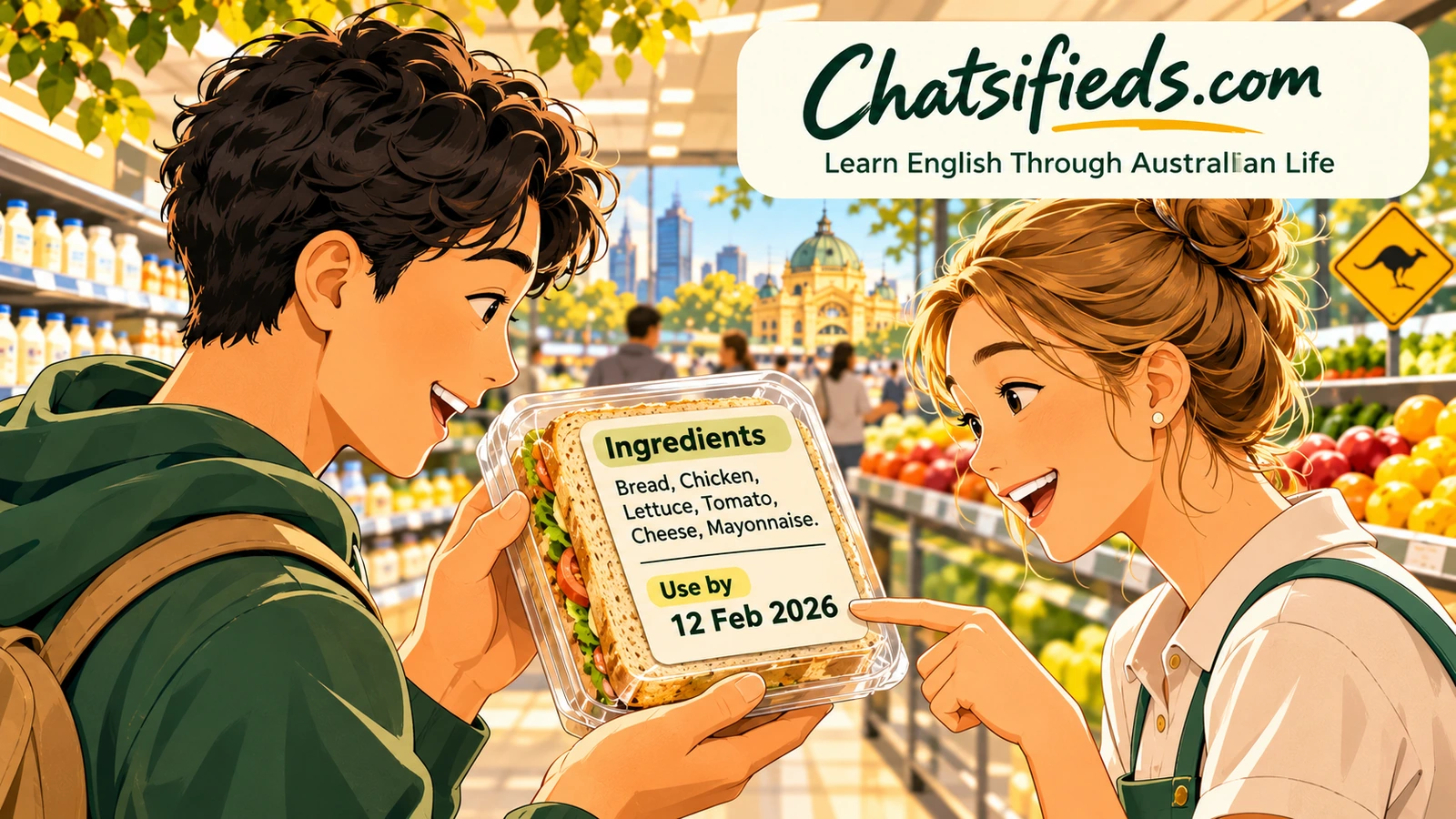
Two small words on a label, "use by" and "best before", mean very different things. One is about safety. The other is about quality. Learn which is which, and how to talk about dates with staff.
Published 18/11/2026 · Educational guide · About 18 minutes
What you need to know
A use-by date is about health and safety: you should not eat the food after that date, and shops cannot sell it after that date. A best-before date is about quality: the food is generally still safe for a while after the date, though it may have lost some quality, and it can be sold after the date if it is still fit to eat.
Two dates, two meanings
Food Standards Australia New Zealand explains that use-by dates apply to foods that must be eaten before a set time for health or safety reasons. Its page says foods should not be eaten after the use-by date, and suppliers cannot sell them after that date because they may be a health or safety risk.
Best-before dates apply to most foods. The same page says the food is generally still safe for a while after the date, although it may have lost some quality. These foods can be sold after the date if they are still fit for people to eat.
There are a few extra details. Bread that lasts less than seven days may carry a baked-on or baked-for date instead. Foods that last two years or more, such as some canned goods, do not need a best-before date. If a product needs special storage to last until its date, the label must say so, for example "keep refrigerated".
For learners, the practical rule is simple: look for the words. "Use by" means check carefully before you buy or eat. "Best before" means quality, so look at the food and use your common sense.
Key words and phrases
- use-by date
- The last day the food is safe to eat. Do not eat it after this date.
- best-before date
- The day until which the food is at its best quality. It may still be safe after.
- expiry date
- A general word for the end date. On Australian labels you will mostly see use by or best before.
- date mark
- The date printed on the package.
- shelf life
- How long a food lasts before it is no longer good.
- fit to eat
- Safe and in good enough condition to eat.
- baked-on date
- A date for fresh bread that shows when it was baked.
- refrigerated
- Kept cold in a fridge.
- stock
- The products a shop has for sale.
- off
- Spoiled. People say "This milk is off" when it smells or tastes bad.
Dialogue: checking a date at the shelf
You: Excuse me, could you help me with something?
Staff member: Sure. What's up?
You: This chicken has a use-by date of today. Is it okay to buy?
Staff member: You can buy it, but you'd need to cook it or freeze it today.
You: Is there one with a later date?
Staff member: Let me check the fridge. ... Yep, these ones are use by Thursday.
You: Great, thanks. And what about this yoghurt? It says best before.
Staff member: That one's about quality. It's the last day it's at its best.
You: So it's okay if it's a day or two after?
Staff member: Generally, if it's been kept cold and it looks and smells fine. Check the label for storage tips.
You: Okay, that makes sense. Thanks for explaining.
Staff member: No worries. Have a good one.
- "What's up?" is a casual way to ask what the problem is.
- "Use by Thursday" is a short way to say the use-by date is Thursday.
- "Yep" is informal for "yes". You will hear it often.
- The staff member gives general advice and tells you to check the label. That is a good habit.
More useful phrases
- What's the use-by date on this?
- Asks about the last safe day for a food.Use it: When the date is hard to read.
- Is there one with a later date?
- Asks for a product with a longer time left.Use it: At the fridge or shelf.
- Is this still okay to eat?
- Asks whether food is safe or good.Use it: When you are not sure about a food at home or in the shop.
- Does best before mean it's unsafe after that day?
- Asks about the meaning of a date mark.Use it: When you are learning the labels.
- It's use by today.
- Says the last day for the food is today.Use it: To explain why you are asking.
- Could you check the back for a fresher one?
- Asks staff to look in the storeroom for newer stock.Use it: When all the shelf items are close to the date.
- This one's past its date.
- Tells staff that a product is after its date.Use it: When you spot an old product on the shelf.
- How should I store this?
- Asks how to keep the food so it lasts.Use it: After you buy fresh food.
Use-by and best-before at a glance
Compare the two date marks.
| Question | Use by | Best before |
|---|---|---|
| What is it about? | Health and safety. | Quality. |
| Can you eat it after the date? | No, you should not. | Often still safe for a while, but quality may drop. |
| Can a shop sell it after the date? | No. | Yes, if it is still fit to eat. |
| Where do you see it? | Foods that go off quickly, such as some fresh meat. | Most other packaged food. |
| What should you do? | Cook, freeze or finish it before the date. | Look, smell and use common sense. |
Always check the label for storage instructions such as keep refrigerated.
Say it aloud: asking about a date
Saying a sentence out loud before you need it makes real conversations easier. Accents differ, so aim to be clear, not perfect.
- Slow. Read the sentence slowly, one phrase at a time.
- In full. Say: Is there one with a later use-by date?
- At normal speed. Say it again, as you would in a real conversation.
- Listen. Listen for the day the staff member says, such as Thursday, and for "use by" or "best before".
Practice 1: Role-play with a partner
Situation: You are at the meat fridge. The packet you want has a use-by date of today and you want to cook it in two days.
Work with a friend, a classmate or your mirror. One person is the staff member. The other is the customer. Read the lines, then cover the “You could say” answers and try it from memory. Swap roles.
staff member: “Hi there. Looking for something in particular?”
You could say:
- “Yes, please. This one's use by today. Is there one with a later date?”
- “Hi. I'd like something with a later use-by date, please.”
staff member: “Let me check out the back. ... These ones are use by Friday.”
You could say:
- “Friday is perfect. Thank you.”
- “Great. Could I have two of those?”
staff member: “Sure. Anything else I can help with?”
You could say:
- “Yes, what does best before mean on the yoghurt?”
- “No, that's all. Thanks very much.”
staff member: “Best before is about quality. Use by is about safety.”
You could say:
- “That's really helpful, thank you.”
- “Okay, so I should be more careful with use by.”
Challenge: Pick a food from your own kitchen. Read its date out loud and say whether it is use by or best before.
Practice 2: Fill the gap
Say the missing word or phrase out loud before you open the answer.
A ___ date is about food safety.
Show answer
use-by — Do not eat the food after this date.
A ___ date is mainly about quality.
Show answer
best-before — The food may be safe for a while after, but not at its best.
Is there one with a ___ date? (a date further in the future)
Show answer
later — "Later" means further away from today.
Could you check the ___ for a fresher one? (the storeroom)
Show answer
back — "The back" or "out the back" means the storeroom.
This milk smells bad. I think it's ___.
Show answer
off — "Off" means spoiled.
Keep it ___ after you open it. (in the fridge)
Show answer
refrigerated — Labels often say "keep refrigerated".
Common mistakes and better ways to say it
Less helpful: “This food is expired, give me money.”
Try instead: “Excuse me, this one is past its use-by date. Could you check it?”
Calm, polite wording gets help faster.
Less helpful: “Best before means it is poison after that.”
Try instead: “Best before is about quality. Use by is about safety.”
The two dates have different meanings.
Less helpful: “What day this finish?”
Try instead: “What's the use-by date on this?”
A full question is clearer and sounds natural.
Less helpful: “Is it fresh?”
Try instead: “Is there one with a later date?”
A specific question about the date is easier to answer.
Culture note: use your eyes, nose and the label
In Australia you will often see staff and shoppers checking dates on meat, milk and ready meals. Looking carefully at a date is normal and nobody will think it is rude.
If you are unsure about food you already own, the label and common sense matter. Use-by food should not be eaten after the date. For best-before food, look and smell it and check how it was stored.
Real-life mission
At your next shop, practise reading dates in English. Tick each one when done.
If you are not sure whether a food is safe, do not eat it. Ask the store or look for official advice.
Phrase Wall practice: phrases to own
Open a phrase to see it on the Phrase Wall, practise it, and save it to My Learning.
- “Is there one with a later date?”Ask for a product with a longer time before its date.
- “What's the use-by date on this?”Ask when the food is no longer safe to eat.
- “This one's past its date.”Tell staff a product is older than its date mark.
- “How should I store this?”Ask how to keep a food so it lasts.