
Australian Supermarket English · Working in a supermarket · Level: Intermediate
Stocking Shelves and Price Checks: Supermarket Work English
Stocking shelves and checking prices are common supermarket jobs. The English for them is short and practical. This lesson helps you understand instructions, ask questions and talk to customers while you work.
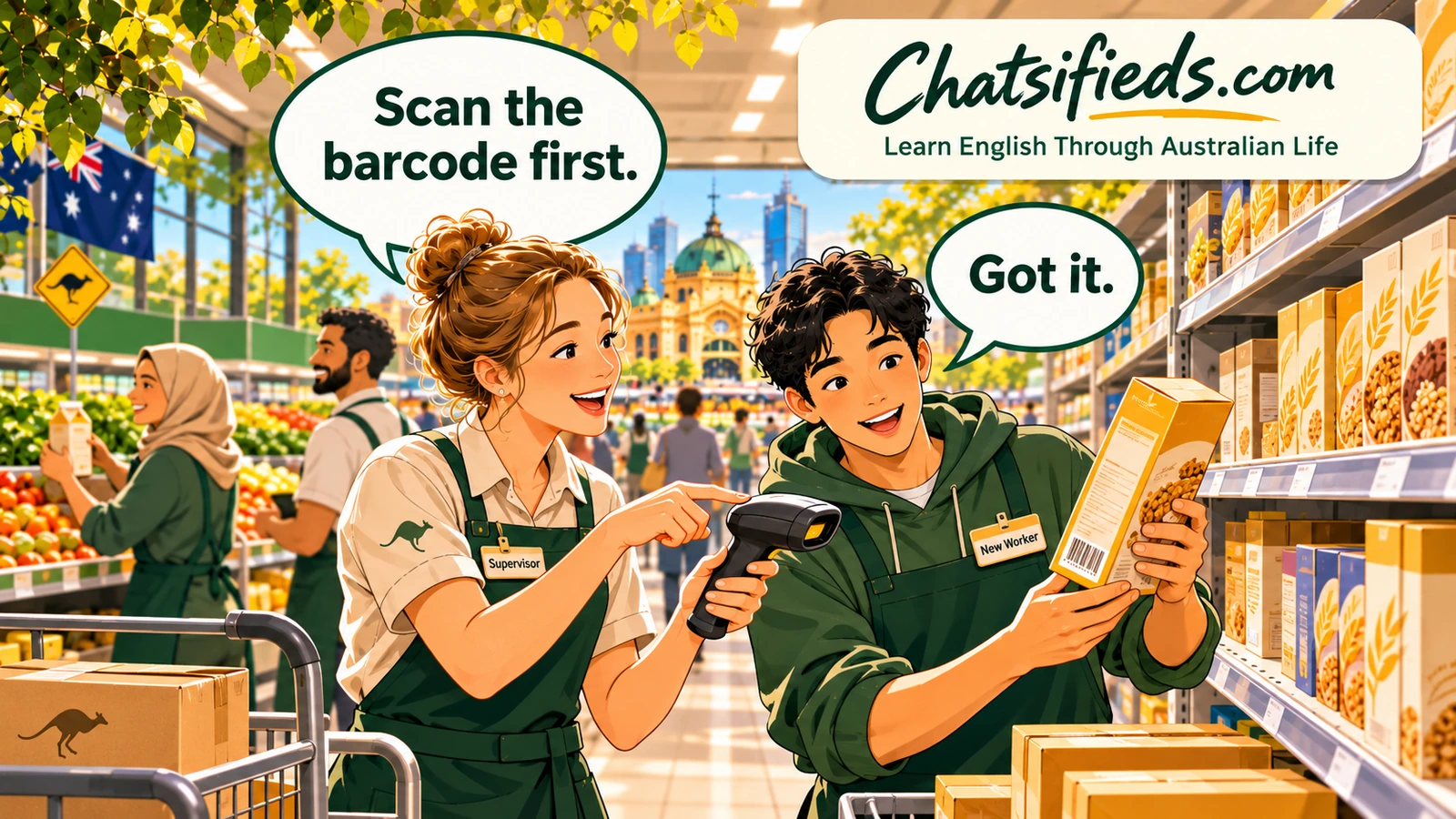
Published 18/11/2026 · Educational guide · About 20 minutes
What you need to know
Common tasks include stocking (filling shelves), facing (pulling products forward), rotating (putting older stock at the front) and price checks. Say 'Could you show me?' and 'Sorry, how do I do a price check?' when you need help.
What stocking and price checks involve
Stocking means moving products from storage, often called 'out the back', to the shelf. You may use a trolley or pallet jack. Staff usually put older products at the front and newer ones behind them. This is often called rotating stock.
Facing means pulling products to the front edge of the shelf so the shelf looks neat. Customers sometimes ask staff to check a price. A price check means finding the right price for a product, for example by scanning it or looking at the shelf label.
Supermarkets use shelf labels with the product price and often a unit price. Staff learn how to read them. Ask a supervisor how your store does price checks, because systems differ between stores.
Key words and phrases
- stock
- The products a shop has to sell.
- restock
- To fill a shelf again.
- face up
- To pull products to the front of the shelf so it looks neat.
- rotate stock
- To put older products at the front and newer ones behind.
- pallet
- A wooden platform that holds many boxes.
- out the back
- The storeroom behind the shop.
- price check
- Checking the correct price of an item.
- shelf label
- The label on the shelf showing the price.
- carton
- A cardboard box that holds products.
- spill
- Liquid or food on the floor that needs cleaning.
Dialogue: stocking and a customer's price check
Supervisor: Can you restock the pasta in aisle six, please?
You: Sure. Where's the pasta stock?
Supervisor: Out the back, on the second pallet.
You: Got it. Should the older boxes go at the front?
Supervisor: Yes, older stock to the front, new stock behind.
Customer: Excuse me, could you check the price of this pasta for me?
You: Of course. Let me check the shelf label.
You: It's on special today, four dollars.
Customer: Thanks. It said five dollars on the website.
You: Sorry about that. I'll ask my supervisor to double-check.
Supervisor: Thanks for letting me know. I'll look into it.
You: No worries. I'll get back to the pasta.
- 'Out the back' means the storeroom. It is very common in shops.
- The learner is honest and says 'I'll ask my supervisor', which is the right thing to do when unsure.
- 'Let me check' is a useful phrase for helping a customer.
- If a spill happens, tell a supervisor or follow your store's safety rules.
More useful phrases
- Where's the stock for ___?
- Asks where the products are stored.Use it: Before restocking a shelf.
- Should the older stock go at the front?
- Checks stock rotation.Use it: When you restock.
- Let me check that for you.
- Offers to look something up for a customer.Use it: When a customer asks about a price.
- Sorry, how do I do a price check?
- Asks how to check a price.Use it: With a supervisor.
- I'll ask my supervisor.
- Says you will get help.Use it: When you are not sure.
- Could you show me how to use this?
- Asks for a demonstration of equipment.Use it: With a pallet jack or scanner.
- There's a spill in aisle ___.
- Reports a spill.Use it: When you see liquid on the floor.
- I'll finish this aisle, then check back.
- Says what you will do next.Use it: When a customer or supervisor asks.
Stocking tasks and the English for them
Short phrases for common tasks.
| Task | What it means | What you can say |
|---|---|---|
| Restock | Fill the shelf again. | "I'll restock the pasta." |
| Face up | Pull products forward. | "I'll face up this shelf." |
| Rotate stock | Older at the front. | "Should older stock go at the front?" |
| Price check | Check the right price. | "Let me check the price." |
| Spill | Liquid on the floor. | "There's a spill in aisle six." |
| Ask for help | Get a supervisor. | "I'll ask my supervisor." |
Systems and safety rules differ between stores. Ask what your store expects.
Say it aloud: helping with a price
Saying a sentence out loud before you need it makes real conversations easier. Accents differ, so aim to be clear, not perfect.
- Slow. Read the sentence slowly, one phrase at a time.
- In full. Say: Let me check that for you.
- At normal speed. Say it again, as you would in a real conversation.
- Listen. Listen for the customer's reply, such as 'Thanks' or 'No worries'.
Practice 1: Role-play with a partner
Situation: You are stocking shelves when a customer asks you to check the price of a product.
Work with a friend, a classmate or your mirror. One person is the customer. The other is the supermarket worker. Read the lines, then cover the “You could say” answers and try it from memory. Swap roles.
customer: “Excuse me, could you check the price of this pasta?”
You could say:
- “Of course. Let me check the shelf label.”
- “Sure, let me check that for you.”
customer: “It says five dollars, but the shelf says four.”
You could say:
- “Sorry about that. I'll ask my supervisor.”
- “Thanks for telling me. Could you wait a moment while I check?”
customer: “Sure, no worries.”
You could say:
- “Thanks for waiting. The shelf label says four dollars.”
- “I've spoken to my supervisor and they'll sort it out at the checkout.”
customer: “Great, thanks. Where's the sauce, by the way?”
You could say:
- “It's in aisle seven, on the left.”
- “Let me show you. Follow me.”
Challenge: Swap roles. As the worker, explain what 'facing up' a shelf means to a new colleague.
Practice 2: Fill the gap
Say the missing word or phrase out loud before you open the answer.
Where's the ___ for the pasta? (the products in storage)
Show answer
stock — Stock means the products a shop has.
Should the ___ boxes go at the front?
Show answer
older — Older stock goes in front.
Let me ___ that for you.
Show answer
check — A helpful phrase for customers.
I'll ask my ___.
Show answer
supervisor — Get help when unsure.
There's a ___ in aisle six.
Show answer
spill — Report spills quickly.
I'll ___ up this shelf.
Show answer
face — Face up means pull products forward.
Common mistakes and better ways to say it
Less helpful: “I don't know the price.”
Try instead: “Let me check that for you.”
Offer to help instead of stopping.
Less helpful: “(guessing a price)”
Try instead: “I'll check the shelf label.”
Guessing can cause mistakes.
Less helpful: “(ignoring a spill)”
Try instead: “There's a spill in aisle six.”
Tell someone so it is fixed quickly.
Less helpful: “I can't do this.”
Try instead: “Could you show me how to do this?”
Asking for help sounds positive.
Culture note: helpful and honest
Customers value staff who are friendly and honest. 'Let me check that for you' is more helpful than a guess, and telling a customer 'I'll ask my supervisor' is respected.
Safety matters in shops. Report spills, blocked aisles and damaged goods to a supervisor, and follow your store's safety training.
Real-life mission
Practise these phrases and watch how staff work next time you shop.
For pay, hours or rights at work, ask your employer, the Fair Work Ombudsman or your education provider.
Phrase Wall practice: phrases to own
Open a phrase to see it on the Phrase Wall, practise it, and save it to My Learning.
- “Let me check that for you.”Offer to look up information for a customer.
- “Should the older stock go at the front?”Check how to rotate stock.
- “I'll ask my supervisor.”Say you will get help when you are unsure.
- “There's a spill in aisle six.”Report a spill so it can be cleaned.