
Australian Supermarket English · Prices, specials & rewards · Level: Beginner to intermediate
Specials, Half Price and Multi-buys
Supermarkets use short, fast words on tags: half price, 2 for, member price, while stocks last. This lesson explains each one and gives you the English to ask about a deal without feeling lost.
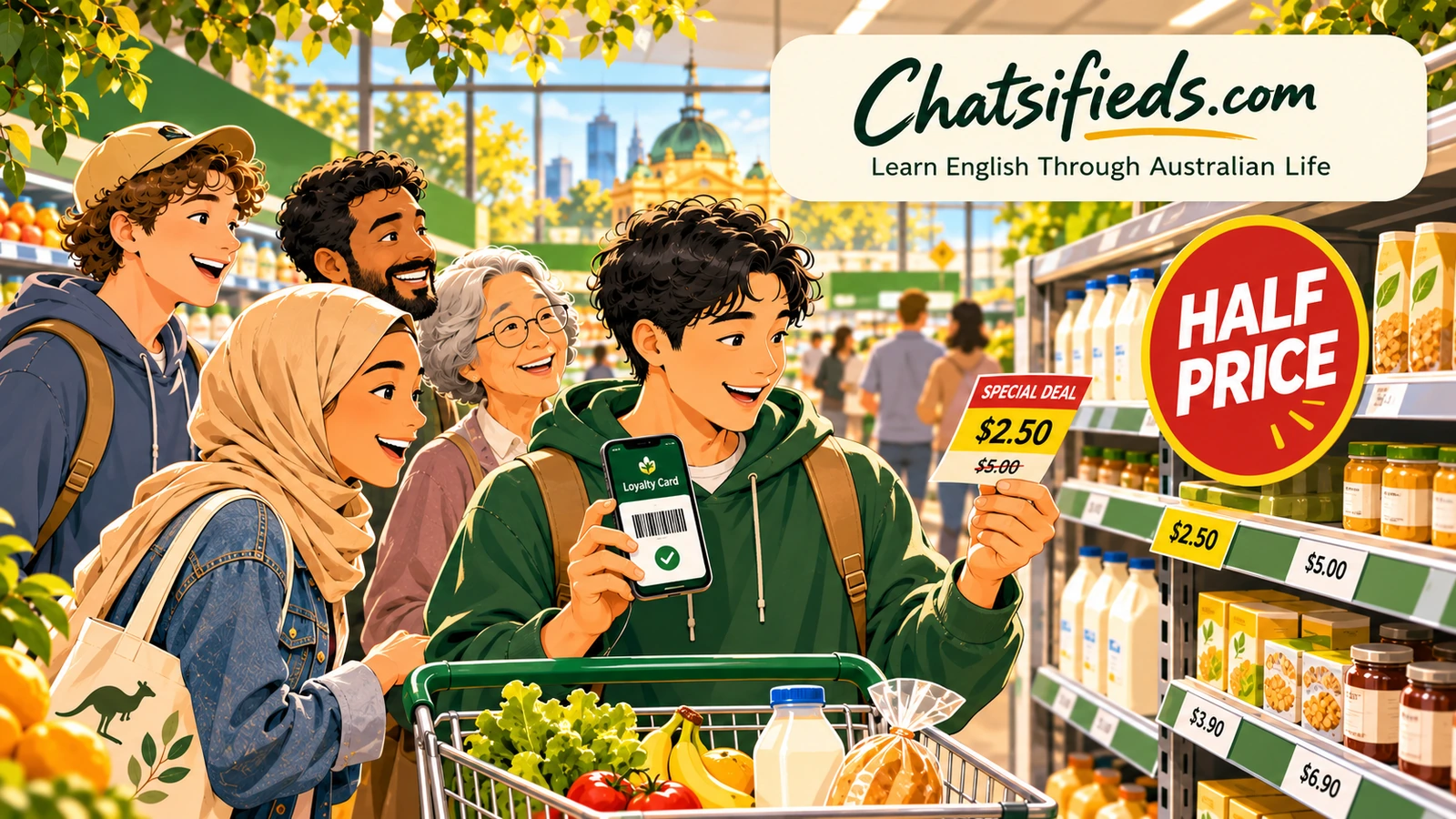
Published 18/11/2026 · Educational guide · About 20 minutes
What you need to know
A special is a lower price for a limited time. Read the tag carefully for words like half price, multi-buy (you buy two or more), limit per customer and while stocks last. Some deals need a loyalty card, so ask or check the tag. Compare unit prices as well, because a special on a small pack is not always the cheapest per kilo.
Words you will see on tags and catalogues
Specials usually appear on shelf tags, on end-of-aisle displays and in the weekly catalogue. The tag may show a price, a deal such as "2 for", or a saving such as "half price". The words are short, so it helps to know what each means before you stand in front of the shelf.
A multi-buy deal means you need to buy a set number to get the price, for example two items. A limit means each shopper can buy only a certain number. "While stocks last" means the special ends when the store runs out of the product, even if the date has not finished.
Some prices are for members only. Everyday Rewards guides and CHOICE explain that stores use member prices to encourage loyalty card use, so a price may only apply if you scan your card or app. If you are not sure, ask at the checkout before you pay.
The ACCC suggests comparing unit prices even on specials. That way you can see if a special on a small pack really is the best value, or if a bigger pack at the normal price costs less per kilo.
Key words and phrases
- special
- A lower price for a limited time.
- half price
- Fifty per cent off the normal price.
- multi-buy
- A deal where you must buy two or more items to get the price.
- 2 for
- A price for two items together, such as "2 for five dollars".
- was / now
- "Was" is the old price and "now" is the new price.
- limit
- The most you can buy at the special price, such as "limit of four".
- while stocks last
- The special ends when the store has no more.
- member price
- A price that may only apply if you use a loyalty card or app.
- catalogue
- A weekly list of specials, on paper or online.
- reduced to clear
- Marked down because the store wants to sell it soon.
- saving
- The amount of money you do not have to pay.
Dialogue: checking a special at the shelf and the checkout
Lin: Excuse me, is this one on special?
Staff member: Yes, it's two for the price on the tag. You need to buy two.
Lin: So if I buy one, it's the normal price?
Staff member: That's right. The special is only for two or more.
Lin: Thanks. Is there a limit?
Staff member: Yes, the tag says limit of four per customer.
Lin: Okay. I'll take two.
Checkout operator: Do you have a rewards card or the app?
Lin: Yes, sorry. Is that member price only for people with the card?
Checkout operator: That one is, so scan your card or app to get it.
Lin: Thanks, I'll scan it now.
Checkout operator: All good. That's your saving.
- "Is this one on special?" is a simple way to check a deal.
- A multi-buy price may only apply when you buy the full number.
- "Limit of four per customer" means each person can buy four at most.
- If you are unsure about a member price, ask the checkout operator before you pay.
More useful phrases
- Is this on special?
- Checks if the price is lower than normal.Use it: At the shelf or the checkout.
- Do I have to buy two to get that price?
- Checks if it is a multi-buy deal.Use it: When the tag says "2 for".
- Is there a limit per customer?
- Asks the most you can buy.Use it: When you want several.
- Is that price for members only?
- Checks if you need a card or app.Use it: When a tag mentions a member price.
- When does the special finish?
- Asks when the deal ends.Use it: When you want to know if you can wait.
- What does while stocks last mean?
- Asks about the end of a deal.Use it: When you see the words on a tag.
- Is that the was price or the now price?
- Checks which price you will pay.Use it: When a tag has two prices.
- Is the special cheaper per kilo?
- Compares the deal using unit price.Use it: When choosing between sizes.
Deal words and what they mean
Read the tag slowly. These words change the price you pay.
| Word or phrase | Meaning | Question you can ask |
|---|---|---|
| half price | Half the normal price | "Is it half price today only?" |
| 2 for ... | A set price for two | "Do I have to buy two?" |
| limit of ... | Maximum you can buy | "Is there a limit per customer?" |
| while stocks last | Ends when the store runs out | "Will you get more in?" |
| member price | May need a card or app | "Is that for members only?" |
| was / now | Old and new prices | "Which price will I pay?" |
| reduced to clear | Marked down to sell soon | "Is this still good to use?" |
Offers and rules change by store and by week. Read the tag or ask a staff member.
Say it aloud: checking a special
Saying a sentence out loud before you need it makes real conversations easier. Accents differ, so aim to be clear, not perfect.
- Slow. Read the sentence slowly, one phrase at a time.
- In full. Say: Sorry, do I have to buy two to get that price?
- At normal speed. Say it again, as you would in a real conversation.
- Listen. Listen for words like "two", "limit", "members" and "today only".
Practice 1: Role-play with a partner
Situation: You see a sign that says "2 for" on a packet of biscuits and you are not sure how it works.
Work with a friend, a classmate or your mirror. One person is the staff member. The other is the customer. Read the lines, then cover the “You could say” answers and try it from memory. Swap roles.
staff member: “Hi, can I help with anything?”
You could say:
- “Yes, please. Is this one on special?”
- “Yes, sorry. How does this "2 for" deal work?”
staff member: “Yes, it's two for the price on the tag. You need to buy two.”
You could say:
- “So one packet is the normal price?”
- “I see. Is there a limit?”
staff member: “Yes, one is the normal price. The limit is four per customer.”
You could say:
- “Okay. When does the special finish?”
- “Thanks. Is the price for members only?”
staff member: “It finishes on Tuesday, and you'll need your card for that price.”
You could say:
- “Great, thanks for explaining. I'll scan my card.”
- “Perfect. I'll take two, then.”
Challenge: Look at a real tag or catalogue page and ask yourself three questions out loud: how many do I have to buy, is there a limit, and is it for members only?
Practice 2: Fill the gap
Say the missing word or phrase out loud before you open the answer.
Do I have to buy ___ to get that price?
Show answer
two — Multi-buy deals need the full number.
Is there a ___ per customer?
Show answer
limit — A limit is the most you can buy.
The special ends while ___ last.
Show answer
stocks — It ends when the store has no more.
That price is for ___ only. (loyalty card)
Show answer
members — Some prices need the card or app.
The was price is the ___ price.
Show answer
old — "Was" shows the earlier price.
I'll check the ___ price too. (per kilo)
Show answer
unit — Unit price helps compare specials.
Common mistakes and better ways to say it
Less helpful: “I pay one price, right?”
Try instead: “Do I have to buy two to get that price?”
The specific question gets a clear answer.
Less helpful: “Why can't I buy ten?”
Try instead: “Sorry, is there a limit on this one?”
A calm question about the limit sounds polite.
Less helpful: “The sign said cheap!”
Try instead: “The tag said member price. Do I need my card?”
Naming the member price shows you read the tag.
Less helpful: “(buying a small special pack without checking)”
Try instead: “I'll check the unit price first.”
A special can still cost more per kilo.
Culture note: weekly specials and planning
Many shoppers plan around weekly specials. They look at the catalogue, then make a list. It is normal to wait for a deal on things you buy often, such as rice, pasta or toilet paper.
Specials can tempt you to buy things you do not need. A common tip is to buy extras only when the item is something you use anyway. Some students split a multi-buy with a flatmate.
Real-life mission
On your next shop, practise these four deal moves. Tick each one when you have done it.
If the tag is unclear, take a photo and ask a staff member to explain it.
Phrase Wall practice: phrases to own
Open a phrase to see it on the Phrase Wall, practise it, and save it to My Learning.
- “Do I have to buy two to get that price?”Check whether a deal is a multi-buy.
- “Is there a limit per customer?”Ask the most you can buy at the special price.
- “Is that price for members only?”Check if you need a loyalty card or app.
- “When does the special finish?”Ask when a deal ends.