
Australian Supermarket English · Prices, specials & rewards · Level: Beginner to intermediate
Unit Prices: Compare Value Like a Local
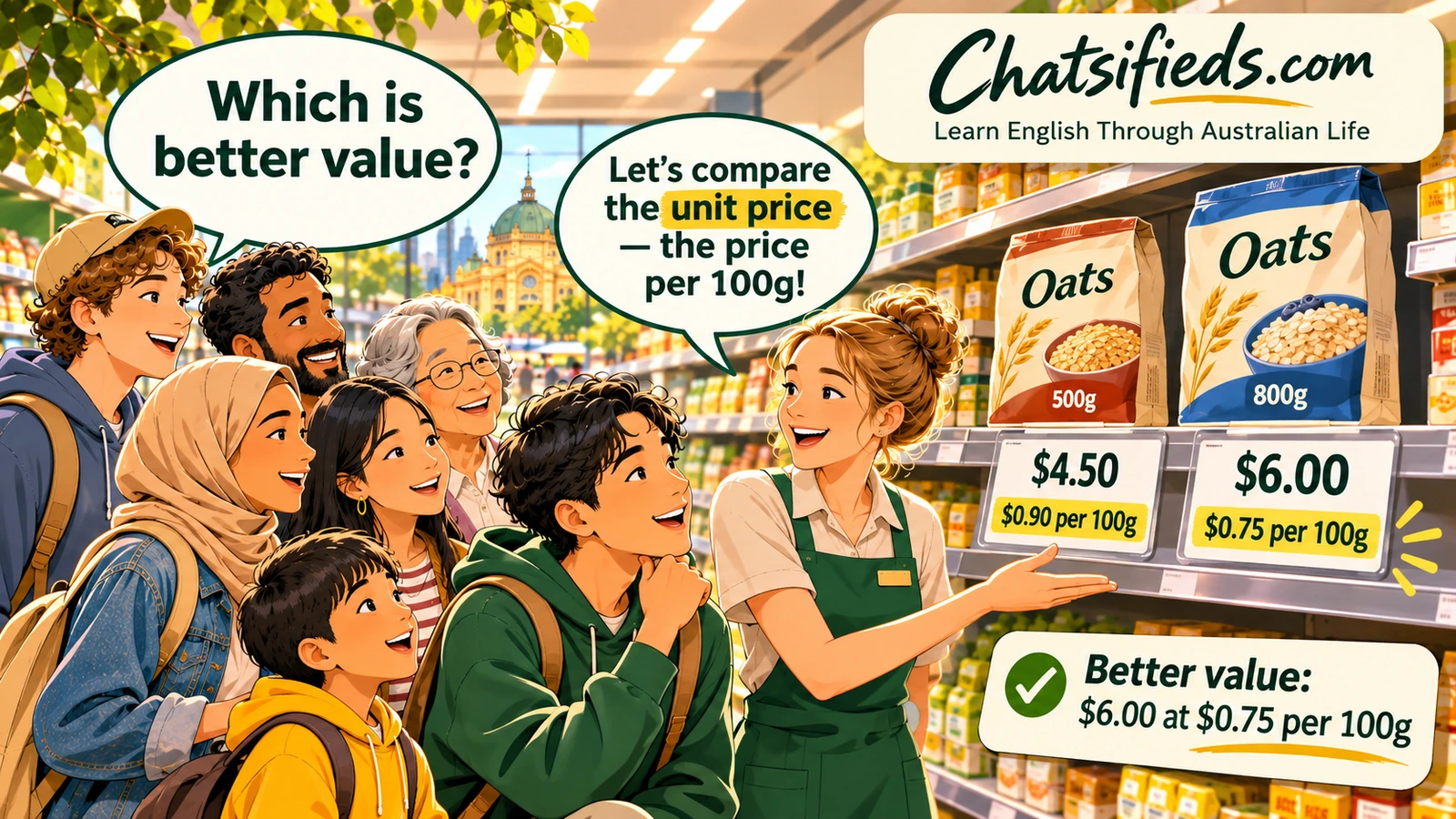
Two packets can look the same price and still be very different value. The unit price shows the real cost of the same amount, and learning to say it aloud helps you compare and ask questions with confidence.
Published 18/11/2026 · Educational guide · About 20 minutes
What you need to know
A unit price is the price for a standard amount, such as per kilo, per litre, per 100 mL or per 100 sheets. Find it on the shelf label near the product price. To compare two products, look at the unit price and make sure both use the same unit, then pick the lower number if the quality and size suit you.
What a unit price is and why it matters
The ACCC explains that a unit price lets you compare the cost of products sold in different sizes. The shelf label shows the unit price in a standard form, such as per kilogram, per litre, per 100 millilitres or per 100 sheets. Some items are priced per piece, for example per avocado.
The ACCC also says the unit price must be prominent, easy to read, close to the product price and clear. Most supermarkets must show it. On the shelf label you will often see the total price in large numbers and the unit price in smaller print, so look for the small number next to a word like "per".
The ACCC suggests comparing unit prices even when a product is on special, because a special on a small pack can still cost more per kilo than a bigger pack at the normal price. In English you can say the unit price aloud like a normal price: "three twenty a kilo" or "two eighty per hundred grams".
A lower unit price is not always the best choice. A bigger pack may be cheaper per kilo but too big for your fridge, or it may go off before you finish it. Unit price helps you decide, and you decide the rest.
Key words and phrases
- unit price
- The price for a standard amount, such as per kilo or per litre.
- per kilo
- For each kilogram. Often said "a kilo": "three twenty a kilo".
- per 100 grams
- The price for 100 grams. Used for smaller foods such as cheese or snacks.
- per litre
- The price for each litre of a liquid such as milk or juice.
- per 100 mL
- The price for 100 millilitres. Used for smaller liquids such as sauces.
- per sheet
- A price for a number of sheets, such as per 100 sheets of paper towel.
- shelf label
- The small price tag on the edge of the shelf under the product.
- compare
- To look at two or more things to see which is better value.
- value
- How much you get for the money you pay. "Good value" means you get plenty for the price.
- bulk
- A large amount in one pack. "Buying in bulk" often means a lower unit price.
- same unit
- Both prices use the same measure, such as both per kilo. Only then can you compare.
Dialogue: comparing two packets of pasta
Mei: Look, these two packets of pasta are almost the same price.
Sam: Check the unit price. It's the small number on the shelf label.
Mei: Sorry, which number is that?
Sam: This one. It says per kilo. The small packet is three eighty a kilo.
Mei: And the big packet says two ninety a kilo. So the big one is cheaper per kilo.
Sam: Right. But will you use that much pasta?
Mei: Yes, I eat it every week. I'll take the big one.
Mei: Excuse me, is this one sold per kilo or per hundred grams?
Staff member: That one is per hundred grams. The other cheese is per kilo.
Mei: Thanks. So I can't compare them yet?
Staff member: Not directly. You'd need to change one so both use the same unit.
Mei: Got it. Thanks for explaining.
- "Three eighty a kilo" means $3.80 per kilo. "A kilo" and "per kilo" mean the same thing.
- "Sorry, which number is that?" is a polite way to ask for help reading a label.
- Only compare unit prices that use the same unit. Per kilo to per kilo, per litre to per litre.
- "Thanks for explaining" is a friendly way to close the conversation.
More useful phrases
- What's the unit price on this?
- Asks for the price per standard amount.Use it: When you cannot find it on the label.
- Is this per kilo or per hundred grams?
- Checks which unit the label uses.Use it: When two labels use different units.
- This one is cheaper per kilo.
- States which product costs less for the same weight.Use it: When you explain your choice.
- Which one is better value?
- Asks which gives more for the money.Use it: When talking with a friend or staff member.
- Is the bigger pack cheaper per kilo?
- Asks if buying bulk saves money.Use it: When you compare pack sizes.
- Both prices are per litre.
- Confirms the units match.Use it: Before you compare two drinks.
- It's smaller print, but it's there.
- Describes where the unit price usually appears.Use it: When showing someone the label.
- I'll go with the cheaper one per hundred grams.
- Makes your decision using the unit price.Use it: When you choose between snacks or cheese.
Common unit prices and how to say them
Look for the small "per" price on the shelf label.
| Item type | Typical unit | How you might say it |
|---|---|---|
| Rice, pasta, fruit | per kilo | "Three twenty a kilo." |
| Cheese, snacks | per 100 g | "Two eighty per hundred grams." |
| Milk, juice | per litre | "One ninety a litre." |
| Sauces, oils | per 100 mL | "One fifty per hundred mil." |
| Paper towel, wipes | per 100 sheets | "Two dollars per hundred sheets." |
| Single items such as avocados | per piece (each) | "Two dollars each." |
These prices are examples for practice only. Check the real label in your store.
Say it aloud: asking about a label
Saying a sentence out loud before you need it makes real conversations easier. Accents differ, so aim to be clear, not perfect.
- Slow. Read the sentence slowly, one phrase at a time.
- In full. Say: Sorry, is this per kilo or per hundred grams?
- At normal speed. Say it again, as you would in a real conversation.
- Listen. Listen for the units: "per kilo", "a kilo", "per hundred grams", "per litre".
Practice 1: Role-play with a partner
Situation: You are comparing two bottles of juice and you are not sure how to read the unit price on the labels.
Work with a friend, a classmate or your mirror. One person is the staff member. The other is the customer. Read the lines, then cover the “You could say” answers and try it from memory. Swap roles.
staff member: “Hi, are you finding everything okay?”
You could say:
- “Yes, thanks. Sorry, can you help me read this label?”
- “Almost. Could you show me the unit price?”
staff member: “Sure. The unit price is this small number. It says per litre.”
You could say:
- “Thanks. So this one is one ninety a litre?”
- “Okay. And this other one says per litre too?”
staff member: “Yes, both are per litre, so you can compare them.”
You could say:
- “Great, so the second one is cheaper per litre.”
- “Perfect. Then the bigger bottle is better value.”
staff member: “That's right. The bigger bottle works out cheaper.”
You could say:
- “Thanks for explaining. I'll take that one.”
- “Thank you, that's really helpful.”
Challenge: Pick two products you really buy, such as rice or milk. Find both unit prices and say which is cheaper out loud.
Practice 2: Fill the gap
Say the missing word or phrase out loud before you open the answer.
Is this per kilo or per hundred ___?
Show answer
grams — Smaller foods often use per 100 grams.
Both prices are per ___. (milk)
Show answer
litre — Liquids usually use litres or millilitres.
The big packet is cheaper ___ kilo.
Show answer
per — "Per kilo" and "a kilo" mean the same.
Which one is better ___?
Show answer
value — Value means how much you get for the money.
You can only compare prices that use the same ___.
Show answer
unit — Both must be per kilo, or both per litre.
The unit price is the small ___ on the shelf label.
Show answer
number — Look near the large total price.
Common mistakes and better ways to say it
Less helpful: “This is cheaper because the packet is small.”
Try instead: “This one is cheaper per kilo.”
A smaller packet price does not mean a lower unit price.
Less helpful: “Which is one cheap?”
Try instead: “Which one is cheaper per kilo?”
Use "which one" and a unit to make the question clear.
Less helpful: “(comparing per kilo to per 100 grams)”
Try instead: “Check that both prices use the same unit first.”
Different units cannot be compared directly.
Less helpful: “Why is the price small?”
Try instead: “Sorry, which number is the unit price?”
Naming the unit price gets you the answer quickly.
Culture note: checking value is normal
Comparing products at the shelf is common in Australia and nobody will think you are rude. Many shoppers check the unit price, especially on bigger items like rice, milk and cheese.
You may hear friends say "it works out cheaper". That means the cost per kilo or litre is lower, even if the packet price looks bigger.
Real-life mission
At your next shop, try these small steps. Tick each one when you have done it.
If you cannot find the unit price, ask a staff member to show you.
Phrase Wall practice: phrases to own
Open a phrase to see it on the Phrase Wall, practise it, and save it to My Learning.
- “What's the unit price on this?”Ask for the price per standard amount.
- “Is this per kilo or per hundred grams?”Check which unit a label uses.
- “Which one is better value?”Ask which gives more for the money.
- “This one works out cheaper.”Say that the cost per kilo or litre is lower.