
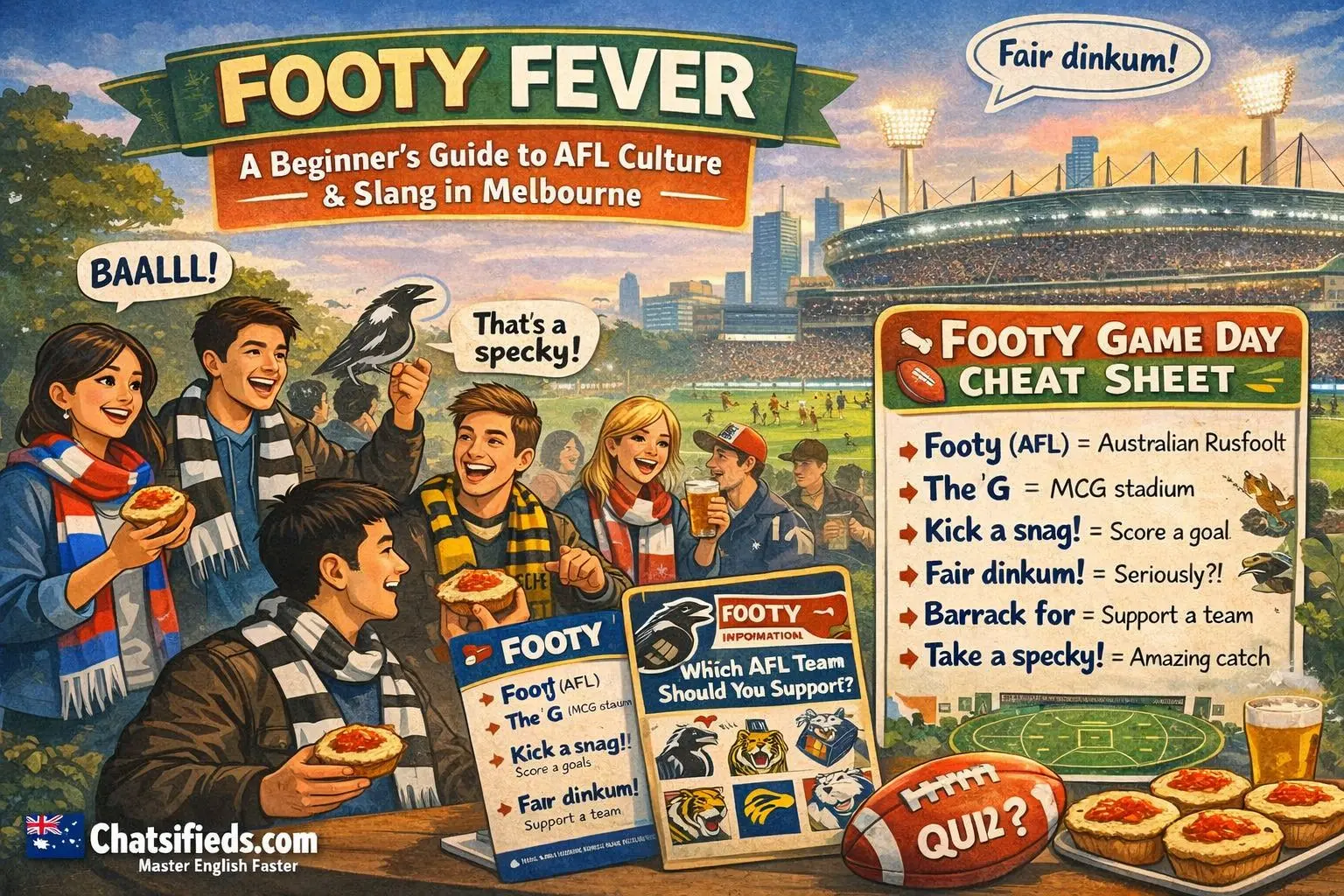
Footy Fever: AFL Guide for International Students 🏉
Understand AFL culture, learn Australian football slang, and speak like a local in Melbourne. Test your knowledge with our interactive ESL quiz and earn a printable certificate.
Footy Fever in Melbourne
& AFL Slang 🏉🌏
How to Talk Like a Local on Game Day
This AFL guide for international students takes you from Flinders Street Station to the roar of the MCG — learn the Aussie football slang locals use every single game day, then test yourself with our quiz and earn a free certificate!
"In Melbourne, footy is not just a sport — it is a language, a community, and a way of life." — Chatsifieds ESL🏉 What Is AFL?
Why AFL Is the Best Way to Connect with Melbourne Culture 🌏
If you live in Melbourne and want to connect with your neighbours, workmates, and uni friends — you need to understand AFL. The Australian Football League is Australia's most popular sport in Melbourne, and game day is the single biggest social event in the city's calendar. People call it simply "footy".
AFL is a fast-paced game where players kick, catch, and score goals across a large oval field. But for ESL learners, the real magic is not on the field — it is in the conversations around it. Asking "Who do you barrack for?" is one of the fastest ways to start a genuine friendship with any Melburnian.
For international students arriving as new migrants, or studying English in Australia, AFL offers something no textbook can: real vocabulary, genuine emotion, and instant belonging. It pairs perfectly with our guides on Australian lifestyle and how to speak Aussie English.
4 Essential AFL Game Day Moments Every ESL Learner Should Know 🎨
Each moment has its own culture — and its own vocabulary lesson. Read our Welcome to Melbourne and Australian Lifestyle posts for the full picture.
Thousands of fans walk from Flinders Street Station to the MCG together — a sea of team scarves, chanting, and excitement. Locals call the MCG "The 'G", short for the Melbourne Cricket Ground. If someone invites you to the 'G, say yes immediately!
Wearing your team's scarf on the walk signals which side you are on. A stranger might grin and say "Good barrack, mate!" if they support the same team.
📖 Grammar: "The 'G" uses an apostrophe to show the letters MCG have been shortened. This clipping is very common in Australian English — locals love abbreviating everything!
The meat pie is AFL's most iconic food — a small pastry filled with minced beef, eaten in the stands. But what is "dead horse"? It is Australian rhyming slang for tomato sauce (horse = sauce). It sounds strange but every local knows it immediately!
Rhyming slang is a fun feature of Australian English where a phrase rhymes with the real word. Knowing even a few examples shows incredible cultural awareness.
📖 Grammar: Rhyming slang — a type of informal language where a word is replaced by a phrase that rhymes with it. Dead horse rhymes with sauce. Other examples: dog and bone = phone; plates of meat = feet.
Inside the MCG, 90,000 fans are using informal Australian English at full volume. You will hear "Take a specky!" when a player makes a spectacular mark (jumping off another player's back to catch the ball). You will hear "BALL!" when fans think the ball is being held. And if something goes badly wrong — "Fair dinkum! That's a terrible call!"
📖 Grammar: Fair dinkum is a uniquely Australian intensifier meaning genuinely or really. It can express surprise, agreement, or disbelief — context determines meaning. An exclamation without a full sentence!
Before the siren sounds, Melbourne CBD comes alive. Fans meet at laneway bars, Federation Square, and pubs near the MCG. This is called pre-match culture — a relaxed, social tradition where everyone mixes, debates, and predicts. You do not need to know every rule to join the conversation.
Just try: "Who do you barrack for?" You will rarely be met with silence. Read more about Melbourne social life in our Melbourne's Melting Pot post.
📖 Grammar: Barrack for = to support. In British English you would say support or cheer for. Australian English uses barrack specifically for sport fandom — it is a verb unique to this cultural context.
Essential AFL Slang — Speak Like a Local 🗣️
Master these words and you will sound like you grew up in Melbourne. Each card includes a grammar note for ESL learners.
📖 Grammar: Shortened noun — removing the ending of football and leaving footy. The -y suffix is a classic Australian hypocorism (word-shortening pattern).
📖 Grammar: Clipping with an apostrophe — the apostrophe replaces the missing letters MCG. Always capitalised and always includes The before it.
📖 Grammar: Verb + preposition (barrack for). Always followed by the team name. Never say "barrack to" — only "barrack for".
📖 Grammar: Informal collocation — kick (verb) + a snag (noun phrase). Snag here is a metaphor; it also means a sausage in everyday Australian English!
📖 Grammar: Shortened adjective used as a noun — spectacular → specky. The -y suffix again! Australians do this constantly to create warm, informal vocabulary.
📖 Grammar: Noun used with a definite article (the siren) — both speaker and listener know which siren is meant because of shared cultural context. This is called the definite reference.
📖 Grammar: Fixed exclamatory phrase — functions as an intensifier meaning truly or genuinely. Can open or close a sentence. Unique to Australian English — originally from goldfield workers in the 1800s!
5 Ways to Use AFL to Improve Your English 🏉
Five practical activities — starting this weekend! Also try our How to Speak Aussie English lesson.
Own a game-day phrase students use before footy
A venue, event organiser, club, ticket partner or student group can own a footy phrase and turn it into a booking code, event offer or game-day practice mission.
Learn → Say → Save → Visit
Use the phrase before watching a match, booking a student table or joining a beginner-friendly AFL event.
Learn: “Who do you barrack for?”
Say: Ask the phrase at a watch party, student event or game-day venue.
Save: Use FOOTY10 or BARRACK10 for a student offer.
Visit: Click straight to the partner’s booking page, event page, ticket page or map.
What the business owns
A partner becomes the place where students connect footy language with a real game-day experience.
Transparent demo: the phrase, code and links are examples until a real partner joins. This can become a dedicated learn-and-visit page for the business.
More Chatsifieds Blog Posts
Explore more Australian culture and English lessons from our community.
AFL Slang Quiz for International Students 🏉
Score 8 out of 10 or higher to unlock your printable Chatsifieds certificate and future partner offers. One attempt per question — choose carefully!
What does "footy" mean in Australian English?
A local says: "Let's meet at the 'G." — Where are they referring to?
What does "barrack for a team" mean?
A friend says: "I'll grab a pie with some dead horse." — What are they going to eat?
The crowd shouts: "He kicked a snag!" — What happened?
What does "take a specky" mean in AFL?
The entire crowd suddenly shouts "BALL!" — What does this mean?
Your friend shouts: "Fair dinkum! That was a terrible call!" — What does fair dinkum mean here?
Where do Melbourne AFL fans typically meet before a game in the CBD?
Why is understanding AFL especially valuable for international students living in Melbourne?
Frequently Asked Questions About AFL & Footy Culture 🏉
Not at all! The atmosphere, the crowd, the food, and the language are all valuable whether you understand every rule or not. Start by understanding the basics — kick, catch, score — and let the crowd teach you the rest. Read our Australian Lifestyle post for more cultural context.
Absolutely. AFL is Melbourne's most powerful social connector. Asking "Who do you barrack for?" instantly breaks the ice with almost any Melburnian. You can explore more about building social connections in our Melbourne's Melting Pot post.
Three habits: (1) Read Australian culture articles daily — start with our Chatsifieds Blog. (2) Have one real English conversation daily at Chatsifieds speaking practice. (3) Watch AFL matches to train your ear on fast, real Australian English.
Now you speak footy — learn the everyday Aussie slang locals use in Melbourne's iconic laneways, cafés, and streets. Includes vocab cards, an ESL quiz, and a printable certificate.
Read the Slang Guide →Chatsifieds Phrase Wall
Take three useful phrases into real Australian conversation.
Every Chatsifieds lesson connects language to real life. Practise these related phrases, learn what they mean and build confidence before you use them in a café, class, workplace or everyday conversation.