
What you need to know
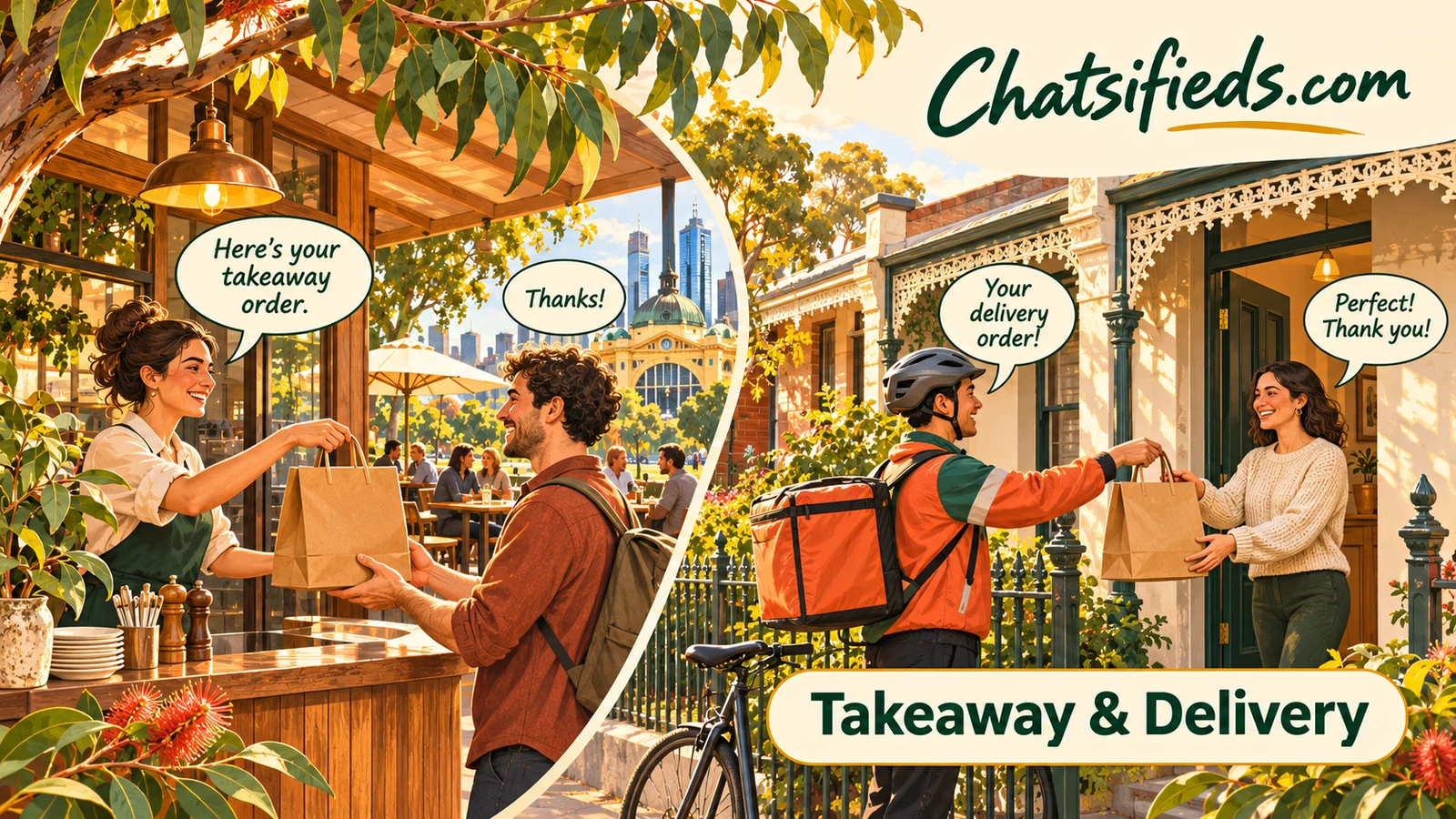
To order takeaway, say "Could I get the chicken burger and a small chips, to take away, please?" Give your name, ask "How long will it be?" and say "I'll pay now" or "I'll pay when I pick it up." If you phone, say "It's for pick-up."
How takeaway ordering works
Takeaway means food you carry out and eat somewhere else. In Australia people say "takeaway" or "take away", and a shop that sells it is also called a takeaway. At a counter the worker may ask "Eating in or takeaway?" You can say "Takeaway, please."
You can order at the counter or by phone. On the phone you say what you want, say it is for pick-up, give your name and ask how long it will take. A common time is fifteen to twenty minutes, but busy times are longer. The worker may say "That will be about twenty minutes."
Some shops ask you to pay when you order. Others let you pay when you pick it up. Ask "Do I pay now or when I pick it up?" Many places take tap and go. The ACCC says from 1 October 2026 businesses can no longer charge a card surcharge on Visa, Mastercard, American Express or eftpos. Check the total before you pay.
When you collect, say your name: "Hi, I'm here to pick up an order for Lee." Check the bag before you leave: "Could I just check it's all in here?" This is polite and avoids problems at home.
Key words and phrases
- takeaway
- Food you carry out. Also a shop that sells it.
- pick up
- To collect your order from the shop.
- eating in
- Eating at the shop, not taking the food away.
- order number
- A number the shop gives you so staff can find your food.
- name for the order
- The name staff write on your order. "Name for the order?"
- ready in
- How long until the food is ready. "Ready in fifteen minutes."
- a bag
- The bag for your food. Some shops charge for bags.
- extra sauce
- More sauce in a small cup or on the side.
- no onion
- A request to leave onion out.
- to go
- American phrase. Australians usually say takeaway.
- collect
- To pick up your order. A more formal word.
Dialogue: ordering takeaway by phone
Staff: Good evening, thanks for calling. How can I help?
Customer: Hi, I'd like to order some takeaway, please.
Staff: Sure. What would you like?
Customer: Could I get a chicken burger and a small chips, please?
Staff: Anything else? Any drinks?
Customer: A can of lemonade, please.
Staff: No problem. Is that for pick-up?
Customer: Yes, for pick-up. How long will it be?
Staff: It'll be about twenty minutes. Can I take a name?
Customer: It's Lee, L-E-E.
Staff: Thanks, Lee. Would you like to pay now or when you pick up?
Customer: I'll pay when I pick it up, thanks.
Staff: No worries. See you soon.
Customer: Hi, I'm here to pick up an order for Lee.
Staff: Here you go. That's twenty-six dollars. You can tap here.
Customer: (taps) Thanks. Could I just check everything's in the bag?
Staff: Of course. Chicken burger, small chips and a lemonade.
Customer: Perfect. Thanks very much.
- "Is that for pick-up?" means you will collect it, not get delivery.
- "About twenty minutes" is a guess, not exact.
- "Can I take a name?" means give your name for the order.
- "Could I just check everything's in the bag?" is polite and normal.
More useful phrases
- I'd like to order some takeaway, please.
- Starts a phone order.Use it: At the start of a call.
- Could I get a chicken burger, to take away?
- Orders food to carry out.Use it: At the counter.
- It's for pick-up.
- Says you will collect the food.Use it: When staff ask about pick-up or delivery.
- How long will it be?
- Asks about waiting time.Use it: After you order.
- It's under the name Lee.
- Gives your name for the order.Use it: When you collect.
- Could I have extra sauce, please?
- Asks for more sauce.Use it: When you want more sauce.
- No onion, please.
- Asks to leave an ingredient out.Use it: When you do not want an ingredient.
- Do I pay now or when I pick it up?
- Checks when to pay.Use it: After you order by phone.
- Could I just check it's all in the bag?
- Asks to check your order.Use it: When you collect your food.
Takeaway: what you may hear and say
These are common lines at a takeaway counter or on the phone.
| Staff says | It means | You can say |
|---|---|---|
| Eating in or takeaway? | Do you eat here or carry it out? | Takeaway, please. |
| Is that for pick-up? | Will you collect it? | Yes, for pick-up. |
| Can I take a name? | What name should we write? | It's Lee, L-E-E. |
| It'll be about twenty minutes. | It will be ready in about twenty minutes. | Okay, thanks. I'll come back then. |
| That's twenty-six dollars. | The total is $26. | Can I tap? / Here you go. |
| Anything else? | Do you want more? | No, that's all, thanks. |
Wait times are guesses. If it is busy, ask "Is it going to be longer than twenty minutes?"
Say it aloud: ordering takeaway
Saying a sentence out loud before you need it makes real conversations easier. Accents differ, so aim to be clear, not perfect.
- Slow. Read the sentence slowly, one phrase at a time.
- In full. Say: Could I get a chicken burger and a small chips, to take away, please?
- At normal speed. Say it again, as you would in a real conversation.
- Listen. Listen for the staff reply, such as "Anything else?" or "Can I take a name?"
Practice 1: Role-play with a partner
Situation: You are at the counter of a takeaway shop. You want food to take home. A worker is ready to take your order.
Work with a friend, a classmate or your mirror. One person is the counter staff. The other is a customer. Read the lines, then cover the “You could say” answers and try it from memory. Swap roles.
counter staff: “Hi there. What can I get you?”
You could say:
- “Could I get a chicken burger and a small chips, please?”
- “Hi, could I see the menu, please?”
counter staff: “Eating in or takeaway?”
You could say:
- “Takeaway, please.”
- “To take away, thanks.”
counter staff: “Anything to drink? Any sauce?”
You could say:
- “Could I have extra sauce, please?”
- “No, thanks. That's all.”
counter staff: “It'll be about fifteen minutes. Can I take a name?”
You could say:
- “It's Lee, L-E-E.”
- “Okay, thanks. Park, P-A-R-K.”
counter staff: “That's twenty-six dollars. You can tap here.”
You could say:
- “Can I tap? Thanks.”
- “Here you go. Thanks very much.”
Challenge: Do the role-play again, but your order is wrong when you collect it. Say: "Sorry, I think there's something missing. Could you check?"
Practice 2: Fill the gap
Say the missing word or phrase out loud before you open the answer.
Takeaway, ___.
Show answer
please — Please makes the order polite.
It's for ___.
Show answer
pick-up — Pick-up means you will collect the order.
How long will it ___?
Show answer
be — This asks about the waiting time.
Can I take a ___?
Show answer
name — Staff need a name for your order.
Could I have extra ___, please?
Show answer
sauce — Sauce is a common extra at takeaway shops.
Could I just ___ it's all in the bag?
Show answer
check — Checking avoids problems at home.
Common mistakes and better ways to say it
Less helpful: “I want burger go.”
Try instead: “Could I get a burger to take away, please?”
A full polite sentence is clearer.
Less helpful: “(leaving without checking your bag)”
Try instead: “Could I just check it's all in the bag?”
Checking is polite and avoids missing items.
Less helpful: “How long?”
Try instead: “How long will it be, please?”
A full question sounds friendlier.
Less helpful: “(not giving a name)”
Try instead: “It's Lee, L-E-E.”
The shop needs a name to find your order.
Culture note: takeaway is part of everyday life
Takeaway is very common in Australia. Many people get fish and chips, pizza, burgers or noodles on a busy night. Staff are used to quick orders, so you can speak short and clear. A friendly "Thanks, have a good one" is a normal goodbye.
The ACCC says that from 1 October 2026 businesses can no longer charge a surcharge for payments with Visa, Mastercard, American Express or eftpos, and that businesses must give clear prices before you buy. Always check the total before you pay. This lesson teaches English only.
If you have an allergy, say so clearly when you order: "I have an allergy to peanuts. Could you check?" A later lesson covers allergy English in detail, and this lesson is not medical advice.
Advertisement
Real-life mission
Order a takeaway meal this week, by phone or at a counter. Tick each step.
If you feel nervous, practise the sentences first, or start with a counter order.
Phrase Wall practice: phrases to own
Open a phrase to see it on the Phrase Wall, practise it, and save it to My Learning.
- “Could I get a chicken burger, to take away?”Orders food to carry out.
- “How long will it be?”Asks how long until your food is ready.
- “It's for pick-up.”Says you will collect the food.
- “Could I just check it's all in the bag?”Asks to check your order before you leave.