Australian Supermarket English · Checkout & paying · Level: Beginner to intermediate
Paying: Tap, Card, Cash and Cash Out
Paying should be the easy part, but there are small things to know: tapping, cash rounding, surcharges and cash out. This lesson gives you the English for all of them.
Published 18/11/2026 · Educational guide · About 20 minutes
What you need to know
Most people pay by tapping a card or phone. If you pay cash, the total is rounded to the nearest 5 cents because there are no 1 or 2 cent coins. Card payments are not rounded. If a shop adds a surcharge, it should tell you. Some stores also offer cash out, where you take cash from your account when you pay by card.
The ways to pay and what each one needs
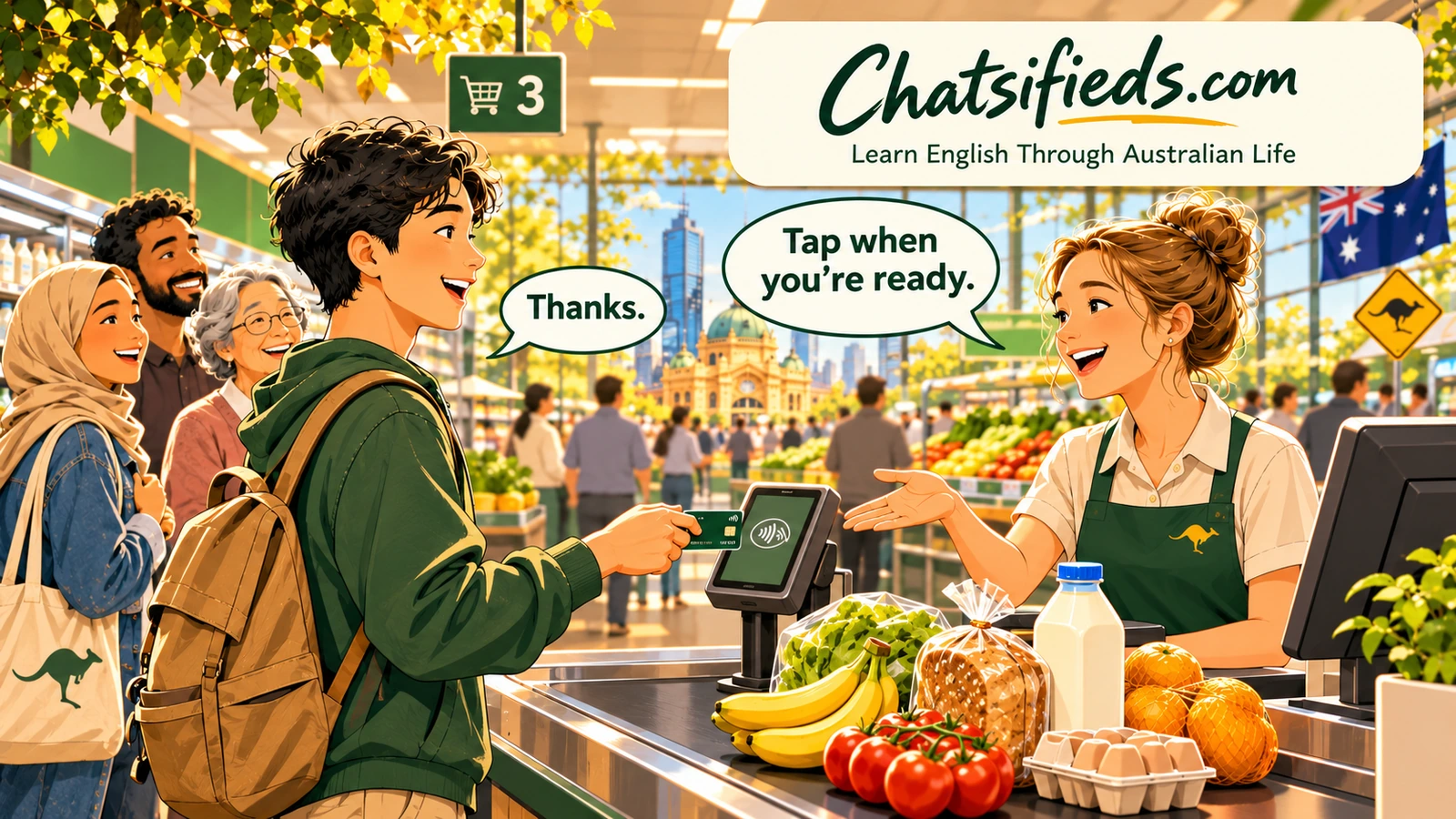
Tap and pay is the most common way to pay at an Australian supermarket. You hold your card or phone near the payment machine and wait for the beep or the green tick. You can also insert or swipe a card and follow the screen. The StudyMelbourne currency page explains tap and pay, cash and cards for international students.
If you pay with cash, there is one extra thing to know. Australia no longer uses 1 and 2 cent coins, so the total for cash is rounded to the nearest 5 cents. WA Consumer Protection explains that rounding applies to the total, not each item, and card payments are not rounded. So a total of $12.42 paid in cash becomes $12.40, and $12.43 becomes $12.45.
Coins run from 5 cents to 2 dollars and notes from 5 to 100 dollars. You will hear "five cents", "twenty cents", "fifty cents", "a dollar", "two dollars", "a five", "a ten", "a twenty".
Some shops charge a card surcharge. StudyMelbourne notes that merchants must tell you about surcharges, so look for a sign or ask. Some supermarkets also offer cash out, where you choose "savings" or "cheque" on the machine and ask for cash. One bank help page says this works at supported merchants only. Ask at the checkout if you are not sure.
Key words and phrases
- tap and pay
- Hold your card or phone near the machine to pay without inserting or swiping.
- insert
- To put your card into the card reader. Some people say "dip".
- PIN
- The secret number you type to confirm a card payment. Always cover the keypad.
- cash out
- Taking cash from your account when you pay by card at a shop. It works only at supported merchants.
- rounding
- Changing a cash total to the nearest 5 cents because there are no 1 or 2 cent coins.
- change
- The money you get back when you pay with more cash than the total.
- surcharge
- An extra fee added for a payment method. Shops should tell you about it.
- eftpos
- A common Australian word for paying with a debit card at a machine.
- savings or cheque
- The account choices on the machine for a debit card.
- declined
- When a payment is not accepted. Try another card or ask the operator.
- note and coin
- The two kinds of cash. Notes are paper or plastic. Coins are metal.
Dialogue: paying cash, with rounding
Operator: That comes to twelve forty-two.
You: Can I pay cash, please?
Operator: Sure. For cash, it rounds to twelve forty.
You: Sorry, why twelve forty?
Operator: There are no one or two cent coins, so cash totals are rounded to the nearest five cents.
You: Oh, I see. Here's a twenty.
Operator: Thanks. That's seven sixty change.
You: Thanks. Could I get a receipt, please?
Operator: Of course. Here you go.
You: Thank you. Have a good one.
Operator: You too.
- "It rounds to twelve forty" means the cash total is changed to the nearest 5 cents.
- "A twenty" means a 20-dollar note. People often say "a five", "a ten", "a twenty".
- "Seven sixty change" means $7.60 in change.
- If you pay by card, the total stays $12.42 because card payments are not rounded.
More useful phrases
- Can I pay by card?
- Checks that you can pay with your card.Use it: At the start of the payment.
- Is there a surcharge for card?
- Asks if there is an extra fee for paying by card.Use it: If you see a sign or are not sure.
- Can I get cash out, please?
- Asks to take cash from your account with your card payment.Use it: At a checkout where this is available.
- Could I get twenty dollars cash out?
- Says how much cash you want.Use it: After you ask for cash out.
- Savings or cheque?
- The machine or operator asks which account to use.Use it: When you insert a debit card.
- Sorry, it didn't go through.
- Says the payment did not work.Use it: When the payment is declined or fails.
- Could I try another card?
- Asks to use a different card.Use it: When one card does not work.
- Do you have change for a fifty?
- Asks if the shop can give change for a 50-dollar note.Use it: When you only have a large note.
Ways to pay at a glance
Here is what happens and what you can say for each way to pay.
| Way to pay | What happens | What you can say |
|---|---|---|
| Tap card or phone | Hold it near the machine and wait for the beep. | I'll tap, thanks. |
| Insert card | Put the card in, choose the account if asked, and enter your PIN. | Savings, please. |
| Cash | The total is rounded to the nearest 5 cents. | Can I pay cash, please? |
| Cash out | You take cash from your account while paying by card, at supported shops. | Could I get twenty dollars cash out? |
| Surcharge | An extra fee that the shop should tell you about. | Is there a surcharge for card? |
| Payment declined | The payment did not go through. | Sorry, could I try another card? |
| Receipt | Proof of payment on paper or by email. | Could I get a receipt, please? |
Check the screen and ask if you are not sure. Rules and offers vary by store and bank.
Say it aloud: asking about cash out
Saying a sentence out loud before you need it makes real conversations easier. Accents differ, so aim to be clear, not perfect.
- Slow. Read the sentence slowly, one phrase at a time.
- In full. Say: Could I get twenty dollars cash out, please?
- At normal speed. Say it again, as you would in a real conversation.
- Listen. Listen for the operator's reply, such as "Sure", "Savings or cheque?" or "Sorry, we don't do cash out here".
Practice 1: Role-play with a partner
Situation: You are paying for your groceries. You want to pay by card and take some cash out too.
Work with a friend, a classmate or your mirror. One person is the checkout operator. The other is the customer. Read the lines, then cover the “You could say” answers and try it from memory. Swap roles.
checkout operator: “That's twenty-six eighty. How would you like to pay?”
You could say:
- “By card, please.”
- “I'll tap, thanks.”
checkout operator: “Sure. Anything else for you today?”
You could say:
- “Could I get twenty dollars cash out, please?”
- “Can I get some cash out as well?”
checkout operator: “No worries. So that's forty-six eighty in total. Insert your card, please.”
You could say:
- “Okay, thanks. (insert the card)”
- “Sure. Thanks.”
checkout operator: “Savings or cheque?”
You could say:
- “Cheque, please.”
- “Savings, please.”
checkout operator: “Done. Here's your cash and your receipt.”
You could say:
- “Thank you. Have a good one.”
- “Thanks very much.”
Challenge: Do the role-play again, but this time the card does not work. Say: "Sorry, it didn't go through. Could I try another card?"
Practice 2: Fill the gap
Say the missing word or phrase out loud before you open the answer.
Can I pay ___, please? (with notes and coins)
Show answer
cash — Cash means notes and coins.
Cash totals are rounded to the nearest five ___.
Show answer
cents — There are no 1 or 2 cent coins.
Is there a ___ for card payments? (an extra fee)
Show answer
surcharge — A surcharge is an extra fee.
Could I get twenty dollars ___ out?
Show answer
cash — "Cash out" means taking cash with a card payment.
Savings or ___?
Show answer
cheque — The two usual account choices on the machine.
Sorry, it didn't go ___.
Show answer
through — "It didn't go through" means the payment did not work.
Common mistakes and better ways to say it
Less helpful: “Give me cash.”
Try instead: “Could I get twenty dollars cash out, please?”
A polite request with the amount is clearer.
Less helpful: “Why you take extra money?”
Try instead: “Sorry, is there a surcharge for card?”
A polite question gets a clear answer.
Less helpful: “(trying the same card again and again)”
Try instead: “Sorry, it didn't go through. Could I try another card?”
Telling the operator the problem is easier than guessing.
Less helpful: “I pay with the cheque.”
Try instead: “Cheque, please. (when asked savings or cheque)”
A short answer is enough when the machine asks.
Culture note: cards and phones are everyday payments
In Australia, many people pay for small purchases with a card or phone. Cash is still accepted by most supermarkets, but many people carry little cash. You can ask staff if you are not sure about a payment type.
Always check the amount on the screen before you tap. If the total looks wrong, ask the operator politely. For safety, cover the keypad when you enter your PIN and keep your receipt until you have checked your bag.
Cash rounding surprises many newcomers. It is a small thing. For card payments, you pay the exact total. If you are watching your budget, paying by card avoids the rounding step.
Real-life mission
On your next shop, try one new way of paying or one new payment phrase. Tick each when done.
Do not share your PIN with anyone. If something looks wrong, ask the operator or the customer service desk.
Phrase Wall practice: phrases to own
Open a phrase to see it on the Phrase Wall, practise it, and save it to My Learning.
- “Could I get cash out, please?”Asks to take cash from your account when you pay by card.
- “Is there a surcharge for card?”Asks whether there is an extra fee for paying by card.
- “Sorry, it didn't go through.”Says that a payment did not work.
- “Can I pay cash, please?”Asks to pay with notes and coins.
- “Savings, please.”Chooses the savings account when the machine asks.