
Australian Supermarket English · Checkout & paying · Level: Beginner
Queues, Express Lanes and Letting People Go First
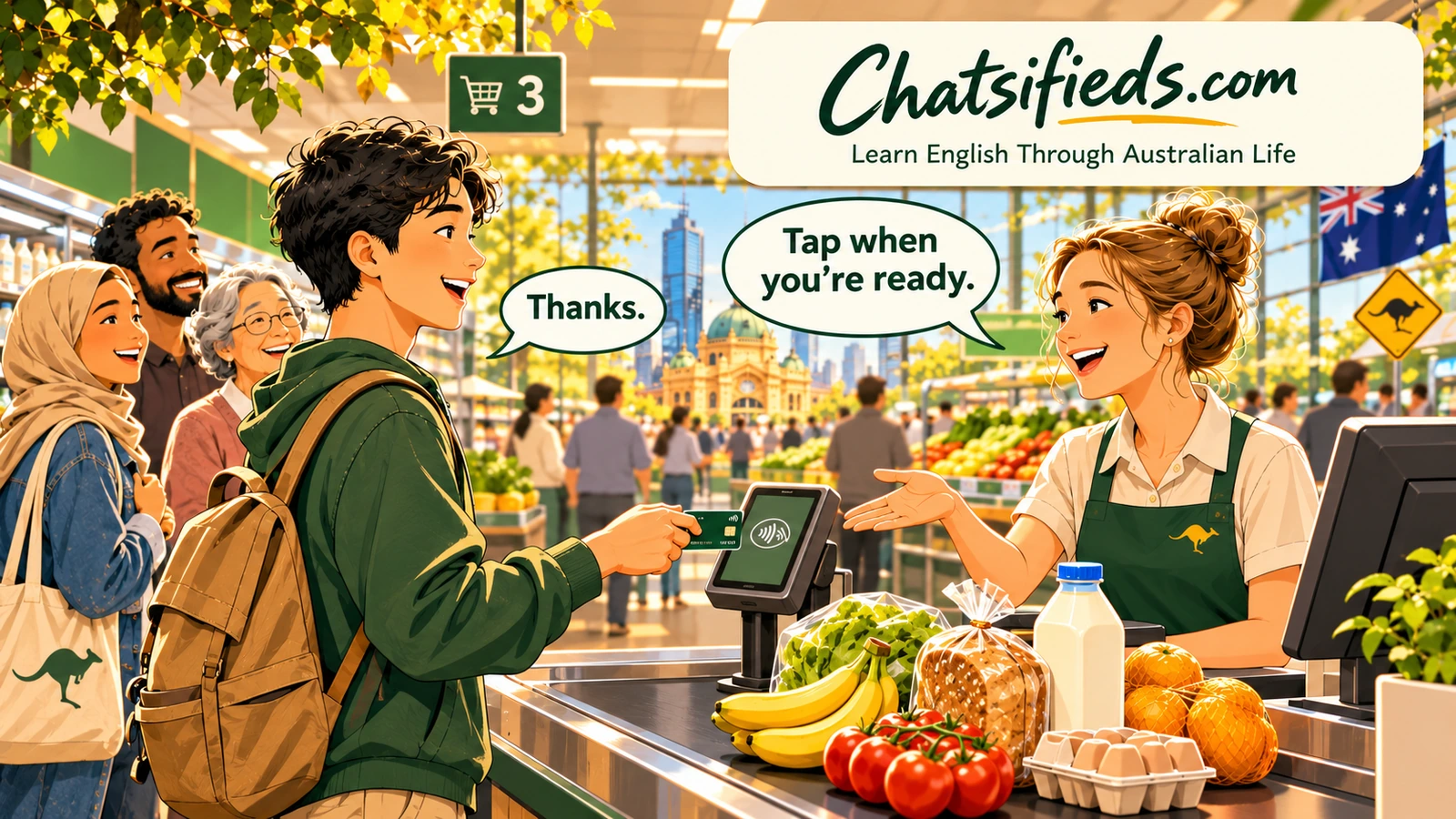
Queues are quiet and polite in Australia, but they still need a little English. This lesson gives you the short phrases for asking who is last, using an express lane, and letting someone go ahead.
Published 18/11/2026 · Educational guide · About 15 minutes
What you need to know
Join the end of the line, keep a little space, and ask "Sorry, are you in the queue?" if you are not sure. Use an express lane only if you have a small number of items and the sign allows it. If someone has one or two items, you can say "Go ahead, you've only got a few."
How supermarket queues usually work
At a staffed checkout, shoppers usually line up behind the last person and wait. Some stores have one lane for each checkout. Others have a single line that leads to the next free checkout. If the system is not clear, it is fine to ask a staff member or the person in front of you.
Many supermarkets have an express lane or a self-checkout area for people with fewer items. The sign above the lane tells you the limit. If your trolley is full, a basket lane or a standard lane is the better choice. Read the sign, because the limits change from store to store.
Small acts of politeness matter. If you see someone with only a few items behind you and you have a full trolley, you can let them go first. They will usually say "Thanks, that's so kind." It is also polite to leave your trolley close to the belt so that you do not block the aisle.
If someone pushes in front of you, stay calm. You can say "Excuse me, I think I was next." Most people will apologise and move. You do not need to argue.
Key words and phrases
- queue
- A line of people waiting. Australians say "queue" or "line".
- express lane
- A checkout for people with only a few items.
- next
- The person who will be served after the person in front.
- belt
- The moving surface where you put your shopping at a staffed checkout.
- divider
- The small bar you place on the belt between your shopping and the next person's.
- go ahead
- A polite way to let someone go first.
- push in
- To join a queue in front of people who were already waiting.
- item limit
- The largest number of items allowed in an express lane.
- basket
- A small carry basket. Basket lanes are for people with a basket, not a full trolley.
- customer service
- The desk or staff who help with problems.
Dialogue: joining a queue and letting someone go first
You: Sorry, are you in the queue?
Shopper: Yes, I'm just waiting for my friend. Go ahead if you like.
You: No, that's fine. I'll wait. Thanks.
Shopper: Okay. I'm after you, then.
Shopper: Excuse me, do you mind if I go in front? I've only got two things.
You: Not at all. Go ahead.
Shopper: Thanks so much, that's really kind.
You: No worries.
Checkout operator: Next, please. Hi, how are you going?
You: Good, thanks. Could I put the divider down for the next person?
Checkout operator: Sure. That's all the items on the belt.
You: Thanks. Have a good one!
- "Are you in the queue?" checks whether a person is waiting or just standing near the line.
- "Go ahead" and "After you" both mean you are letting the other person go first.
- "Do you mind if I go in front?" is a polite way to ask when you have only a few items.
- "No worries" is a relaxed reply to "thank you" and "sorry".
More useful phrases
- Sorry, are you in the queue?
- Asks if a person is waiting in the line.Use it: When people are standing close and you are not sure.
- Are you last?
- Asks who is at the end of the line.Use it: When you arrive and want to join the queue.
- Go ahead.
- Lets another person go first.Use it: When someone has fewer items than you.
- After you.
- A polite way to let someone go first.Use it: At a door, belt or checkout.
- Do you mind if I go in front?
- A polite request to go first.Use it: When you have only one or two items.
- Is this the express lane?
- Checks whether this lane is for a small number of items.Use it: When the sign is hard to see.
- I think I was next.
- A calm way to say you were waiting before the other person.Use it: If someone moves in front of you.
- Could I put the divider down?
- Asks to use the bar that separates your shopping from the next person's.Use it: At a staffed checkout belt.
Queue situations at a glance
Five common moments and the English that fits each one.
| Situation | What you can say | Meaning |
|---|---|---|
| You are not sure who is last | "Are you last?" | Finds the end of the line. |
| Someone stands near the belt | "Are you in the queue?" | Checks whether they are waiting. |
| You have only two items | "Do you mind if I go in front?" | Asks politely to go first. |
| Someone has a few items | "Go ahead, you've only got a few." | Lets them go first. |
| Someone moves ahead of you | "Excuse me, I think I was next." | Calm correction. |
| Your trolley is too full for the lane | "Is there a standard lane open?" | Finds a suitable checkout. |
A smile and a calm voice do most of the work. You rarely need more than one short sentence.
Say it aloud: joining the queue
Saying a sentence out loud before you need it makes real conversations easier. Accents differ, so aim to be clear, not perfect.
- Slow. Read the sentence slowly, one phrase at a time.
- In full. Say: Sorry, are you in the queue?
- At normal speed. Say it again, as you would in a real conversation.
- Listen. Listen for "yes", "no" or "go ahead". If you hear "I'm after you", that person will go behind you.
Practice 1: Role-play with a partner
Situation: You have a trolley of shopping. A person with two items stands behind you at the checkout.
Work with a friend, a classmate or your mirror. One person is the shopper with two items. The other is the customer with a trolley. Read the lines, then cover the “You could say” answers and try it from memory. Swap roles.
shopper with two items: “Excuse me, do you mind if I go in front? I've only got two things.”
You could say:
- “Not at all. Go ahead.”
- “Sure, no worries. Go ahead.”
shopper with two items: “Thank you so much. That's really kind.”
You could say:
- “No worries.”
- “That's okay. Have a good day.”
shopper with two items: “Are you in the queue for this lane?”
You could say:
- “Yes, I'm next after you.”
- “Yes, I'm after this person.”
shopper with two items: “Is this the express lane? I can't see the sign.”
You could say:
- “I think it's the standard lane. The express lane is over there.”
- “Sorry, I'm not sure. The sign is above the checkout.”
Challenge: Swap roles. Now you have two items and you ask someone with a full trolley to let you go first. Practise a polite, short request.
Practice 2: Fill the gap
Say the missing word or phrase out loud before you open the answer.
Sorry, are you in the ___?
Show answer
queue — You can also say "line".
Do you mind if I go in ___?
Show answer
front — "Go in front" means go before the person behind.
___ ahead. You've only got two items.
Show answer
Go — "Go ahead" lets someone go first.
Excuse me, I think I was ___.
Show answer
next — A calm way to say you were waiting earlier.
Could I put the ___ down for the next person?
Show answer
divider — The divider separates your shopping on the belt.
Is this the ___ lane?
Show answer
express — An express lane is for a small number of items.
Common mistakes and better ways to say it
Less helpful: “Move. I am first.”
Try instead: “Excuse me, I think I was next.”
A calm sentence is more polite and usually works.
Less helpful: “You are in line?”
Try instead: “Sorry, are you in the queue?”
The question word order is clearer and more natural.
Less helpful: “Let me go first.”
Try instead: “Do you mind if I go in front?”
A request sounds friendlier than a command.
Less helpful: “(standing silently with a full trolley in the express lane)”
Try instead: “Is there a standard lane open?”
Check the sign and ask if you are not sure.
Culture note: orderly, quiet and friendly
Australians generally expect people to wait in order. Pushing in is considered rude, but people usually correct it gently. A short sentence and a smile is better than an argument.
At some stores, such as ALDI, you may use a coin for the trolley and return it when you finish. Watch what others do, or ask a staff member if you are not sure.
Real-life mission
On your next shop, try these small queue moves. Tick each one when you have done it.
If a queue is long, take a breath and wait. Short, friendly English is enough.
Phrase Wall practice: phrases to own
Open a phrase to see it on the Phrase Wall, practise it, and save it to My Learning.
- “Sorry, are you in the queue?”Check whether someone is waiting in the line.
- “Go ahead, you've only got a few.”Let a person with only a few items go first.
- “Do you mind if I go in front?”Politely ask to go first when you have only one or two items.
- “Excuse me, I think I was next.”Calmly say you were in line before another person.