
Australian Supermarket English · Checkout & paying · Level: Beginner to intermediate
Checkout Small Talk: Friendly Chat in Seconds
The checkout is a good place to practise English because the chat is short and the topics are easy. This lesson gives you ready-made lines for greetings, quick answers and friendly goodbyes.
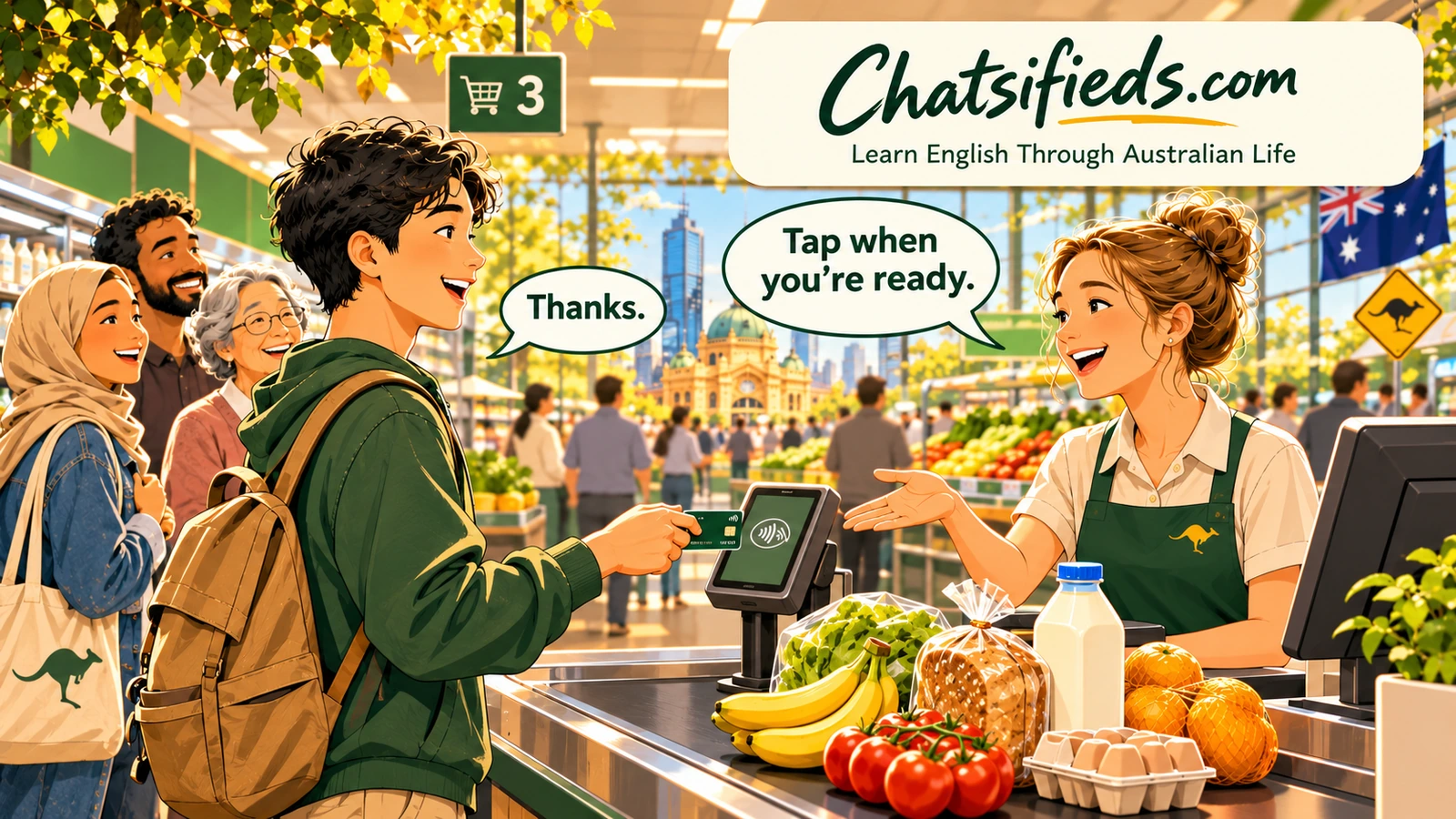
Published 18/11/2026 · Educational guide · About 15 minutes
What you need to know
Checkout small talk is usually two or three short lines: a greeting ("How are you going?"), a quick reply ("Good, thanks. And you?") and a goodbye ("Have a good one!"). You can add a short comment about the weather or the day. You do not need long answers.
Why checkout small talk matters
Many people in Australia say a few friendly words to shop staff. It is a polite way to show respect, not a request for a long conversation. "How are you going?" is a greeting. The best reply is short and positive.
If the operator makes a comment, such as "Busy day?" or "Got any plans for the weekend?", you can answer in one or two sentences and then return to the task. If you do not understand, it is fine to say "Sorry, could you say that again?"
Weather is a common topic. "Lovely day, isn't it?" or "Looks like rain later" are easy openers you can use too. Food and plans are also common. Learners who practise these short lines at the checkout often feel more confident in other places.
Staff are working, so keep the chat short, especially when there is a queue behind you. A smile and a thank you are always welcome.
Key words and phrases
- small talk
- Light, friendly conversation about everyday things.
- greeting
- A word or phrase you say when you meet someone, such as "Hi" or "How are you going?".
- How are you going?
- A friendly greeting. It means "How are you?".
- not bad
- A relaxed way to say "quite good".
- busy
- Having a lot to do, or with many people around.
- plans
- Things you intend to do, such as at the weekend.
- cheers
- A casual way to say thank you or goodbye.
- have a good one
- A friendly goodbye, like "have a good day".
- arvo
- A casual word for afternoon. You can understand it without using it.
- snags
- A casual word for sausages. A common item in weekend barbecues.
Dialogue: friendly chat at the checkout
Checkout operator: Hi there, how are you going?
You: Good, thanks. And you?
Checkout operator: Not bad. Bit busy today.
You: Yeah, it looks busy. Is it always like this on Saturdays?
Checkout operator: Pretty much. Getting ready for the weekend.
You: Same here. I'm cooking dinner for friends.
Checkout operator: Nice. Do you need any bags today?
You: No, thanks. I've got my own.
Checkout operator: That's all done. Tap whenever you're ready.
You: Thanks very much.
Checkout operator: Enjoy your weekend.
You: You too. Have a good one!
- "How are you going?" is a greeting. Answer in one short sentence and ask the same back.
- "Not bad" is a very common Australian answer. It usually means "pretty good".
- "You too" is a short, natural reply to "Enjoy your weekend".
- Notice how each speaker says only one or two sentences. Short turns are normal.
More useful phrases
- Good, thanks. And you?
- A short, polite answer to a greeting.Use it: When the operator says "How are you going?".
- Not bad, thanks.
- A relaxed way to say you are well.Use it: When you want a casual reply.
- Busy day?
- Asks if the day has been busy.Use it: To start a short chat.
- Lovely day, isn't it?
- A friendly comment about nice weather.Use it: As a simple opener.
- Any plans for the weekend?
- Asks about someone's weekend.Use it: To make friendly conversation.
- Sorry, could you say that again?
- Asks the speaker to repeat.Use it: When you did not hear or understand.
- You too!
- Returns a good wish.Use it: After "Enjoy your day" or "Have a good one".
- Cheers.
- A casual thank you or goodbye.Use it: As you leave the checkout.
Small-talk moments at a glance
What the operator may say, and a short reply you can use.
| The operator says | You can say | Meaning |
|---|---|---|
| "How are you going?" | "Good, thanks. And you?" | Greeting and reply. |
| "Busy day?" | "A bit. How about you?" | Short chat about the day. |
| "Any plans for the weekend?" | "Just relaxing. You?" | Friendly question about plans. |
| "Lovely weather, isn't it?" | "It is. Perfect for a walk." | Weather chat. |
| "Enjoy your weekend." | "You too!" | Return the wish. |
| "Have a good one." | "Thanks, you too. Cheers!" | Friendly goodbye. |
Keep replies short. If you do not understand, say "Sorry, could you say that again?" and smile.
Say it aloud: a friendly reply
Saying a sentence out loud before you need it makes real conversations easier. Accents differ, so aim to be clear, not perfect.
- Slow. Read the sentence slowly, one phrase at a time.
- In full. Say: Good, thanks. And you?
- At normal speed. Say it again, as you would in a real conversation.
- Listen. Listen to how the operator answers. You may hear "Not bad", "Good" or "Busy but good".
Practice 1: Role-play with a partner
Situation: You are paying for your shopping. The operator is friendly and likes to chat for a few seconds.
Work with a friend, a classmate or your mirror. One person is the checkout operator. The other is the customer. Read the lines, then cover the “You could say” answers and try it from memory. Swap roles.
checkout operator: “Hi there, how are you going today?”
You could say:
- “Good, thanks. And you?”
- “Not bad, thanks. How are you?”
checkout operator: “Not bad. Busy day today. Did you find everything okay?”
You could say:
- “Yes, thanks. Everything was easy to find.”
- “Yes, thank you. Staff were really helpful.”
checkout operator: “Any plans for the weekend?”
You could say:
- “Just relaxing, I think. What about you?”
- “I'm meeting some friends. And you?”
checkout operator: “Sounds good. That's all done. Have a good one!”
You could say:
- “Thanks, you too. Cheers!”
- “You too. Have a good one!”
Challenge: Do it again and add one weather comment, such as "Lovely day, isn't it?" at the start.
Practice 2: Fill the gap
Say the missing word or phrase out loud before you open the answer.
Good, thanks. And ___?
Show answer
you — Return the question so the chat feels friendly.
Any ___ for the weekend?
Show answer
plans — "Plans" means things you intend to do.
Lovely day, ___ it?
Show answer
isn't — A short question tag: "isn't it?".
Sorry, could you say that ___?
Show answer
again — Asks someone to repeat.
Enjoy your weekend. — ___ too!
Show answer
You — Return a good wish.
Have a good ___!
Show answer
one — "Have a good one" is a friendly goodbye.
Common mistakes and better ways to say it
Less helpful: “I am fine, thank you, and how are you doing today?”
Try instead: “Good, thanks. And you?”
Shorter is more natural in a quick checkout chat.
Less helpful: “(saying nothing when greeted)”
Try instead: “Hi. Good, thanks.”
Even a small reply feels friendly.
Less helpful: “How are you going? (answering with a travel story)”
Try instead: “Good, thanks. And you?”
"How are you going?" is a greeting, not a travel question.
Less helpful: “What?”
Try instead: “Sorry, could you say that again?”
A polite request is better than a short question word.
Culture note: warm, short and relaxed
Australians often keep chat light. A friendly greeting, a short comment and a goodbye are enough. You do not have to share personal details.
Informal words such as "arvo" (afternoon) and "snags" (sausages) are common in casual talk. You can understand them without using them. Use them only if you feel comfortable.
Real-life mission
At your next checkout, try these small talk moves. Tick each one when you have done it.
If there is a long queue, keep it very short. A smile and "Thanks" is perfect.
Phrase Wall practice: phrases to own
Open a phrase to see it on the Phrase Wall, practise it, and save it to My Learning.
- “Good, thanks. And you?”A short, friendly reply to "How are you going?".
- “Lovely day, isn't it?”A friendly weather comment to start a short chat.
- “Any plans for the weekend?”A friendly question to start small talk.
- “Sorry, could you say that once more?”Politely ask someone to repeat.
- “You too. Cheers!”A friendly reply to a good wish.