Australian Supermarket English · Checkout & paying · Level: Beginner to intermediate
Buying Alcohol: ID Checks and Bottle Shops
Staff at bottle shops and supermarket liquor sections often ask for ID. It is normal and it is the law, not a personal insult. This lesson gives you the polite English to understand the request and show your ID.
Published 18/11/2026 · Educational guide · About 15 minutes
What you need to know
If you buy alcohol, staff may say "Can I see some ID, please?" Show a valid photo ID such as your passport or driver licence and say "Sure, here you go." Sellers must check ID for anyone who could be under 18, and the minimum age to buy alcohol is 18. Rules are state-specific, so check yours.
Why staff ask for ID
In Australia, sellers must not supply alcohol to people under 18. The Victorian Government explains that a seller must check ID for anyone who could be under 18. Staff are trained to ask when they are not sure, and some people look younger than they are.
Acceptable ID depends on the state. In Victoria, the government page says Australian and overseas passports and foreign driver licences are accepted. Other states and territories have their own lists, so check the rules where you live.
Many international students carry a passport, a driver licence or another photo ID. Some also carry a proof of age card. If staff say "Sorry, I can't accept that", ask politely which ID they can accept. It is not personal.
In many places, alcohol is sold in a separate bottle shop, called a "bottle-o" in casual speech. Some supermarkets have a liquor section at the front or in a separate area. Staff ask for ID at the point of sale, either at the register or at the bottle shop counter.
Key words and phrases
- ID
- Identification. A document that shows who you are and your date of birth.
- photo ID
- An ID with your photo, such as a passport or driver licence.
- passport
- The travel document issued by your country.
- driver licence
- A card that shows you can drive. Spelt "licence" in Australian English.
- proof of age
- A card that shows your age, used instead of a licence.
- bottle shop
- A shop that sells alcohol. Casually called a "bottle-o".
- valid
- Accepted and not out of date.
- date of birth
- The day, month and year you were born.
- under 18
- Younger than eighteen years old.
- check
- To look at something carefully.
Dialogue: showing ID at the checkout
Checkout operator: Hi there. Can I see some ID, please?
You: Sure. Here you go.
Checkout operator: Thanks. Is this a passport?
You: Yes, it's my passport.
Checkout operator: That's fine. I just need to check the date of birth. Thanks.
You: No problem.
Checkout operator: That's forty-six fifty.
You: I'll pay by card, thanks.
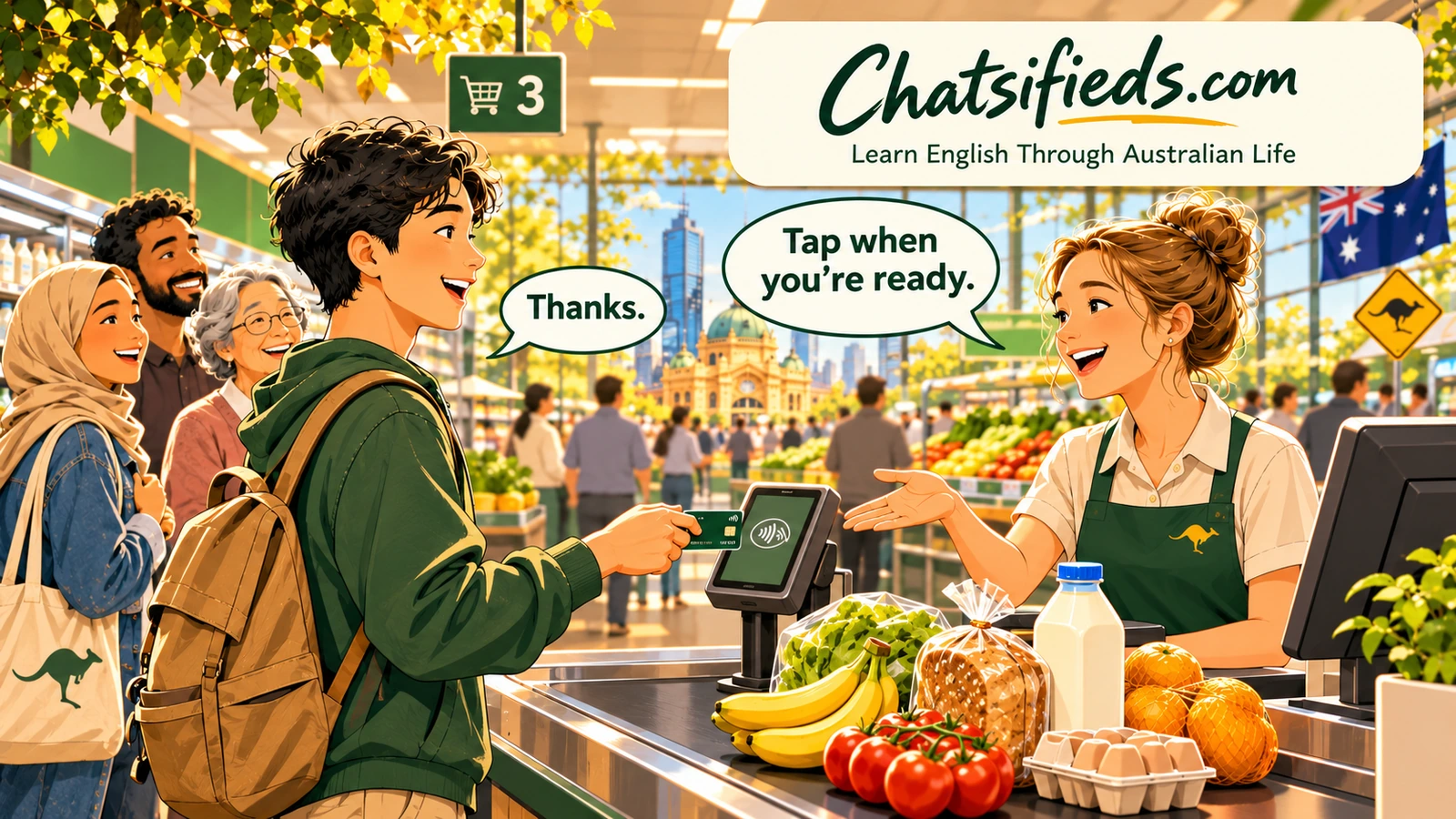
Checkout operator: Tap whenever you're ready.
You: Thanks. Do you need to see it again?
Checkout operator: No, that's all. Have a good night.
You: You too. Cheers.
- "Can I see some ID, please?" is a polite request, and staff ask it of many customers.
- "Here you go" is what you say when you hand something over.
- "No problem" is a friendly reply when someone checks something.
- If staff cannot accept your ID, ask "Is there another ID you can accept?" and stay calm.
More useful phrases
- Sure. Here you go.
- A polite answer when you hand over ID.Use it: When staff ask for ID.
- Can I see some ID, please?
- What staff say when they check ID.Use it: You will hear this at bottle shops and registers.
- I've got my passport.
- Tells staff what ID you have.Use it: If you do not carry a licence.
- Is that okay?
- Asks if your ID is acceptable.Use it: After you show it.
- Is there another ID you can accept?
- Asks about other kinds of ID.Use it: If staff cannot accept the one you show.
- No problem.
- A friendly reply to a request.Use it: When staff check your ID.
- I don't have it with me.
- Says you do not have ID now.Use it: If you forgot your ID.
- Do you need to see it again?
- Checks whether staff need your ID again.Use it: At the point of sale.
ID moments at a glance
Five common moments and the English that fits each one.
| Moment | What staff say | What you can say |
|---|---|---|
| Staff check ID | "Can I see some ID, please?" | "Sure. Here you go." |
| Staff ask the type | "Is this a passport?" | "Yes, it's my passport." |
| ID is accepted | "That's fine, thanks." | "No problem." |
| ID is not accepted | "Sorry, I can't accept that." | "Is there another ID you can accept?" |
| You forgot your ID | "I need to see your ID." | "Sorry, I don't have it with me." |
| You are finished | "All done, thanks." | "Thanks. Have a good night." |
Rules about ID differ between states and stores. Always follow the staff member's instructions.
Say it aloud: showing your ID
Saying a sentence out loud before you need it makes real conversations easier. Accents differ, so aim to be clear, not perfect.
- Slow. Read the sentence slowly, one phrase at a time.
- In full. Say: Sure. Here you go.
- At normal speed. Say it again, as you would in a real conversation.
- Listen. Listen for "Can I see some ID, please?" and for questions such as "Is this a passport?".
Practice 1: Role-play with a partner
Situation: You are buying a drink for a dinner at a bottle shop. The staff member asks for ID.
Work with a friend, a classmate or your mirror. One person is the bottle shop staff member. The other is the customer. Read the lines, then cover the “You could say” answers and try it from memory. Swap roles.
bottle shop staff member: “Hi there. Can I see some ID, please?”
You could say:
- “Sure. Here you go.”
- “Of course. I've got my passport.”
bottle shop staff member: “Thanks. Is that your passport?”
You could say:
- “Yes, it is.”
- “Yes. Is that okay?”
bottle shop staff member: “That's fine. Sorry for asking. We have to check.”
You could say:
- “No problem. I understand.”
- “That's okay. Thanks for checking.”
bottle shop staff member: “Can I help you with anything else?”
You could say:
- “No, that's all, thanks.”
- “No, I'll pay by card, please.”
Challenge: Swap roles. Now the staff member says, "Sorry, I can't accept that ID." What can you ask?
Practice 2: Fill the gap
Say the missing word or phrase out loud before you open the answer.
Can I see some ___, please?
Show answer
ID — ID means identification.
Sure. Here you ___.
Show answer
go — "Here you go" is what you say when you hand something over.
Is this a ___? (a travel document)
Show answer
passport — A passport is the document from your country.
Is there another ID you can ___?
Show answer
accept — "Accept" means take as okay.
Sorry, I don't have it with ___.
Show answer
me — "With me" means in my bag or pocket.
Minimum age to buy alcohol: ___.
Show answer
18 — The seller must not supply alcohol to anyone under 18.
Common mistakes and better ways to say it
Less helpful: “Why you want my ID? I am an adult.”
Try instead: “Sure. Here you go.”
Staff ask many customers. A calm answer is the fastest.
Less helpful: “No ID. Just give me.”
Try instead: “Sorry, I don't have it with me.”
Be honest and polite. Staff may not be able to sell.
Less helpful: “Photo is in my phone.”
Try instead: “Is a photo on my phone okay, or do you need the card?”
Ask what they accept instead of assuming.
Less helpful: “Take it.”
Try instead: “Here you go.”
A short polite phrase is better.
Culture note: it is the law, not personal
Checking ID is a legal responsibility for sellers. It happens to many adults, including people who look older. If you are asked, stay friendly, show your ID and say thank you.
Carry a valid photo ID when you plan to buy alcohol. If you are not sure which ID is accepted in your state, check the rules on your state government website or ask the staff.
Real-life mission
These tasks help you practise ID English. They do not require you to buy alcohol.
Rules differ between states. Use your state's official page for the latest information.
Phrase Wall practice: phrases to own
Open a phrase to see it on the Phrase Wall, practise it, and save it to My Learning.
- “Sure. Here you go.”A polite reply when you hand over ID or a card.
- “Can I see some ID, please?”A polite request staff use when checking ID.
- “Is there another ID you can accept?”Ask politely which other ID is acceptable.
- “Sorry, I don't have it with me.”Say you do not have the item or document now.