
Australian Supermarket English · Checkout & paying · Level: Beginner
At the Checkout: What Staff Say and How to Reply
The checkout is the fastest conversation in a supermarket. The operator asks three or four short questions in a row, often quickly. If you know what is coming, you can answer without stress.
Published 18/11/2026 · Educational guide · About 20 minutes
What you need to know
Checkout staff usually greet you, ask about bags, ask about a loyalty card, tell you the total and say how to pay. You only need short answers: "Good, thanks", "No, thanks, I've got my own", "Yes, I have a card" and "Card, please". If you miss something, say "Sorry, could you say that again?"
The usual order of a checkout chat
A staffed checkout often goes in the same order. The operator says hello, scans your items, asks if you need bags or have a rewards card, says the total, and waits for you to pay. Then there is a goodbye.
Operators often speak fast because they say the same lines all day. That is not rudeness. The questions are short and predictable, so a few ready answers are enough. Many learners find it easier once they know the five or six questions that come up again and again.
You can ask the operator to repeat. "Sorry, how much was that?" and "Sorry, could you say that again?" are normal. People behind you may be waiting, but one repeat is fine. If you are paying by tap, you can also watch the payment screen for the total.
Key words and phrases
- operator
- The staff member who scans your items at a staffed checkout. You may also hear "cashier" or "checkout person".
- total
- The full amount you have to pay.
- belt
- The moving surface where you put your items so the operator can scan them.
- divider
- A small bar you place on the belt to separate your items from the next person's.
- scan
- To pass a barcode over the reader so the price is recorded.
- rewards card
- A loyalty card or app, such as Flybuys or Everyday Rewards, that you scan at the checkout.
- tap
- To hold your card or phone near the payment machine to pay.
- receipt
- The paper or emailed proof of what you bought and paid.
- change
- The money you get back when you pay cash with more than the total.
- bag
- A carry bag for your shopping. Some stores charge for them.
- eftpos
- The Australian word for paying with a debit card at a machine. People say "eftpos or credit?" in some shops.
Dialogue: a full checkout, step by step
Operator: Hi there. How's your day going?
You: Good, thanks. And you?
Operator: Not bad. Do you want any bags today?
You: No, thanks. I've got my own.
Operator: Have you got a rewards card or the app?
You: Yes, I do. Here you go.
Operator: Thanks. Would you like your receipt?
You: Yes, please.
Operator: That comes to thirty-eight forty.
You: Sorry, how much was that?
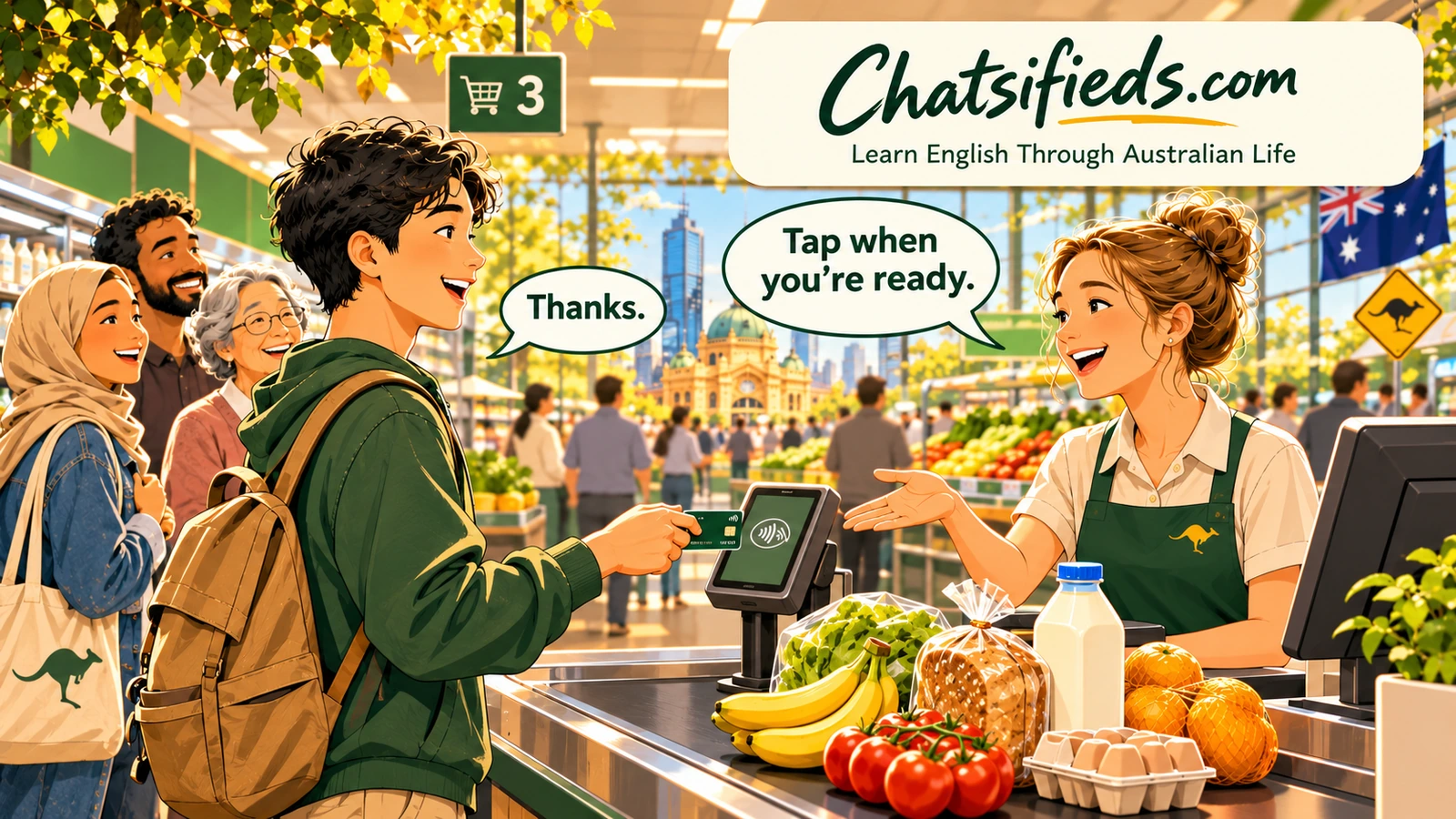
Operator: Thirty-eight forty. You can tap when you're ready.
You: Thanks. Tap or card, both fine?
Operator: Either one. Thanks very much, have a good one.
You: Thanks. You too!
- "How's your day going?" is a greeting. One short answer is enough.
- "Thirty-eight forty" means $38.40. Operators often skip "dollars" and "cents".
- "Sorry, how much was that?" is a polite way to ask for the total again.
- "You too" is the usual reply to "have a good one".
More useful phrases
- No, thanks. I've got my own.
- A polite answer when you have your own bags.Use it: When the operator asks about bags.
- Yes, I have a card.
- Tells the operator you have a rewards card.Use it: When asked about a rewards card.
- Sorry, how much was that?
- Asks for the total again.Use it: If you did not hear the amount.
- Could you put those in a bag, please?
- Asks the operator to bag items for you.Use it: When you buy a bag and want help packing.
- Do you mind if I pack these myself?
- Asks permission to pack your own bags.Use it: When you prefer to pack in a certain way.
- Could you scan that one again, please?
- Asks the operator to scan an item a second time.Use it: If you think an item beeped twice or not at all.
- Card, please.
- Tells the operator you will pay by card.Use it: When asked how you will pay.
- I'm all good, thanks.
- A friendly way to say you do not need anything else.Use it: When asked if you want a receipt, bag or anything extra.
Checkout questions and easy answers
These are the questions you will hear again and again, with answers you can say quickly.
| The operator says | It means | You could say |
|---|---|---|
| How's your day going? | A friendly greeting. | Good, thanks. And you? |
| Do you need any bags? | Do you want to buy or use a carry bag? | No, thanks. I've got my own. |
| Have you got a rewards card? | Do you want to collect points or use member prices? | Yes, I do. / No, I don't. |
| Would you like your receipt? | Do you want a paper or emailed receipt? | Yes, please. / I'm all good, thanks. |
| That comes to forty-two ten. | The total is $42.10. | Sorry, how much was that? |
| Tap or insert, whichever. | You can pay by tapping or inserting your card. | Thanks. Card, please. |
| Have a good one. | A friendly goodbye. | Thanks. You too! |
Questions and order can change from store to store. If you are not sure, ask the operator.
Say it aloud: answering the bag question
Saying a sentence out loud before you need it makes real conversations easier. Accents differ, so aim to be clear, not perfect.
- Slow. Read the sentence slowly, one phrase at a time.
- In full. Say: No, thanks. I've got my own.
- At normal speed. Say it again, as you would in a real conversation.
- Listen. Listen for the operator's question, "Do you need any bags?", and answer straight away without waiting for it to end.
Practice 1: Role-play with a partner
Situation: You are at a staffed checkout with a basket of groceries. You have your own bag and a rewards card.
Work with a friend, a classmate or your mirror. One person is the checkout operator. The other is the customer. Read the lines, then cover the “You could say” answers and try it from memory. Swap roles.
checkout operator: “Hi, how are you going today?”
You could say:
- “Good, thanks. And you?”
- “Not bad, thanks. How about you?”
checkout operator: “Do you need any bags?”
You could say:
- “No, thanks. I've got my own.”
- “No, I'm all good, thanks.”
checkout operator: “Have you got a rewards card or the app?”
You could say:
- “Yes, I do. Here you go.”
- “No, I don't. Sorry.”
checkout operator: “That's thirty-one fifty. Tap when you're ready.”
You could say:
- “Thanks. (tap your card)”
- “Sorry, how much was that?”
checkout operator: “Would you like your receipt?”
You could say:
- “Yes, please.”
- “No, I'm all good, thanks.”
checkout operator: “Thanks very much. Have a good one.”
You could say:
- “Thanks. You too!”
- “Thanks, have a good day!”
Challenge: Repeat the role-play, but this time the operator speaks fast. Practise saying "Sorry, could you say that again?" once, then answer.
Practice 2: Fill the gap
Say the missing word or phrase out loud before you open the answer.
Do you need any ___? (carry bags)
Show answer
bags — A very common checkout question.
No, thanks. I've got my ___.
Show answer
own — "My own" means your own bags.
Sorry, how ___ was that?
Show answer
much — "How much was that?" asks for the total.
Tap whenever you're ___.
Show answer
ready — "Whenever you're ready" is polite and relaxed.
Have you got a ___ card?
Show answer
rewards — Also: loyalty card, Flybuys card, Everyday Rewards card.
Thanks very much, have a ___ one!
Show answer
good — A friendly goodbye. Reply: "You too!"
Common mistakes and better ways to say it
Less helpful: “(nodding but not answering a question)”
Try instead: “Sorry, could you say that again?”
A short question helps the operator, and it is better than guessing.
Less helpful: “I do not want bag.”
Try instead: “No, thanks. I've got my own.”
A full, polite answer sounds friendlier.
Less helpful: “What?”
Try instead: “Sorry, how much was that?”
"What?" can sound rude. Adding "Sorry" and a clear question is polite.
Less helpful: “Give me a receipt.”
Try instead: “Could I get a receipt, please?”
"Could I get ...?" is polite when you ask for something at a counter.
Culture note: quick, friendly and not personal
Checkout chat in Australia is usually quick, friendly and light. The operator may talk to you the same way they talk to every customer, so there is no need to read extra meaning into a short question.
Many operators say "Thanks very much" or "Have a good one" even when the day is busy. You can say "Thanks, you too". If you want to be a bit warmer, add "Take care" or "Have a good day".
Cash, card and phone are all common ways to pay. The StudyMelbourne currency page lists Australian coins from 5 cents to 2 dollars and notes from 5 to 100 dollars, so you can use the same currency words when you pay with cash.
Real-life mission
On your next shop, try to use all of these at the checkout. Tick each one when you have done it.
If you feel nervous, practise the lines out loud at home first, then try them at a quiet checkout.
Phrase Wall practice: phrases to own
Open a phrase to see it on the Phrase Wall, practise it, and save it to My Learning.
- “Sorry, how much was that?”A polite way to ask for the total again.
- “I'm all good, thanks.”A friendly way to say you do not need anything extra.
- “Do you mind if I pack these myself?”Asks permission to pack your own bags.
- “Could you scan that one again, please?”Asks the operator to scan an item a second time.